
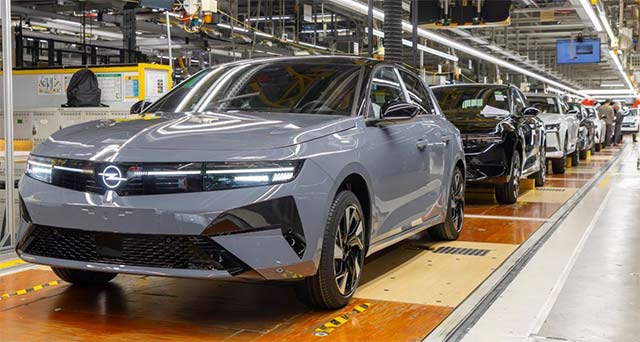
Stellantis has confirmed that the next-generation Opel Astra will be produced at Opel’s historic manufacturing plant in Rüsselsheim, Germany, reinforcing the company’s long-term commitment to its home market while laying the foundation for a new era of electrified vehicles.
The upcoming Astra will be developed and engineered at Opel’s new global headquarters, the grEEn-campus in Rüsselsheim, and will be among at least four new Opel models scheduled to launch before 2030. The announcement was made during Stellantis Investor Day, where Opel outlined its future product strategy and role within the automaker’s broader FaSTLAne 2030 plan.
New Astra to Ride on STLA ONE Architecture
The next Astra will be built on Stellantis’ all-new STLA ONE platform, a flexible architecture designed for B-, C-, and D-segment vehicles. The platform is expected to replace multiple existing vehicle architectures and support a wide range of powertrains, including battery-electric, hybrid, plug-in hybrid, and internal combustion engines.
Stellantis plans to deploy STLA ONE across 30 vehicle models by 2035, targeting annual production volumes of up to two million units.
While Opel has not yet revealed technical details for the future Astra, the current model already offers one of the broadest powertrain portfolios in its class, including battery-electric, plug-in hybrid, hybrid, and diesel variants. The latest facelifted Astra Electric features a larger 58-kWh battery pack (55.4 kWh usable), increasing WLTP driving range to up to 454 kilometers.
Rüsselsheim Remains the Home of Astra
The production decision secures the future of Opel’s flagship compact car in Germany and highlights the strategic importance of the Rüsselsheim facility.
“The allocation of the next-generation Astra to our plant in Rüsselsheim demonstrates Opel’s commitment to Germany as an industrial location,” said Opel CEO Florian Huettl. “I am delighted that Rüsselsheim will remain the home of the Astra and be built in the direct vicinity of our new grEEn-campus.”
Stellantis Enlarged Europe COO Emanuele Cappellano emphasized the importance of the C-segment, which accounts for roughly 30% of all vehicle sales in Europe. He noted that the Astra remains a key pillar of Stellantis’ regional growth strategy under the FaSTLAne 2030 roadmap.
According to local reports, the investment could help secure approximately 1,350 manufacturing jobs at the plant while also providing long-term employment opportunities for apprentices and dual-study graduates.
More Than €1 Billion Invested in Germany
The Astra announcement forms part of a broader investment strategy that will see Stellantis invest more than €1 billion in Germany by 2030.
A major portion of that funding is being directed toward the construction of the new grEEn-campus headquarters in Rüsselsheim. The facility is designed around sustainability and flexible working principles, incorporating photovoltaic power generation, green roofing, geothermal cooling systems, and environmentally friendly building materials.
“Made in Germany is a well-recognized quality label for customers worldwide and a defining strategic asset for Opel in the Stellantis group,” said Xavier Chéreau, Chairman of the Opel Board.
Opel Expands Product Lineup Through 2030
The next Astra is only one piece of Opel’s future product offensive.
The company has confirmed plans to introduce at least three additional new models before the end of the decade. These include the next-generation Opel Corsa, which will also migrate to the STLA ONE platform, and a new all-electric C-segment SUV being developed in partnership with Leapmotor.
The upcoming electric SUV will be produced in Zaragoza, Spain, and is expected to enter the market as early as 2028. Designed by Opel in Rüsselsheim and developed through collaboration between engineering teams in Germany and China, the model will strengthen Opel’s presence in the highly competitive C-segment alongside the Frontera and Grandland.
Opel’s C-segment heritage stretches back nearly 90 years, beginning with the Kadett in 1936. Combined Astra and Kadett sales have now reached approximately 25 million units worldwide, underscoring the importance of the model line as Opel prepares for its next chapter of electrification.


