
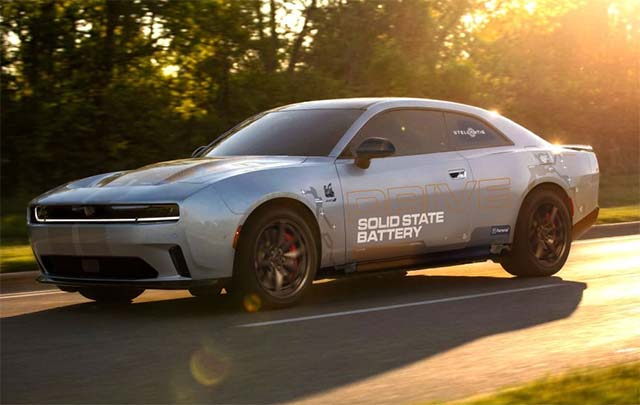
Stellantis has taken a major step toward bringing next-generation battery technology to production vehicles by integrating Factorial’s FEST (Factorial Electrolyte System Technology) solid-state batteries into a Dodge Charger Daytona development vehicle.
The milestone marks the first time solid-state battery cells have been installed and tested in a Stellantis vehicle, moving the technology beyond laboratory validation and into real-world automotive development. The companies have also launched an extensive road-testing program designed to evaluate performance, safety, durability, and charging characteristics under everyday driving conditions.
Solid-State Technology Moves Closer to Production
Solid-state batteries have long been viewed as one of the most promising advancements for electric vehicles, offering the potential for higher energy density, faster charging times, improved safety, and lower overall costs compared with conventional lithium-ion batteries.
According to Stellantis, the latest generation of Factorial’s FEST cells has already demonstrated impressive performance during validation testing. The batteries achieved an energy density of 375 Wh/kg and were capable of charging from 15% to 90% in just 18 minutes. The cells also maintained reliable operation across a wide temperature range, from -30°C to 45°C.
Ned Curic, Stellantis Chief Engineering and Technology Officer, emphasized that battery development requires balancing multiple performance targets rather than focusing on a single benchmark.
“This milestone shows we are bringing solid-state batteries closer to our customers with the potential for longer range, faster charging and lower costs,” Curic said. He also noted that FEST technology’s compatibility with existing lithium-ion manufacturing processes could help accelerate large-scale production.
Engineering Challenges Behind the Integration
Moving from successful cell-level testing to a fully operational vehicle required significant engineering work from both companies.
The FEST solid-state cells were incorporated into an existing battery pack using a newly developed and patented mechanical architecture created by Stellantis engineers. The design was specifically developed to maximize the performance advantages of solid-state technology while meeting the demanding safety and durability standards required for automotive applications.
Engineers also modified battery management systems and pack controls to optimize cell behavior under real-world driving and charging conditions. These adaptations are intended to ensure consistent performance across a variety of environments and operating scenarios.
Road Testing Now Underway
With vehicle integration completed, Stellantis and Factorial have entered the next phase of development: on-road validation.
The testing and calibration program will evaluate battery pack performance under a wide range of driving conditions while also examining charging behavior, reliability, thermal management, and overall vehicle safety. The data gathered during this phase will help refine the technology and support future commercialization efforts.
Factorial CEO Siyu Huang described the project as a significant achievement for automotive-grade solid-state battery development.
According to Huang, the collaboration spans every aspect of the technology, from cell chemistry and battery pack architecture to real-world vehicle testing. She noted that the milestone establishes a new benchmark for what solid-state batteries can deliver in production-focused automotive applications.
A Key Step Toward Future EVs
The Dodge Charger Daytona development vehicle serves as an important proving ground for Stellantis’ future electrification strategy. The project also represents continued progress under the companies’ previously announced solid-state battery development program.
While commercial deployment timelines have not yet been announced, the successful integration of FEST cells into a road-going vehicle demonstrates meaningful progress toward bringing solid-state batteries from research labs to production EVs.
If testing continues to deliver positive results, the technology could eventually enable future Stellantis electric vehicles to offer longer driving ranges, significantly faster charging times, and improved efficiency—all key factors in accelerating EV adoption worldwide.


