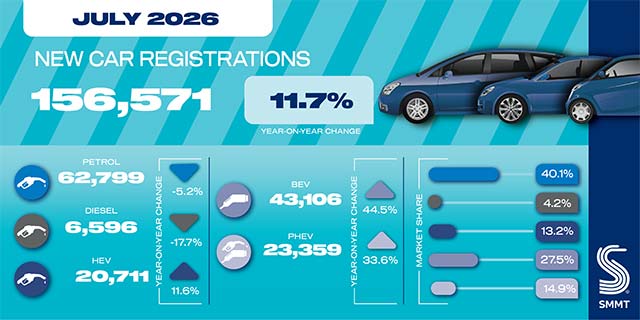
Britain’s new car market continued its recovery in July, posting an 11.7% year-over-year increase as demand for electrified vehicles reached new highs. According to the latest figures from the Society of Motor Manufacturers and Traders (SMMT), 156,571 new cars were registered during the month, marking the eighth consecutive month of market growth.
The strong performance was led by record battery electric vehicle (BEV) registrations, while plug-in hybrid and hybrid models also recorded double-digit gains, highlighting the continued shift toward lower-emission mobility.
Record EV Demand Powers Market Growth
Battery electric vehicles were the standout performers in July, with registrations surging 44.5% compared to the same month last year. BEVs captured a record 27.5% share of the UK new car market, helped in part by comparisons with a weaker July 2025, when uncertainty surrounding eligibility for the Electric Car Grant (ECG) delayed some purchases.
Plug-in hybrid electric vehicles (PHEVs) also enjoyed strong momentum, rising 33.6% to account for 14.9% of total registrations. Conventional hybrids (HEVs) increased by 11.6%, securing a 13.2% market share.
Combined, electrified vehicles represented well over half of all new cars registered during the month, underlining the UK’s accelerating transition toward cleaner transportation.
Demand Increased Across Every Buyer Segment
Growth was recorded across all customer categories.
Private buyers increased purchases by 12.6%, while fleet registrations rose 9.5% and continued to dominate the market, representing nearly 60% of all new vehicle registrations. The smaller business sector posted the strongest percentage increase, climbing 61.3% year over year.
The broad-based demand suggests that both consumers and businesses remain confident despite ongoing economic pressures.
BEVs Still Expected to Miss Government Targets
Despite July’s record performance, industry forecasts indicate the UK is still unlikely to meet the government’s ambitious Zero Emission Vehicle (ZEV) Mandate targets.
The SMMT now expects battery electric vehicles to account for 27.4% of all new car registrations by the end of the year, slightly higher than its previous 26.8% forecast. However, this remains well below the government’s 33% target for 2026.
Looking further ahead, BEV market share is projected to reach 32.1% in 2027, still falling short of the 38% regulatory target.
The forecast was compiled before changes to Electric Car Grant eligibility removed demonstrator and courtesy vehicles from the scheme in mid-July. Since these vehicles currently represent around 10% of all BEV registrations—and approximately one-third of EV sales benefit from the grant—the policy change could affect future demand.
Industry Warns Current Growth Is Costly
Automakers continue to support EV sales through substantial incentives, discounts and marketing campaigns to comply with government emissions targets.
While these measures have boosted adoption, the SMMT warns they are placing significant financial pressure on manufacturers. Heavy discounting is reducing profitability, weakening residual values and forcing some companies to delay or redirect investment.
The industry argues that regulatory flexibility has helped narrow the gap between consumer demand and government mandates, but maintaining this approach becomes increasingly difficult as annual EV targets continue to rise.
SMMT Chief Executive Mike Hawes said July’s record EV performance demonstrates the automotive industry’s commitment to zero-emission mobility but warned that relying on expensive incentives is not sustainable over the long term. He called for urgent reforms to the current regulations, arguing that stronger underlying consumer demand—not simply increased supply—is needed to support a healthy and competitive automotive sector while protecting jobs and future investment.
Outlook
July delivered another encouraging month for Britain’s automotive industry, with EVs reaching a new milestone and overall registrations continuing their steady recovery. However, the gap between market demand and regulatory targets remains significant.
Unless consumer demand accelerates without heavy manufacturer incentives, the UK automotive industry may continue facing mounting financial pressure as it works toward an increasingly ambitious electrification roadmap.