
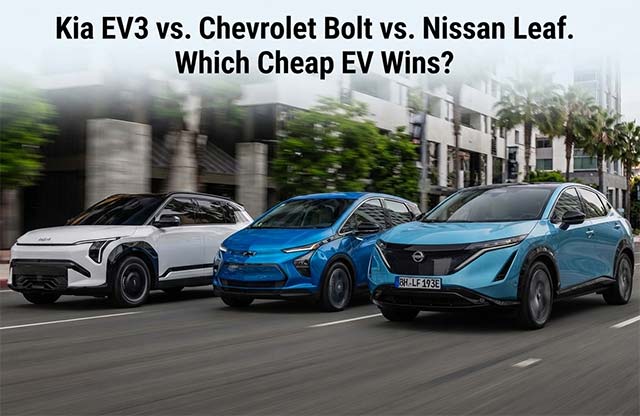
TL;DR: The 2027 Kia EV3, Chevrolet Bolt, and Nissan Leaf are now America’s three cheapest new EVs, all starting near $30,000. The EV3 wins on range and is the only one with AWD, the Bolt wins on price and cargo space, and the Leaf splits the difference with strong range at a mid-pack price. This guide breaks down pricing, range, charging, and cargo space so you can pick the right one for your budget and daily driving.
Kia just put a price on the 2027 EV3, and it changes everything about the budget EV fight. For months, the 2027 Chevrolet Bolt and Nissan Leaf were the only affordable-EV story. Now the Kia EV3 vs. Chevrolet Bolt vs. Nissan Leaf comparison is a real three-way race, and all three cars start under $32,000 before any state incentives.
These aren’t identical cars wearing different badges. The EV3 is a compact crossover with an available all-wheel-drive option. The Bolt and Leaf are hatchbacks (well, the new Leaf leans crossover-ish) that stick to front-wheel drive only. Each one wins in a different category, so the “best” choice really depends on what you drive every day and how much cargo room you need.
We pulled pricing, range, and charging data straight from each automaker’s official numbers to help you compare apples to apples. Let’s break down where each car pulls ahead, and where it falls short.

Which of the Three Costs the Least?
The Chevrolet Bolt is the cheapest of the three, starting at $28,995 including destination, with the Nissan Leaf close behind at $29,990 and the Kia EV3 rounding out the group at $31,385.
That $2,400 gap between the cheapest and priciest option is small in the grand scheme of car shopping, but it matters more now that federal EV tax credits are gone. The $7,500 credit for new EVs ended on September 30, 2025, so sticker price is the real price for anyone buying now. No rebate is coming to soften the difference.
Here’s how the trims break down:
2027 Chevrolet Bolt
– LT: starts at $29,990 (with a cheaper LT trim arriving later at $28,995)
2026 Nissan Leaf
– S+: starts at $29,990
– SV+: starts at $34,230
2027 Kia EV3
– Light: $31,385 (with destination)
– Wind: roughly $36,485
– Land: roughly $39,985
– GT-Line: roughly $44,985
– GT: $47,385
The full EV3 pricing and specs breakdown shows the EV3 spreads across five trims, which gives shoppers more room to move up in features and power. The Bolt and Leaf keep things simpler with fewer trims, which can make shopping faster if you just want an affordable EV without a lot of decisions to make.

How Much Range Do You Really Get?
The Nissan Leaf and Kia EV3 both offer around 300 miles of range on their top trims, while the Chevrolet Bolt tops out lower at 255 to 262 miles. If you drive long distances often, that gap matters. If you mostly commute locally, all three have range to spare.
Here’s the range breakdown by trim:
– Kia EV3 Light (58.3 kWh): 221 miles EPA-estimated
– Kia EV3 long-range trims (81.4 kWh, FWD): up to 321 miles EPA-estimated, based on official EPA range ratings released this week
– Kia EV3 AWD trims: up to 280 miles
– Chevrolet Bolt (65 kWh LFP battery): 255 to 262 miles EPA-estimated
– Nissan Leaf S+: up to 303 miles EPA-estimated
The average American drives about 37 to 42 miles a day, according to Department of Energy data cited in coverage of the Bolt’s launch. That means even the Bolt’s shorter range covers close to a week of typical driving on one charge. But if you take frequent road trips or live somewhere with sparse charging stations, the EV3’s long-range trim or the Leaf’s 303-mile rating give you more breathing room.
It’s worth noting the EV3’s 321-mile figure only applies to front-wheel-drive models with the bigger battery. Add all-wheel drive, and that range drops to 280 miles, still competitive but no longer the class leader.

Performance and All-Wheel Drive
This is where the Kia EV3 pulls ahead in a category the Bolt and Leaf can’t touch. The EV3 offers optional dual-motor all-wheel drive, something neither the Bolt nor the Leaf has on their spec sheets.
The EV3’s front-wheel-drive Light and Wind trims make 201 horsepower and 209 lb-ft of torque from a single motor. Add AWD, and output jumps to 261 horsepower with 284 lb-ft of torque. The top EV3 GT trim pushes that further to 288 horsepower and 345 lb-ft, with a 0-60 mph time of 5.4 seconds according to reporting on the EV3’s EPA ratings.
The Bolt and Leaf are both front-wheel drive only, no AWD option at any trim or price point. That’s a real limitation for shoppers in snowy or mountainous regions who want extra traction without stepping up to a bigger, pricier crossover.
If all-wheel drive is a must-have for your climate or driving style, the EV3 is the only one of these three that can deliver it, even if it costs more to get there.
Fast Charging and Network Access
All three EVs now use NACS (North American Charging Standard) ports, which means owners of any of these three cars can plug into Tesla Supercharger locations without an adapter.
Charging speeds vary a bit between the three:
– Kia EV3 (small battery): 10% to 80% in about 29 minutes
– Kia EV3 (large battery): 10% to 80% in about 31 minutes
– Chevrolet Bolt: 10% to 80% in about 26 minutes on a 150 kW DC fast charger, based on details from Chevrolet’s official Bolt launch information
The Bolt edges out the EV3 on raw fast-charging speed, though the difference of a few minutes probably won’t make or break your road trip. All three support Plug and Charge, letting the car authenticate and pay automatically at compatible stations without you tapping a screen or scanning a card.
For home charging, an 11-kW Level 2 charger takes roughly five to seven hours to bring the EV3 from 10% to 80%, depending on battery size.
Cargo Space and Interior Room
The Chevrolet Bolt has the most maximum cargo room of the three at 56.3 cubic feet with the seats folded, giving it a real edge for anyone who hauls gear, luggage, or bulky items regularly.
Here’s how cargo space stacks up:
– Chevrolet Bolt: up to 56.3 cubic feet with seats folded, based on dealer spec comparisons of the Bolt and Leaf
– Kia EV3: 26.1 cubic feet behind the rear seats, growing to 56.5 cubic feet with seats folded, plus a small front trunk
The Bolt also offers noticeably more rear legroom than the Leaf in older trim comparisons, at 39.1 inches versus 31.8 inches, according to the same dealer breakdown. That’s a big difference if you regularly carry rear-seat passengers.
Body style plays a role here too. The EV3 is styled as a compact SUV, which tends to offer a higher seating position and easier cargo loading, even if its outright volume numbers land in the middle of the pack. The Bolt keeps more of a traditional hatchback shape, which helps explain its strong cargo numbers relative to its compact footprint.
Which One Should You Actually Buy?
If price is your top priority, the Chevrolet Bolt wins outright. If you want the most range and don’t mind paying a bit more, the Kia EV3’s long-range trim or the Nissan Leaf are your best bets. If all-wheel drive matters for where you live, the EV3 is the only one of the three that offers it.
Here’s a quick way to think about it based on what matters most to you:
– Tightest budget: Chevrolet Bolt. Starting under $29,000, it’s the cheapest new EV from a major automaker in the U.S. right now.
– Longest range without AWD: Nissan Leaf. Up to 303 miles EPA-estimated puts real distance between it and the Bolt.
– Need AWD or want the newest tech: Kia EV3. It’s pricier, but it’s the only one with all-wheel drive, and it edges out the Leaf on maximum range in FWD form.
– Hauling gear or people regularly: Chevrolet Bolt. Its cargo volume and rear legroom lead the group.
Since the federal tax credit is off the table, your final decision may come down to what state or utility incentives you can still find, plus how each car feels to drive. We’d recommend test-driving all three before signing anything, since seat comfort and driving feel vary more than the spec sheets suggest.
Conclusion
The Kia EV3, Chevrolet Bolt, and Nissan Leaf all deliver real value in a market that lost its federal tax credit safety net. The Bolt is the budget champion, the Leaf balances price and range well, and the EV3 brings AWD and top-tier range at a slightly higher cost. There’s no universally “best” pick here, only the one that fits your budget, your climate, and how much cargo space you actually need.
Before you head to a dealership, check out our complete guide to the cheapest EVs you can buy right now for more context on how these three stack up against the rest of the affordable EV field. Whichever one you choose, you’re getting a legitimate, no-compromise electric car for under $32,000.


