
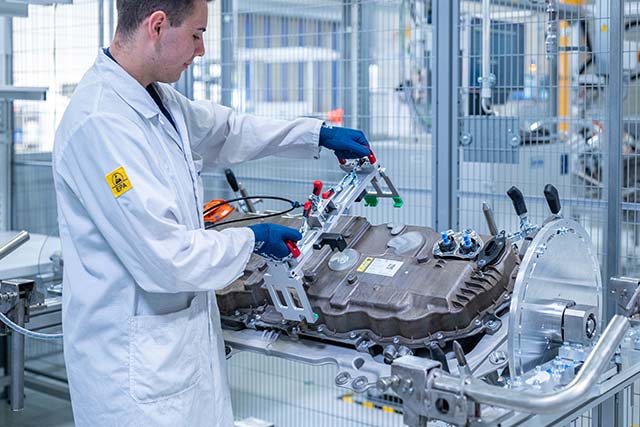
BMW Group is accelerating its hydrogen vehicle ambitions as BMW Group Plant Landshut begins pre-series production of a crucial control unit for the upcoming BMW iX5 Hydrogen. The move marks another major step toward the launch of BMW’s first series-production hydrogen-powered SUV in 2028.
At the same time, the German facility is also expanding production capacity for the Energy Master units used in the brand’s next-generation battery-electric Neue Klasse models, including the upcoming BMW iX3 and BMW i3.
BMW’s Energy Master Takes Center Stage
The Energy Master acts as the central control unit of the vehicle’s high-voltage system. In battery-electric models, the component is mounted directly on the high-voltage battery. For the hydrogen-powered BMW iX5 Hydrogen, a specially modified version is integrated into the BMW Hydrogen Flat Storage system.
The advanced control unit manages energy and data flows throughout the drivetrain while controlling the power supply for both the electric motor and the vehicle’s electrical system. It also ensures safe and intelligent operation of the overall system, making it a critical link between the fuel cell system, high-voltage battery, and electric drive units.
According to BMW, the company is now handling both development and production of the Energy Master entirely in-house for the first time. The strategy allows the automaker to create stronger synergies between battery-electric and hydrogen drivetrain technologies.
Josef Hochreiter, Vice President Hydrogen Vehicles at BMW Group, said the Energy Master is essential for delivering the “brand-typical BMW driving pleasure” expected from the BMW iX5 Hydrogen.
Landshut Expands EV and Hydrogen Production Capacity
BMW Group Plant Landshut is becoming one of BMW’s most important production hubs for electrified drivetrains.
The facility already produces Energy Master units for Neue Klasse battery-electric vehicles, with series production having started last year. A second production line is now being commissioned, nearly doubling manufacturing capacity for those EV components.
At the same time, Landshut is expanding its role within BMW’s hydrogen network. The site already manufactures the media distribution plate and fuel cell stack housing used in the current BMW iX5 Hydrogen pilot fleet.
The media distribution plate precisely controls the flow of hydrogen and air inside the fuel cell system, while the stack housing provides structural integration and protection for the fuel cell stack itself.
Thomas Thym, Head of BMW Group Plant Landshut, said the new hydrogen-focused Energy Master production reinforces the plant’s position as a center of expertise for advanced drivetrain technologies.
BMW iX5 Hydrogen Targets 750 km Range
The production version of the BMW iX5 Hydrogen is scheduled to launch in 2028 with a newly developed hydrogen storage concept.
BMW says the updated tank arrangement and sizing will enable a driving range of up to 750 kilometers (466 miles). The new BMW Hydrogen Flat Storage system has been designed to maximize packaging efficiency without compromising interior space.
One of the key advantages of the system is compatibility with BMW’s Gen6 high-voltage battery architecture, allowing fuel cell vehicles to be produced on the same assembly lines as other drivetrain variants.
The SUV will also use BMW’s latest third-generation fuel cell technology, developed jointly with Toyota Motor Corporation. BMW says the new Gen3 fuel cell system is more compact, more powerful, and more efficient than previous generations.
Series production of the fuel cell systems will begin in 2028 at BMW Group Plant Steyr, while Landshut will continue supplying key hydrogen drivetrain components.
BMW Continues Multi-Technology Strategy
BMW continues to position hydrogen as a complementary technology alongside battery-electric vehicles rather than a replacement.
The automaker believes hydrogen fuel cell technology offers several advantages, particularly for customers seeking long driving ranges and fast refueling times. BMW also argues that hydrogen can help diversify energy sources and reduce dependence on a single charging infrastructure or raw material supply chain.
By integrating hydrogen technology into the BMW X5 lineup, the company is broadening its electrified portfolio while maintaining flexibility across different global markets.
Germany Supports BMW Hydrogen Development
The BMW iX5 Hydrogen project is receiving major government backing through the “HyPowerDrive” initiative.
Development of the hydrogen drivetrain and tank system is being funded by Germany’s Federal Ministry of Transport under the IPCEI Hy2Move framework. The federal government is contributing EUR 191 million, while the state of Bavaria is providing an additional EUR 82 million in co-financing.
BMW has also invested a high three-digit million-euro amount into expanding electromobility and related technologies at Plant Landshut since 2020.
With hydrogen and battery-electric development now advancing side by side, BMW is signaling that multiple zero-emission technologies will remain part of its long-term strategy well beyond the launch of the Neue Klasse generation.


