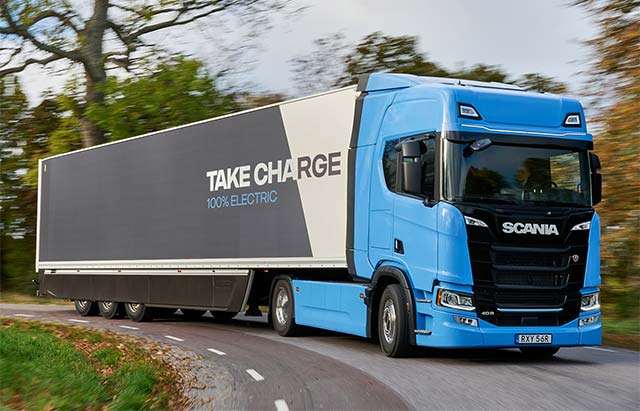
Scania has started the global rollout of its new under-cab battery module for electric trucks, introducing a major step forward for long-haul and heavy-duty zero-emission transport. The new configuration allows operators to better balance battery capacity, payload, and vehicle flexibility while supporting driving ranges of more than 800 km in certain applications.
The new battery positioning underneath the cab frees up additional chassis space for bodywork and cargo solutions. This directly addresses one of the biggest challenges facing electric transport operators: increasing range without compromising payload capacity.
By relocating the battery module, Scania can adapt battery placement more precisely for different transport applications, including heavy loads, advanced bodywork setups, and long-haul operations. The solution gives fleet operators more flexibility while maintaining operational efficiency.
A key factor behind the improved capability is the European Union’s updated Gross Train Weight allowance introduced in 2025. Thanks to the revised regulations, Scania can now offer a usable 400-kWh battery configuration delivering around 360 km of typical range without reducing payload capacity, even at the legal maximum weight.
Charging Strategy Becomes More Important Than Battery Size
Scania also highlighted that battery size alone does not determine an electric truck’s effectiveness. Instead, charging strategy is becoming increasingly important for transport companies looking to optimise operations and lower costs.
Many fleet operators traditionally assume electric trucks require the largest possible battery pack to cover worst-case scenarios. However, Scania argues that this approach can unnecessarily increase vehicle weight and reduce payload potential in everyday operations.
For routes around 300 km, for example, oversized battery packs may not provide meaningful advantages. Instead, strategic charging during legally required driver rest breaks can keep trucks moving efficiently while reducing operational costs.
This strategy is supported by Scania’s Megawatt Charging System (MCS), which enables rapid charging during scheduled stops. Operators can recharge batteries from around 20% to 75% during a break, providing enough energy to complete the remaining route or return journey.
Additional charging can then be carried out at depots or logistics hubs, reducing the need for excessive onboard battery capacity.
Scania Expands Its Electric Transport Ecosystem
According to Tobias Ejderhamn, Global Manager for Transformation & New Business at Scania, the new under-cab battery module helps transport operators optimise truck configurations based on real operational needs rather than simply maximising battery size.
The company also pointed to its growing charging ecosystem, including Scania Charging Access and its charging company Erinion, as part of a broader effort to simplify the transition to electric freight transport.
Lars Gustafsson, Head of Solutions Management at Scania, said the company can now offer operators a more complete electrification pathway that combines vehicle technology, charging infrastructure, and operational flexibility.
With growing pressure on the logistics sector to reduce emissions, Scania’s latest battery innovation could help accelerate adoption of electric trucks across long-haul and heavy-duty transport segments.