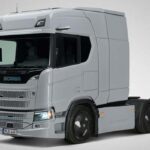
Scania is pushing electric trucks further into long-distance transportation with a new long-haul configuration capable of delivering up to 720 kilometres of range.
The solution combines increased battery capacity, batteries positioned behind the cab, chassis-mounted battery packs and Megawatt Charging System (MCS) technology. The goal is to address some of the biggest challenges facing electric trucking, including range, payload, charging time and trailer compatibility.
For fleet operators, long-haul electrification requires more than simply installing a larger battery. An electric truck must be able to travel long distances, carry a useful payload and recharge quickly enough to fit into demanding transport schedules.
Scania’s latest configuration is designed around those requirements.
Up to 720 km of electric range
A key part of Scania’s approach is adding battery capacity behind the cab rather than relying exclusively on batteries mounted along the chassis and underneath the cab.
In a typical configuration, two MP20 battery packs can be installed behind the cab, providing approximately 356 kWh of additional installed battery capacity. Combined with the truck’s existing battery packs and MCS charging capability, the setup can deliver up to 720 km of driving range.
The additional battery capacity gives operators greater flexibility when configuring a truck for specific routes. Depending on the operation, fleets can prioritize range, payload or a balance between the two.
This is particularly important for long-haul applications, where every kilogram of additional battery capacity can have an impact on payload.
Designed for European long-haul operations
Scania has also addressed the practical requirements of operating an electric tractor with standard European trailer combinations.
When combined with Scania’s protruding IVD (Increased Vehicle Dimension) front, the battery-behind-cab configuration enables a 6×2*4 vehicle and trailer combination designed for maximum electric range.
The configuration can exceed the conventional 16.5-metre total vehicle length while maintaining compatibility with European trailer applications and the turning performance required for long-haul transport.
That makes the solution more than a range-focused battery upgrade. It is intended to integrate electric propulsion into the way heavy trucks are already used across Europe.
New front design can reduce energy consumption
Aerodynamics also play an increasingly important role as electric trucks travel longer distances.
Scania says its new front design can reduce energy consumption by up to 3 percent, depending on the vehicle specification and operating conditions.
At highway speeds, aerodynamic drag represents a significant portion of an electric truck’s energy consumption. Even a relatively small efficiency improvement can therefore contribute to additional usable range and lower energy consumption over the life of a vehicle.
For long-haul operators, these incremental efficiency gains can become particularly valuable across high-mileage fleets.
Megawatt charging is critical for electric trucks
Battery capacity is only part of the equation for long-distance electric transportation. Charging speed is equally important.
Scania’s solution is designed to work with MCS charging, which is intended to provide the high charging power required by heavy-duty electric trucks.
Fast charging allows operators to replenish a significant amount of energy during scheduled stops rather than requiring long charging sessions that could disrupt vehicle utilization.
The combination of a larger battery and high-power charging gives fleet operators more options when planning routes and charging around driver breaks, loading operations and mandatory rest periods.
Scania targets difficult-to-electrify routes
Long-haul trucking remains one of the more challenging areas of road transport to electrify because vehicles travel long distances while carrying heavy loads and operating under tight schedules.
Scania’s new configuration takes a system-level approach by considering battery capacity, range, payload, aerodynamics, charging and trailer compatibility together.
With up to 720 km of range, additional battery packs behind the cab and MCS charging, the company is targeting routes that have traditionally required diesel trucks because of their demanding distance and energy requirements.
The development also highlights how electric truck technology is moving beyond simply replacing a diesel powertrain. Vehicle packaging, charging infrastructure and route planning are becoming increasingly important in determining whether battery-electric trucks can compete in demanding commercial applications.
For European fleets looking to electrify longer routes, Scania’s latest configuration could represent another step toward making battery-electric trucks practical for high-mileage transport.
Scania electric trucks are moving into long-haul territory
The ability to combine up to 720 km of range with megawatt charging and European trailer compatibility represents a significant development for battery-electric heavy-duty transport.
Rather than focusing solely on maximum battery size, Scania is attempting to optimize the complete vehicle around the needs of long-haul operators.
As charging infrastructure expands and battery technology continues to improve, configurations such as this could help electric trucks move from shorter regional routes into increasingly demanding long-distance applications.