
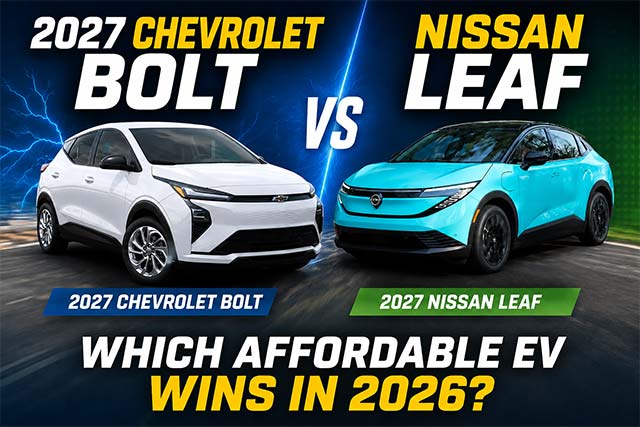
Chevrolet Bolt vs Nissan Leaf battle is on, and it’s the most exciting one yet. Two familiar names have both come back completely refreshed, and they’re now going head-to-head at price points most people can actually afford.
The 2027 Chevrolet Bolt returned from near-death with a new Ultium-based powertrain, LFP batteries, and a starting price under $30,000. At the same time, the all-new Nissan Leaf arrived with a whole new platform, a crossover-inspired body, and up to 386 miles of range on the European WLTP cycle.
Same goal. Totally different game plan.
We dug into both cars using real specs, professional comparison tests, and the latest pricing data. Here’s everything you need to know before you pick one.

How Much Does Each EV Actually Cost?
The 2027 Chevrolet Bolt starts at $28,995 (including destination), making it America’s most affordable new EV from a major automaker. The 2026 Nissan Leaf starts slightly higher, with the base S trim expected around $27,000 to $28,000 when it arrives, and the first available S+ trim starting at $31,485. If you want the extended-range SV+ model, budget around $35,725.
One important thing to know: the $7,500 federal EV tax credit is gone. It expired for most buyers after September 30, 2025, and neither the Bolt nor the Leaf qualifies for a federal rebate in 2026. State incentives can still apply in places like Colorado and California, so check what’s available in your area.
The Bolt does offer optional extras that push the price up. The panoramic glass roof and Super Cruise driver assistance system both cost extra. A well-equipped Bolt can easily cross $36,000. Meanwhile, the Leaf’s top Platinum trim starts at $41,930, but the sweet spot is the SV+ at $35,725.
On pure sticker price, the Bolt wins. But the real cost of ownership includes insurance, which is worth noting: both the Chevrolet Bolt and Nissan Leaf rank among the cheapest EVs to insure in the US, which helps keep monthly costs down.

Which EV Goes Farther on a Single Charge?
The Nissan Leaf wins on range. The extended-range version, with its 75 kWh battery, delivers up to 303 miles of EPA-estimated range in the US and up to 386 miles on the WLTP cycle used in Europe. The 2027 Chevrolet Bolt comes in at 255 miles of EPA-estimated range, using a 65 kWh LFP (lithium iron phosphate) battery.
That’s a meaningful gap. If range anxiety is your main concern, the Leaf is the clear answer.
That said, 255 miles is plenty for most daily drivers. The average American drives about 37 miles per day, which means the Bolt’s range covers over a week of typical commuting on a single charge. The Bolt also uses LFP battery chemistry, which is more durable and resists degradation better over time compared to older NMC chemistry.
The Leaf’s base trim uses a smaller 52 kWh battery (arriving in spring 2026), which will likely deliver around 180 to 200 miles. So if you want the Leaf’s full range advantage, you’ll need the larger battery trim.
For a wider look at how these two compare to other options in this price band, our guide to affordable EVs with 300-plus miles of range has a helpful breakdown.
How Fast Can You Charge the Bolt and the Leaf?
The Bolt charges faster at public DC fast chargers. It goes from 10% to 80% in about 26 minutes using its 150 kW DC fast-charging capability. The Nissan Leaf takes around 30 to 35 minutes to hit the same 80% mark.
Both support 150 kW DC fast charging, so the difference comes down to efficiency and battery management. The Bolt’s NACS (North American Charging Standard) port gives it access to Tesla’s Supercharger network and a growing number of other fast chargers across the country.
The Leaf has an interesting edge here, though: it comes with dual charging ports. That gives you more flexibility at different public chargers. The Leaf also supports vehicle-to-load (V2L) technology, letting you power devices like camping equipment or a laptop directly from the car. The Bolt goes one step further with vehicle-to-home (V2H) capability, meaning you can potentially use the car to power your house during an outage.
For home charging on Level 2 (the kind you’d install in your garage), the Bolt handles up to 11.5 kW. The Leaf’s standard home charging runs at 7.2 kW, which is slower but still enough to fully charge overnight.
Power, Performance, and Driving Feel
The Bolt and the Leaf feel different to drive, even if the specs look close on paper.
The Bolt runs a 210 horsepower electric motor shared with the Chevrolet Equinox EV. It’s front-wheel drive, feels light and nimble, and handles well in city traffic. Reviewers at Autoblog described it as a city dweller’s ride: maneuverable, peppy, and easy to park.
The Leaf offers two powertrain options. The base trim makes 174 horsepower, while the extended-range version steps up to 214 horsepower and 261 lb-ft of torque. That torque advantage gives the Leaf a stronger feel off the line, particularly with the larger battery. The Leaf rides on Nissan’s new CMF-EV platform, giving it a more planted and comfortable feel compared to the Bolt’s sportier setup.
For driver assistance, the Bolt offers GM’s Super Cruise as an option. That’s a genuinely impressive hands-free highway driving system. The Leaf counters with Nissan’s ProPilot Assist, which combines adaptive cruise control and lane centering. It’s capable but not quite at Super Cruise’s level for long highway trips.

Tech, Interior, and the CarPlay Debate
This is where the two cars split most sharply, and it matters a lot depending on how you use your phone.
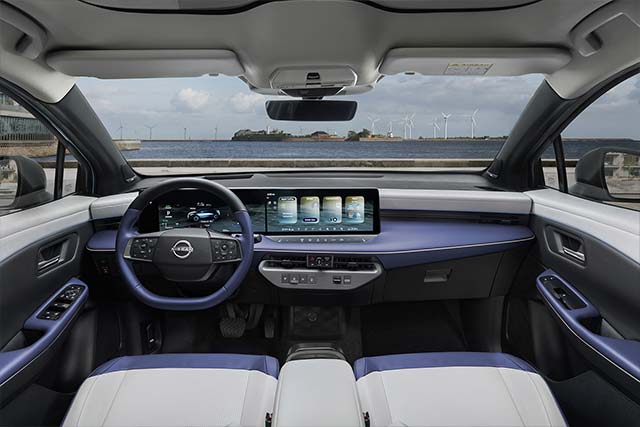
The 2027 Bolt uses Google Built-in, giving you Google Maps, Google Assistant, and access to streaming apps like HBO Max and Amazon Prime Video. It has a large dual-screen setup with an 11.3-inch infotainment display and an 11-inch digital gauge cluster. But it does not support Apple CarPlay or Android Auto. That’s a real drawback for anyone who relies on iPhone navigation or Spotify through CarPlay.
The Leaf goes the other way. It comes with wireless Apple CarPlay and Android Auto as standard, which is what most buyers want. GM Authority confirmed that the Bolt’s omission of CarPlay is a notable weak point compared to the Leaf’s approach. The Leaf also gets a generous twin-screen setup of its own.
On cargo space, the Leaf wins again. Behind the rear seats, you get more usable space than in the Bolt’s hatchback. Both cars fold flat for bigger loads, and total cargo volume with seats down is comparable, but the Leaf’s day-to-day cargo room has an edge.
The Bolt does win on rear passenger space. Despite being the smaller car overall, it actually offers more rear legroom, making it more comfortable for taller adults in the back seat.
Which EV Is the Better Buy in 2026?
If you want the lowest price and the fastest charging speed, buy the Bolt. It’s the most affordable new EV you can get from a major automaker right now, and its 26-minute 10-to-80% charge time is excellent for road trips and daily top-ups.
If you want more range, more cargo room, and Apple CarPlay, buy the Leaf. Edmunds gave the overall verdict to the Leaf, noting its extra space, smartphone integration, and competitive range make it the smarter package for most buyers willing to spend a little more.
The Bolt’s Ultium platform gives it superior charging infrastructure access and efficiency, while the Leaf prioritizes comfort and familiar dynamics. Neither car is a wrong choice. They’re just built for slightly different buyers.
If you find yourself wanting even more range and space, the Chevrolet Equinox EV is worth a look as a step up from the Bolt. And on the Nissan side, the Nissan Ariya offers a more premium crossover experience.
Conclusion
The 2027 Chevrolet Bolt and the redesigned Nissan Leaf are two of the best reasons to go electric right now. The Bolt is cheaper, charges faster, and gets you into the Tesla Supercharger network via NACS. The Leaf gives you more range, more cargo space, Apple CarPlay, and a more versatile crossover body style.
Your best move? Visit a Chevrolet dealer and a Nissan dealer in the same weekend. Sit in both. Drive both. The difference in feel is real, and only you know which one fits your life.
Keep an eye on our site for hands-on drive impressions, updated pricing news, and full EV comparisons as both cars hit dealerships this year. The affordable EV era is here, and it’s better than ever.


