
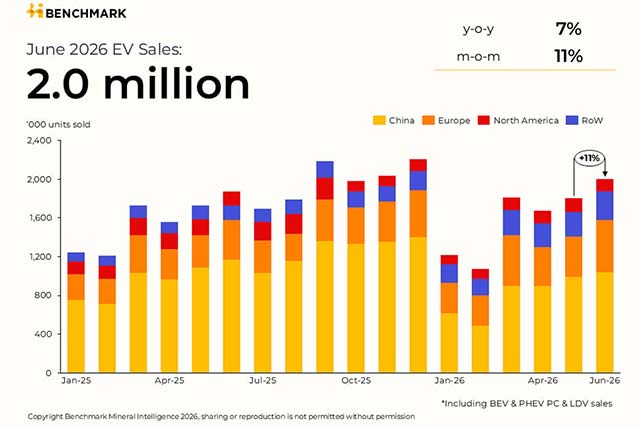
Global electric vehicle (EV) sales reached 2.0 million units in June 2026, according to the latest data from Benchmark Mineral Intelligence. The strong monthly performance pushed year-to-date (YTD) global EV sales to 9.6 million vehicles, highlighting continued momentum despite significant differences in regional market conditions.
Compared with June 2025, worldwide EV sales increased 7% year-over-year, while sales rose 11% compared with May 2026, reflecting improving demand across several major markets.
Europe Extends Its Lead in Global EV Growth
Europe delivered another record-breaking month for electric vehicle sales, with registrations increasing 31% year-over-year and 28% month-over-month. The region remains the strongest growth market in 2026, with EV sales up 27% YTD compared with the first half of 2025.
Several factors continue to support Europe’s expansion, including stricter emissions regulations, government incentive programs, and higher fuel prices that have encouraged more consumers to switch to electric vehicles. Deliveries of vehicles ordered following the rise in fuel prices earlier this year also contributed to June’s record performance.
France, Denmark, Spain and Portugal all recorded their highest-ever monthly EV sales.
France, in particular, continued to favor domestic manufacturers despite increasing competition from Chinese brands. Renault captured approximately 20% of the country’s EV market, with four of the five best-selling electric vehicles carrying the French brand’s badge. The recently introduced Renault Twingo EV has quickly gained traction, becoming the country’s third best-selling EV only months after deliveries began.
Meanwhile, Volkswagen Group has started delivering its new generation of affordable electric vehicles across Europe. Production of models including the Volkswagen ID.Polo, Cupra Raval, and Skoda Epiq is now underway in Spain.
These new compact EVs represent an important shift for the European market. Unlike earlier small electric cars that struggled to generate profits, the latest models have been developed on dedicated EV platforms, allowing manufacturers to lower production costs while offering competitive pricing. As more affordable options become available, the small EV segment is expected to play a growing role in Europe’s continued electrification.
North America Continues to Lose Momentum
North America’s EV market remains under pressure in 2026.
Regional EV sales are down 20% year-to-date, reflecting weaker policy support and the upcoming expiration of the U.S. federal EV tax credit later this year. Several domestic automakers have also slowed their electrification plans following restructuring efforts and substantial financial write-downs.
Sales of battery-electric vehicles from both General Motors and Ford have declined faster than the overall U.S. EV market, illustrating the challenges facing traditional manufacturers as competition intensifies.
One notable development came from Lotus, which shipped its first Chinese-built Eletre electric SUVs to Canada under the country’s tariff quota program. The agreement allows up to 49,000 Chinese-made EVs to enter Canada under reduced tariff rates, creating additional opportunities for manufacturers expanding beyond China.
China’s Domestic Market Softens While Exports Surge
China’s EV market continues to face a challenging domestic environment despite remaining the world’s largest electric vehicle market.
June EV sales declined 11% year-over-year, leaving the market 14% lower YTD compared with the same period in 2025.
However, Chinese automakers are increasingly offsetting weaker domestic demand by expanding overseas. Nearly 500,000 new energy vehicles (NEVs) were exported during June, setting another monthly record.
Europe remains one of the primary targets for Chinese manufacturers. While higher European tariffs on Chinese-built battery-electric vehicles introduced in late 2024 slowed BEV exports, many automakers shifted their focus toward plug-in hybrid electric vehicles (PHEVs).
Sales of Chinese-built PHEVs in the European Union increased more than fourfold during 2025 and have continued to rise throughout 2026. The European Commission is now reportedly investigating additional anti-subsidy measures that could lead to new countervailing duties on imported Chinese PHEVs.
Snapshot electric vehicle sales YTD 2026 (Jan-May 2026) |
|
Policy Differences Continue to Shape the Global EV Market
Benchmark Mineral Intelligence notes that regional policy differences remain the biggest factor influencing EV adoption worldwide.
Europe continues to benefit from supportive regulations and incentives that are accelerating consumer demand, particularly as more affordable electric vehicles enter the market. North America, by contrast, is experiencing slower adoption amid reduced government support and shifting manufacturer strategies. China remains highly competitive but is increasingly relying on exports as domestic sales soften.
The result is a global EV market that continues to expand overall, even as regional performance varies significantly.
With nearly 9.6 million electric vehicles sold during the first six months of 2026, the industry remains on track for another strong year, although future growth will likely depend on evolving government policies, consumer incentives, and the availability of lower-cost electric vehicles in key markets.


