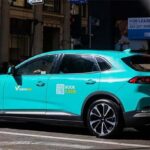
Rivian Automotive and Uber Technologies have announced a major strategic partnership aimed at accelerating the rollout of autonomous electric mobility.
The agreement outlines plans to deploy 10,000 fully autonomous Rivian R2 robotaxis, marking a significant step toward large-scale self-driving ride-hailing services.
Robotaxi Rollout Begins in 2028
The first phase of deployment is scheduled to begin in San Francisco and Miami in 2028, with rapid expansion planned across North America and Europe. By 2031, the companies aim to scale operations to 25 cities, offering fully autonomous rides exclusively through the Uber platform.
If milestones are met, the partnership could result in thousands of unsupervised robotaxis operating globally—bringing Level 4 autonomy closer to everyday reality.
Up to $1.25 Billion Investment from Uber
As part of the agreement, Uber will invest up to $1.25 billion in Rivian through 2031, tied to the achievement of key autonomy milestones. An initial $300 million investment is expected following regulatory approvals.
Looking ahead, the deal also includes an option for Uber to purchase up to 40,000 additional Rivian R2 vehicles starting in 2030, signaling long-term confidence in Rivian’s autonomous technology.
Built on Rivian’s Advanced Autonomy Platform
At the heart of the partnership is Rivian’s third-generation autonomy platform, unveiled in late 2025 and expected to debut in the R2 lineup by 2026. The system combines a powerful sensor suite and high-performance computing, including:
– 11 cameras (65 megapixels total)
– 5 radars and 1 LiDAR sensor
– Dual in-house RAP1 chips delivering 1600 TOPS of AI compute
This architecture enables real-time processing of complex driving environments while feeding Rivian’s “data flywheel”—a continuous loop of real-world data collection and improvement.
The inclusion of LiDAR-generated 3D point clouds plays a crucial role in advancing end-to-end physical AI, helping refine autonomous decision-making at scale.
A Vertically Integrated Approach
Both companies emphasize the importance of Rivian’s vertically integrated strategy—designing the vehicle, software, and compute platform in-house while maintaining control over manufacturing.
This approach, combined with data from Rivian’s growing consumer fleet and Uber’s experience managing large-scale ride-hailing operations, forms the foundation for what could become one of the most advanced autonomous ecosystems in the industry.
The Bigger Picture
The Rivian–Uber collaboration reflects a broader shift toward electric, autonomous, and shared mobility. With aggressive timelines and substantial investment backing the project, the partnership could reshape urban transportation over the next decade.