The European new car market continued its recovery in the first half of 2026, with registrations rising despite ongoing economic and geopolitical uncertainty. Strong consumer demand for electrified vehicles, supported by government incentives and market support measures, helped drive growth across the European Union.
Battery-electric vehicles (BEVs), hybrid-electric vehicles (HEVs), and plug-in hybrid electric vehicles (PHEVs) all gained market share during the first six months of the year, while registrations of petrol and diesel-powered cars continued to decline.
EU New Car Registrations Increase 5.7% in H1 2026
New passenger car registrations across the European Union increased by 5.7% year-over-year through June 2026. A particularly strong June performance helped offset continued geopolitical challenges and uncertainty affecting the broader automotive market.
Electrified vehicles remained the primary growth engine, with hybrids maintaining their position as Europe’s most popular powertrain and battery-electric vehicles reaching another record market share.
Battery-Electric Vehicles Reach 20.7% Market Share
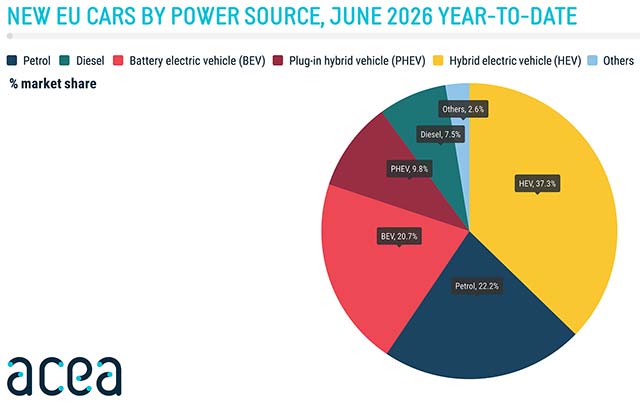
Battery-electric vehicle registrations climbed to 1,220,890 units during the first half of 2026, giving BEVs a 20.7% share of the EU new car market. That marks a significant improvement from 15.6% during the same period in 2025.
Growth was strongest in several of Europe’s largest EV markets:
– France: +62.9%
– Germany: +48.0%
– Denmark: +41.2%
– Belgium: +8.2%
France, Germany, and Denmark accounted for a substantial share of total battery-electric vehicle registrations, highlighting continued momentum in Europe’s transition toward zero-emission mobility.
Hybrid Vehicles Remain Europe’s Top Choice
Hybrid-electric vehicles continued to dominate the market, with 2,198,148 registrations recorded in the first six months of 2026. HEVs captured 37.3% of all new EU passenger car registrations, making them the most popular powertrain among European buyers.
Several major markets posted healthy growth for hybrid models:
– Italy: +23.0%
– Spain: +20.8%
– Germany: +6.9%
– France: +3.2%
The sustained popularity of hybrids reflects strong consumer dema
Plug-In Hybrid Sales Continue to Grow
Plug-in hybrid electric vehicles also strengthened their position in the European market. Registrations reached 577,735 units during H1 2026, increasing their market share to 9.8%, up from 8.5% a year earlier.
The strongest gains came from:
– Italy: +84.3%
– Spain: +39.0%
– Germany: +17.9%
The continued expansion of the PHEV segment demonstrates that many buyers still value the flexibility of combining electric driving with conventional gasoline power.
Petrol and Diesel Cars Continue Losing Ground
Traditional internal combustion vehicles continued to see declining demand across Europe.
Petrol car registrations fell 17.2% year-over-year, with every major market reporting significant declines:
– France: -34.2%
– Spain: -18.5%
– Germany: -18.2%
– Italy: -17.1%
A total of 1,309,153 petrol cars were registered during the first half of 2026, reducing petrol’s market share from 28.4% to 22.2%.
Diesel vehicles also continued their long-term decline. Registrations dropped 16.5%, with diesel accounting for just 7.5% of new EU car sales, compared with 9.4% one year earlier.
Combined, petrol and diesel vehicles represented 29.7% of all new EU registrations, a sharp decline from 37.8% in the first half of 2025.
Europe’s Electrification Momentum Continues
The latest registration figures underline Europe’s accelerating shift toward electrified mobility. Battery-electric vehicles now account for more than one in every five new cars sold across the EU, while hybrid models remain the region’s preferred choice for consumers seeking greater efficiency.
Although economic and geopolitical uncertainties continue to influence the automotive industry, demand for electrified vehicles remains resilient. As governments maintain support for low-emission transportation and manufacturers expand their electric lineups, battery-electric, hybrid, and plug-in hybrid models are expected to continue increasing their share of Europe’s new car market throughout the remainder of 2026.
[source: ACEA]