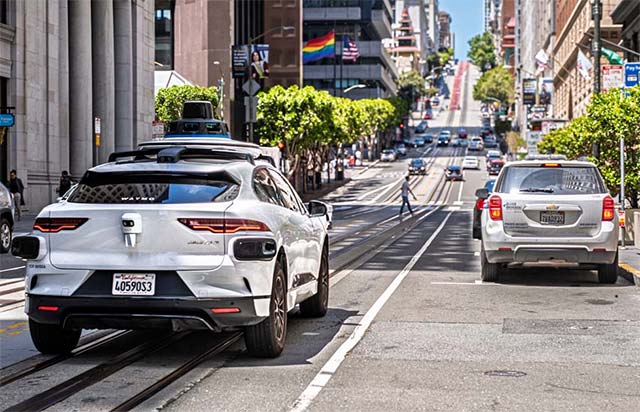
Waymo’s fully driverless vehicles are involved in significantly fewer crashes than human-driven vehicles, according to a new study from the Insurance Institute for Highway Safety (IIHS).
While the findings suggest that autonomous driving technology is making meaningful safety gains, researchers say the current U.S. reporting system needs major improvements before it can accurately monitor self-driving vehicles on a larger scale.
The study found that Waymo’s Level 4 autonomous vehicles recorded 68% fewer police-reportable crashes per vehicle mile traveled (VMT) than human drivers across San Francisco, Phoenix, Los Angeles, and Austin.
Driverless Vehicles Show Strong Safety Performance
Researchers analyzed crashes involving autonomous vehicles between 2021 and 2024 and compared Waymo’s driverless fleet with conventional human-driven vehicles operating in the same locations.
After removing duplicate reports, non-public-road incidents, crashes where automation was not engaged, and other ineligible events, the researchers focused only on crashes that a typical driver would likely report to police. This allowed for a more realistic comparison with human crash statistics.
Over the study period, Waymo’s fully driverless fleet accumulated approximately 50 million miles of autonomous driving.
Compared with human drivers, Waymo’s vehicles experienced:
– 68% fewer police-reportable crashes
– 85% fewer single-vehicle crashes
– 81% fewer injury crashes
Safety performance also varied by city:
– Phoenix: 76% fewer crashes
– Los Angeles: 71% fewer crashes
– San Francisco: 35% fewer crashes
– Austin: 4% higher crash rate, although researchers noted the sample size there remains too small for meaningful conclusions.
According to IIHS President David Harkey, the results demonstrate that, on a limited scale, driverless vehicles can outperform human drivers, who remain vulnerable to distraction, fatigue, impairment and other human errors.
Understanding Level 4 Autonomous Driving
Waymo operates Level 4 autonomous vehicles, capable of handling all driving tasks without human supervision within specific operating areas and conditions.
Originally launched as Google’s self-driving car project in 2009, Waymo introduced its public robotaxi service in Phoenix in 2020 before expanding to San Francisco, Los Angeles and Austin.
Unlike Level 4 systems, the advanced driver assistance technologies currently available to consumers—such as General Motors’ Super Cruise and Ford BlueCruise—are classified as Level 2 automation. These systems still require drivers to remain attentive and ready to take control at all times.
Level 3 systems, which allow limited hands-off driving under certain conditions while requiring a human driver to intervene when requested, remain rare. Fully autonomous Level 5 vehicles capable of operating everywhere without human input are not yet available.
Reporting Rules Make Comparisons Difficult
Although the study’s safety results are encouraging, researchers emphasized that current crash reporting systems make it difficult to accurately compare autonomous vehicles with human drivers.
Since 2021, the National Highway Traffic Safety Administration (NHTSA) has required companies operating automated driving systems to report crashes under its Standing General Order (SGO). California has maintained similar reporting requirements since 2014 for companies testing self-driving vehicles.
However, several limitations reduce the usefulness of these databases.
Autonomous vehicle companies must report qualifying crashes, but they are generally not required to disclose how many miles their vehicles travel or whether those miles were driven autonomously or under human supervision. Waymo voluntarily releases its mileage data, allowing researchers to calculate crash rates, while most competitors do not.
Another challenge is that autonomous vehicle operators have historically been required to report many minor incidents that human drivers rarely report. Until reporting rules changed in 2025, even minor contact such as scraping a vehicle’s underbody could qualify as a reportable crash.
Because autonomous vehicles also contain expensive sensors that can be damaged in relatively small impacts, their crashes are more likely to exceed property damage reporting thresholds than conventional vehicles.
These differences required IIHS researchers to manually review hundreds of crash reports before making meaningful comparisons.
Better Data Will Be Critical as Autonomous Driving Expands
The researchers believe the study provides encouraging evidence that fully autonomous vehicles can improve road safety. However, they also argue that better nationwide reporting standards will be essential as autonomous driving technology becomes more widespread.
A standardized reporting system that includes both crash data and vehicle mileage across all autonomous vehicle operators would allow regulators, researchers and the public to better monitor real-world safety performance over time.
As robotaxi services continue expanding across U.S. cities, more transparent and consistent data collection will play an important role in evaluating whether autonomous driving technology continues delivering safety benefits at scale.