
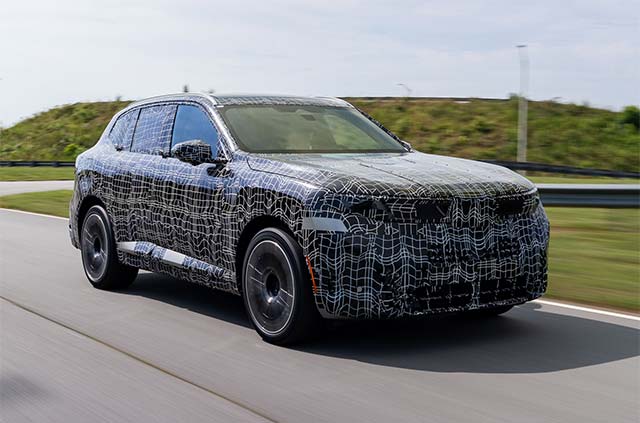
BMW is entering the final stages of development for the next-generation X5, marking a major milestone for the brand’s best-selling Sports Activity Vehicle (SAV). As testing concludes around BMW Group’s Spartanburg manufacturing facility in South Carolina, the fifth-generation BMW X5 is preparing to become one of the most versatile luxury SUVs on the market.
For the first time, the BMW X5 lineup will be available with five different propulsion technologies. Alongside gasoline and diesel engines featuring 48-volt mild-hybrid systems, buyers will be able to choose plug-in hybrid variants, the all-new fully electric BMW iX5, and a hydrogen-powered production model scheduled to arrive in 2028.
BMW iX5 Introduces Sixth-Generation eDrive Technology
The biggest headline is the debut of the fully electric BMW iX5, which will become the first production BMW SUV to utilize the company’s sixth-generation eDrive technology.
At the heart of the new iX5 is an advanced 800-volt electrical architecture paired with a newly developed high-voltage battery using cylindrical cells. The SUV features BMW’s largest battery pack ever installed in a production EV, delivering a usable capacity of 144 kWh in the U.S. market and 141 kWh in Europe.
Power comes from dual electric motors—one mounted on each axle—working together through BMW’s xDrive all-wheel-drive system. The range-topping BMW iX5 60 xDrive produces 578 horsepower (425 kW), positioning it among the most powerful electric SUVs in BMW’s portfolio.
The adoption of 800-volt technology is expected to improve charging speeds, efficiency, and overall performance while supporting longer driving ranges.
BMW iX5 Hydrogen Arrives in 2028
BMW’s commitment to multiple zero-emission technologies continues with the upcoming BMW iX5 Hydrogen, which is scheduled to enter series production in 2028.
The hydrogen-powered SUV combines a third-generation fuel-cell system with a newly developed Hydrogen Flat Storage architecture and a compact high-voltage battery. One of the most innovative aspects of the design is its seven interconnected high-pressure hydrogen tanks, constructed from carbon-fiber-reinforced composite materials and packaged within a robust metal framework.
This flat-storage layout maximizes interior space by integrating the tanks beneath the vehicle floor without compromising passenger or cargo room. It also enables BMW to manufacture hydrogen models alongside electric, hybrid, and combustion variants on the same production line, improving manufacturing flexibility.
Heart of Joy Technology Enhances Driving Dynamics
The new X5 will benefit from technologies developed for BMW’s upcoming Neue Klasse vehicle architecture, including the company’s new “Heart of Joy” control system.
Powered by BMW Dynamic Performance Control software, the central computing platform can process vehicle functions up to ten times faster than previous systems. It continuously manages power delivery, steering, braking, energy recuperation, and charging functions in milliseconds.
For electric and hydrogen-powered models, the system enables smoother regenerative braking and greater energy recovery. In hybrid and combustion-powered variants, it enhances traction, stability, and overall handling precision.
BMW says the result is a more agile, responsive, and refined driving experience across the entire X5 lineup.
The SUV will also feature adaptive suspension as standard, electronically controlled dampers, nearly perfect 50:50 weight distribution, and available wheel sizes up to 23 inches. Optional Adaptive Chassis Control Professional adds two-axle air suspension, Integral Active Steering, and active roll stabilization for even greater comfort and performance.
Advanced Driver Assistance and Safety Features
The next-generation BMW X5 will introduce a new suite of SAE Level 2 driver assistance technologies derived from BMW’s Neue Klasse development program.
Among the available features is the optional Motorway and City Assistant package, which includes Entry-to-Exit highway assistance and Address-to-Address urban driving support. BMW’s approach emphasizes collaboration between driver and technology rather than full automation, allowing drivers to remain actively engaged while receiving intelligent assistance.
A key part of the system is BMW Symbiotic Drive, which enables drivers to accelerate, steer, and brake without automatically disengaging assistance functions.
The X5 will also gain a range of enhanced active safety technologies, including:
– Intelligent Lane Keeping Assistant that considers steering inputs and driver attention.
– Automated evasive maneuvers within the current lane.
– Lane Change Warning.
– Side Collision Warning with steering intervention.
– Crossing Traffic Warning.
– Automatic braking when entering roadways or exiting parking spaces.
Together, these systems aim to improve safety while maintaining the engaging driving characteristics BMW customers expect.
A Multi-Powertrain Future for the BMW X5
With gasoline, diesel, plug-in hybrid, battery-electric, and hydrogen-powered variants all planned within a single model family, the next-generation BMW X5 represents one of the most comprehensive powertrain strategies in the premium SUV segment.
The all-electric BMW iX5 will lead the launch with next-generation battery technology and 800-volt architecture, while the hydrogen-powered BMW iX5 Hydrogen will further expand BMW’s zero-emission portfolio when it arrives in 2028. Combined with advanced software, improved chassis technology, and enhanced driver assistance systems, the new BMW X5 is set to become a showcase for BMW’s future mobility strategy.


