
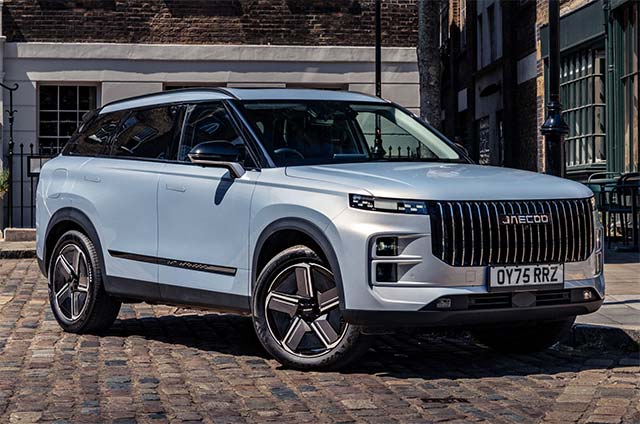
The JAECOO 7 has returned to the top of the UK new-car sales charts, highlighting the rapidly growing influence of Chinese automakers in the British market.
The Chinese SUV recorded 10,813 registrations in September 2026, making it the UK’s best-selling new car for the month, according to figures from the Society of Motor Manufacturers and Traders (SMMT). It is the second time this year that the JAECOO 7 has taken the monthly sales crown, after also leading the market in March.
The result is particularly notable because the JAECOO 7 is still a relatively new name in the UK. JAECOO entered the British market in January 2025, yet the brand has already established itself as a serious competitor to much more familiar European, Japanese and Korean automakers.
The JAECOO 7 finished September ahead of several established models, including the Tesla Model 3, Ford Puma and Kia Sportage.
Its success also helped its parent company, OMODA&JAECOO UK, achieve its strongest month since entering the British market.
The company registered 22,296 vehicles in September, giving it a 6.37% share of the UK new-car market. Registrations more than doubled compared with the 10,812 vehicles recorded by OMODA&JAECOO in September 2025.
JAECOO alone accounted for 4.30% of the market, up from 2.07% a year earlier, while OMODA increased its share from 1.38% to 2.07%.
The September result also came during the UK’s important new-number-plate month, when vehicle registrations traditionally receive a significant boost.
OMODA&JAECOO has now surpassed 100,000 cumulative UK sales, less than two years after OMODA entered the market.
Chinese Cars Are Gaining Ground in Britain
The JAECOO 7’s success is part of a much larger shift in the UK automotive market.
Chinese automakers collectively accounted for around 23% of the UK’s new-car market in September, according to SMMT data cited in the supplied reports. JAECOO accounted for 4.3%, while Chery held 2.8% and BYD reached 5.75%.
That growth demonstrates how quickly Chinese brands are moving from relative newcomers to major players in one of Europe’s most competitive car markets.
The UK has also been more open to Chinese-built vehicles than the European Union, where additional tariffs have affected some Chinese electric cars. That gives manufacturers greater flexibility to compete on price while offering increasingly sophisticated vehicles.
Why Is the JAECOO 7 So Popular?
One obvious factor is the JAECOO 7’s combination of styling, equipment and price.
The SUV has been compared with the Range Rover Velar because of its exterior design, earning it the unofficial “Temu Range Rover” nickname. While the comparison is deliberately tongue-in-cheek, it reflects one of the model’s biggest selling points: it offers a premium-looking SUV without the premium price.
With pricing starting at roughly £30,000, the JAECOO 7 is dramatically cheaper than a Range Rover Velar while offering a relatively upscale interior and a long list of standard equipment.
That formula appears to be resonating with British buyers, particularly as household budgets remain under pressure.
The JAECOO 7 is also available with plug-in hybrid technology, giving buyers another reason to consider it over a conventional petrol SUV.
Plug-In Hybrids Are Booming in the UK
Electrified vehicles continued to gain significant ground in Britain during September.
Battery-electric vehicles accounted for 28.3% of the UK new-car market, up from September 2025. Plug-in hybrids also recorded strong growth, reaching a 17% market share.
Within OMODA&JAECOO’s own September registrations, electrified models made up more than three-quarters of sales.
Plug-in hybrids represented 55.7% of the company’s registrations, followed by full hybrids at 10.4% and battery-electric vehicles at 10%.
That leaves petrol-only vehicles representing just 23.9% of OMODA&JAECOO’s September sales, compared with 37.5% a year earlier.
The figures underline the growing importance of hybrids and plug-in hybrids in the UK, where some buyers remain hesitant to make the complete switch to battery-electric vehicles.
JAECOO Is Expanding Quickly
The JAECOO 7 isn’t succeeding in isolation.
Over the past year, OMODA&JAECOO’s UK retailer network has expanded from 81 locations to 146, while its model range has grown from three model families and five powertrain options to six model families and 12 powertrain choices.
The current lineup includes the OMODA 5, 7 and 9 alongside the JAECOO 5, 7 and 8.
The company is also putting greater emphasis on aftersales support, an important issue for a relatively new automotive brand trying to establish long-term customer confidence.
In August, OMODA&JAECOO expanded its seven-year/100,000-mile manufacturer warranty to cover additional components and applied the change retrospectively to vehicles already sold in the UK. The company also expanded its partnership with the RAC to provide additional roadside and warranty support.
Those moves could become increasingly important as the number of JAECOO and OMODA vehicles on British roads continues to grow.
The JAECOO 7 Isn’t Without Problems
The SUV’s rapid sales growth doesn’t mean it has a perfect reliability record.
The JAECOO 7 was recently included among the UK’s least reliable cars in a What Car? reliability survey. Reported problems were largely related to electronic systems rather than the powertrain, while some owners experienced lengthy repair times.
That could become an important test for the brand as thousands of additional JAECOO vehicles enter the UK market.
A low purchase price can attract buyers, but long-term reliability, parts availability and dealer support will ultimately determine whether Chinese brands can convert their initial sales success into lasting market share.


