
Hyundai Motor Group is partnering with energy intelligence company Kaluza to develop smart charging technology for its electric vehicles, creating a more seamless connection between EVs and the energy grid.
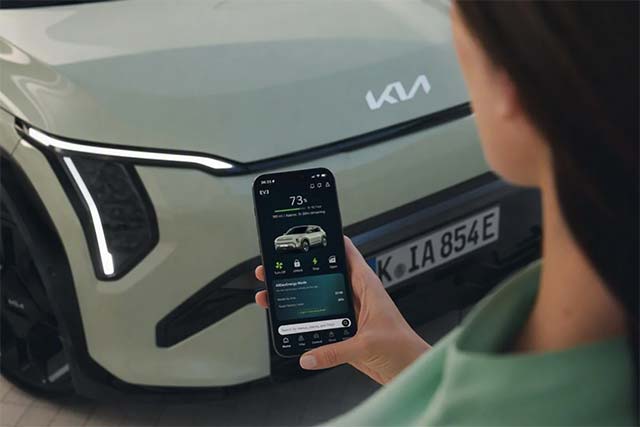
The global technology partnership is scheduled to begin rolling out in August 2026, initially covering Kia and Hyundai EVs in the UK before expanding to Australia. The technology will be integrated directly into the Kia App and myHyundai App, allowing drivers to manage smart charging without relying on a separate energy app.
The partnership is designed to make EV charging more convenient while helping drivers reduce both charging costs and carbon emissions.
Instead of manually choosing when an EV should charge, the integrated system can automatically schedule charging for periods when electricity is cheaper and cleaner. Drivers can set when their vehicle needs to be ready, while the software handles the timing in the background.
The UK rollout will initially include OVO as the first energy retailer to provide smart charging through the Kia App. Kia owners who use OVO will therefore be able to manage their vehicle and charging in one place.
Drivers currently using the OVO Charge app are expected to transition to the Kia App in early autumn, with Hyundai drivers expected to gain access shortly afterward.
Hyundai Motor Group says the partnership goes beyond a conventional app integration. The companies are working together on the underlying technology that will allow EVs to interact more intelligently with energy networks.
Woong Tae Hwang, Vice President and Head of EV Energy Strategy Group at Hyundai Motor Group, said the company chose Kaluza because of its expertise in energy intelligence and its ability to work on advanced EV-energy integration.
The technology could eventually allow EVs to become an active part of the electricity system rather than simply consuming electricity.
Kaluza’s platform is being embedded directly into the automakers’ digital ecosystems, giving drivers control over charging from their smartphones while allowing the system to respond to electricity prices, renewable energy availability and grid conditions.
One of the most important developments enabled by the partnership is vehicle-to-grid (V2G) technology.
Hyundai Motor Group and Kaluza are laying the groundwork for V2G services expected to begin in 2027. Unlike conventional smart charging, V2G allows compatible EVs to send stored electricity back to the grid when needed.
That could create another potential source of value for EV owners. Vehicles could charge when electricity is abundant and inexpensive, then potentially supply energy back to the grid during periods of higher demand.
The technology could also help make better use of renewable energy. When solar or wind generation is high, EVs can provide a flexible source of electricity demand by charging at times when cleaner energy is more readily available.
For drivers, the biggest advantage is convenience. Rather than monitoring electricity prices or renewable-energy production, the smart charging platform can automate those decisions.
A driver can specify when the car needs to be ready, while the system determines an appropriate charging schedule based on available energy and cost.
The approach could become increasingly important as EV adoption grows. Millions of electric vehicles connected to the grid represent a significant source of flexible energy demand, particularly when charging can be coordinated automatically.
OVO’s Director of EV, Alex Thwaites, said the goal is for drivers to charge at cheaper and greener times without having to actively manage the process.
The Kaluza partnership represents a broader shift in how automakers are approaching EV ownership. Charging is increasingly becoming part of the vehicle’s connected digital ecosystem rather than a separate service handled entirely by charging networks or energy providers.
By integrating smart charging directly into the Kia and Hyundai apps, Hyundai Motor Group can give EV owners a single interface for vehicle and energy-related functions.
The initial rollout in the UK and Australia will provide a foundation for expanding the technology to additional markets and services. The planned introduction of V2G capabilities from 2027 could take that integration further, turning compatible EVs into flexible energy assets.
As electric vehicle adoption continues to increase, partnerships between automakers, energy companies and technology providers are likely to play a growing role in determining how EVs interact with the electricity grid.
For Kia and Hyundai drivers, the first step will be simpler: letting the car automatically charge at the right time, rather than making the driver decide when to plug in.


