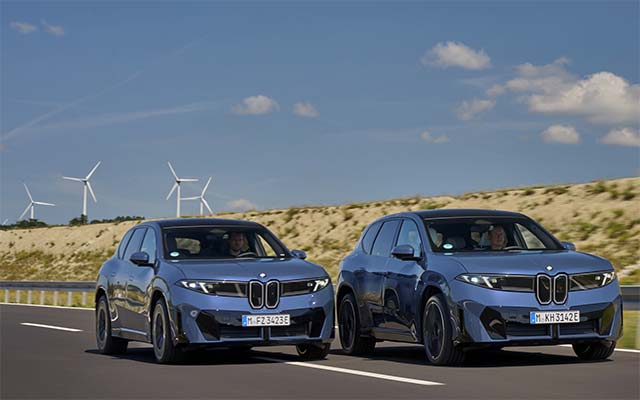
BMW is significantly expanding its active safety technology with the arrival of the Neue Klasse generation, bringing a wider range of driver-assistance features to multiple model lines as standard equipment.
The new BMW iX3 is the first production model to introduce the technology, with the upcoming BMW i3 and other models, including the X5 and 7 Series, set to follow. The new systems are designed to work more closely with the driver while providing additional protection during everyday driving, parking and vehicle exit situations.
BMW says the approach is based on its “Smart, Symbiotic, Safe” philosophy, which treats the driver and vehicle’s assistance systems as a cooperative system rather than having electronic interventions constantly compete with driver inputs.
BMW Adds Active Door Opening Protection
One of the most useful additions is an enhanced Exit Warning system with active door opening delay, designed to reduce the risk of so-called dooring accidents.
Dooring occurs when someone opens a parked vehicle’s door directly into the path of a cyclist, motorcycle, car or another road user. The problem is particularly dangerous for cyclists traveling alongside parked vehicles.
BMW’s system uses side-mounted radar sensors to monitor the area around the vehicle after it has stopped. If an approaching road user is detected and opening the door could create a collision risk, the electronic door lock temporarily delays the door from opening until the danger has passed.
The feature builds on BMW’s existing Exit Warning technology, which already provides visual and audible warnings when a potential hazard is detected.
The importance of the technology is highlighted by data from Berlin. According to the German Insurance Association, dooring incidents accounted for 8% of all bicycle accidents in Berlin in 2024.
By making active door-opening protection part of its standard safety package on Neue Klasse vehicles, BMW is addressing a type of accident that can be difficult for drivers to anticipate.
BMW’s New Driver Assistance System Understands Driver Intent
Another major development is BMW’s Symbiotic Drive, which is designed to make driver-assistance interventions feel more natural.
Rather than simply reacting to every movement toward a lane boundary, the system considers signals that indicate what the driver is deliberately trying to do. Steering input, turn-signal activation and even a driver’s shoulder check can help the vehicle determine whether a maneuver is intentional.
For example, the Lane Keeping Assistant can provide a warning or steering intervention when the vehicle detects an unintended lane departure or an imminent collision. If the driver intentionally changes direction, the system can avoid unnecessary intervention as long as there is no foreseeable risk of a crash or the vehicle leaving the road.
This approach is becoming increasingly important as automakers add more sophisticated driver-assistance technology. The goal is to provide intervention when it is needed without making the driver feel as though the vehicle is constantly fighting their inputs.
BMW Reports Millions of Safety Interventions
BMW says data from its connected vehicle fleet demonstrates the potential benefits of active safety systems.
In Europe alone, the customer-consented fleet analyzed by BMW covered approximately 1.6 billion kilometers in a single month. During that period, drivers received around 8 million visual and acoustic collision warnings.
More importantly, BMW says active steering and braking interventions helped prevent a potential collision in 243,977 cases.
The figures provide a glimpse into how frequently modern driver-assistance systems can become relevant during everyday driving, although they do not mean that every intervention would otherwise have resulted in a crash.
Emergency Steering Can Avoid Obstacles
The Neue Klasse safety package also introduces an Emergency Steering Intervention designed to help drivers avoid obstacles while keeping the vehicle within its lane.
The system can intervene when an unexpected obstacle appears in the vehicle’s path. BMW gives examples such as a person stepping into the road between stopped vehicles or a cyclist becoming difficult to see in low-light conditions.
The technology can also help during potential side-impact situations. If another vehicle gets dangerously close and the system determines that there is sufficient space, it can provide a brief steering input to move the BMW away from the approaching object while remaining within its lane.
This adds another layer of protection beyond conventional automatic emergency braking, particularly in situations where simply stopping may not be enough to avoid an impact.
Emergency Braking Gets Smarter
BMW is also upgrading its Emergency Brake Assistant, which can automatically apply the brakes when a collision is imminent.
The system can provide full braking force when necessary and now benefits from improved sensor technology capable of assisting in situations involving animals and wildlife crossings.
The company is also expanding its Road Priority Warning system. Recognized traffic signs can be displayed directly within the driver’s field of view through BMW Panoramic Vision.
The system can identify hazards including red traffic lights, stop signs, yield signs and no-entry signs, with crosswalk warnings also incorporated into the expanded functionality.
BMW Can Bring a Vehicle to a Controlled Stop
Another potentially important safety feature is the Attentiveness Assistant with emergency stop.
If the vehicle’s interior camera determines that the driver is no longer fit to continue driving, the system can temporarily take control and bring the vehicle to a controlled stop.
During the procedure, the vehicle can activate its hazard lights and initiate an eCall emergency communication. The driver can override the system at any time.
The feature is intended for situations such as a medical emergency where the driver becomes unable to safely operate the vehicle.
New Safety Technology Also Works in Parking Lots
BMW’s expanded safety systems are not limited to highway driving.
The new Active Park Distance Control uses ultrasonic sensors and surround-view cameras to help prevent collisions while maneuvering. The system can apply the brakes when stationary or moving objects are detected, including protection from obstacles at the sides of the vehicle.
Cross-traffic protection is also being enhanced. When a vehicle is reversing out of a parking space with limited visibility, rear side radars can monitor approaching traffic, including cyclists and other road users. The rearview camera and bird’s-eye-view display provide additional information to the driver.
BMW is also introducing standard Start Monitoring, which is designed to detect potential accelerator-pedal misapplication.
If an obstacle is less than one meter away, the vehicle is traveling at up to 2 km/h and the system detects an unusually rapid and forceful accelerator input, it can intervene by applying the brakes and bringing the vehicle to a controlled stop.
BMW Panoramic iDrive Gives Drivers More Information
The new safety systems are supported by BMW’s latest display and operating technology.
The BMW Panoramic iDrive system, combined with the next generation of sensors and the Assisted View display in BMW Operating System X, provides drivers with a more detailed representation of the surrounding traffic environment.
Information can be displayed on the central screen, BMW Panoramic Vision and, where equipped, the 3D Head-Up Display.
The objective is to make it easier for drivers to understand detected vehicles, pedestrians and other objects, while also showing when driver-assistance systems are active and why they are intervening.
A New Computer Powers BMW’s Safety Systems
Behind the expanded driver-assistance technology is a new centralized computing platform BMW calls the “Superbrain of Automated Driving.”
The high-performance, water-cooled computer manages the vehicle’s active safety, assisted-driving and assisted-parking functions.
BMW says the system provides approximately 20 times the computing power of the previous generation.
That additional processing capability is important because modern driver-assistance systems increasingly have to combine information from cameras, radar sensors and other vehicle systems in real time. A centralized architecture can allow those systems to share information more quickly and coordinate their responses.
BMW Tests the Technology in Real-World Conditions
BMW has also invested heavily in testing the new systems before bringing them to production vehicles.
The company’s Future Mobility Development Center (FMDC) in Sokolov, Czech Republic, opened in 2023 and is now an important part of the development process for active safety and assisted-driving technology.
The approximately 600-hectare facility includes around 25 kilometers of test tracks designed to reproduce a wide range of driving conditions. Engineers can simulate urban traffic, highway driving and parking maneuvers in controlled and repeatable environments.
BMW combines this testing with virtual simulations and millions of kilometers of public-road testing in different environments, including extreme heat, snow and ice.
The testing program covers regions including Europe, North America, South Africa and China, allowing BMW to evaluate its assistance systems under a wide variety of road and weather conditions.
BMW’s Neue Klasse Makes Safety a Bigger Part of the EV Platform
The Neue Klasse represents more than a new generation of electric vehicles for BMW. It also introduces a substantially more integrated approach to active safety and driver assistance.
The BMW iX3 is the first production model to showcase the technology, while the upcoming BMW i3 and other BMW models are expected to expand its availability.
Features such as active door opening delay could have an immediate impact on everyday safety, particularly for cyclists and pedestrians, while emergency steering, improved automatic braking and enhanced parking protection add additional layers of accident prevention.
With significantly more computing power and sensors working together, BMW is positioning its next-generation vehicles to make driver assistance more predictive, more responsive and less intrusive.
The broader rollout of these systems could also make advanced safety technology less dependent on expensive options, as BMW moves more of its active safety equipment into standard vehicle specifications.