
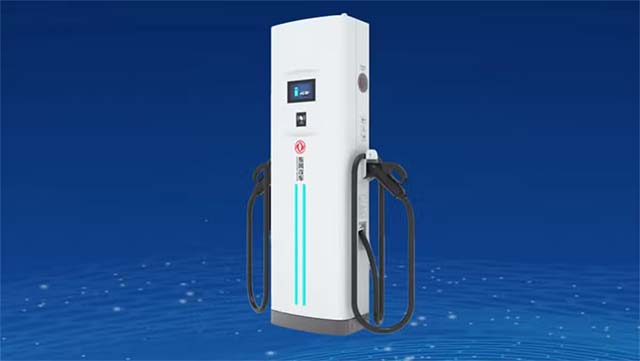
China’s electric vehicle charging race is accelerating once again as Dongfeng Motor has introduced its first in-house developed ultra-fast charging system capable of delivering up to 1.5 megawatts (1,500 kW) through a single charging connector. The new charger matches the peak output of BYD’s latest Flash Charger and highlights the growing competition among Chinese automakers to reduce EV charging times to just a few minutes.
The unveiling also marks Dongfeng’s broader strategy to develop next-generation charging infrastructure and high-voltage electric powertrains as the industry moves toward megawatt-level charging for both passenger and commercial electric vehicles.
Dongfeng’s New 1.5 MW EV Charger
At the heart of Dongfeng’s latest charging technology is a modular system built around a 1.2 MW power cabinet. Multiple cabinets can be combined to create a larger shared power pool, allowing charging stations to scale their total installed capacity to 2.4 MW or more.
When connected to a compatible vehicle, a single charging connector can deliver:
– Up to 1,500 kW peak charging power
– 1,500 amps of current
– Up to 1,000 volts operating voltage
The charger is designed with a broad voltage range of approximately 150V to 1,000V, allowing compatibility with a wide variety of current and future electric vehicles. If both charging cables are in use simultaneously, the available output is automatically shared between the two vehicles.
Dongfeng also claims an overall system efficiency of 96.7%, making the charger one of the industry’s first products to achieve Level 1 energy-efficiency certification under China’s new GB 46519-2025 national standard.
Charging Speeds Will Depend on the Vehicle
Although Dongfeng has not disclosed charging times for its own electric vehicles, the charger’s hardware is capable of supporting extremely high charging rates when paired with batteries designed for megawatt charging.
In theory, vehicles equipped with battery systems comparable to BYD’s latest Blade Battery technology could benefit from similarly short charging sessions. The charger itself does not impose limitations; real-world performance will depend on the battery architecture, thermal management system and vehicle software.
Next-Generation Chargers Already in Development
Dongfeng confirmed that development is already underway on a new family of ultra-fast chargers featuring integrated battery energy storage.
The company plans to offer charging solutions ranging from 720 kW to 2.4 MW, targeting both passenger EVs and commercial electric trucks and buses. Battery-buffered charging systems could also help reduce stress on the electrical grid while enabling consistent high-power charging at busy stations.
A New Kilovolt Electric Drive
Alongside the charging infrastructure, Dongfeng introduced the iD5-300SN, its first kilovolt electric drive system.
The drive features a 1,500V-rated silicon carbide (SiC) power module, supports operating voltages between 450V and 1,000V, and produces up to 300 kW of peak power.
According to Dongfeng, the new drive offers:
– Around 30% higher power density than its predecessor
– Industry-leading efficiency under the CLTC test cycle
– Compatibility with today’s 800V EV platforms
– Expandability to future 1,200V vehicle architectures
The powertrain will become part of Dongfeng’s Mach platform and is expected to power the company’s first kilovolt production EV under the Epicland brand, a project being developed in partnership with Huawei.
BYD Still Sets the Benchmark
Dongfeng’s announcement comes just months after BYD introduced its second-generation Flash Charger, which also delivers up to 1.5 MW through a single charging connector.
BYD says its latest charging system enables compatible vehicles equipped with the newest Blade Battery to recharge from 10% to 70% in roughly five minutes under ideal conditions. The automaker has also announced plans to install 20,000 Flash Charging stations across China by the end of 2026.
China’s Charging Race Continues to Heat Up
The battle for faster charging extends beyond Dongfeng and BYD.
Earlier this week, Hongqi revealed an experimental battery capable of charging from 10% to 70% in just 3 minutes and 41 seconds, while CATL’s third-generation Shenxing LFP battery is claimed to recharge from 10% to 80% in under four minutes and reach 98% in approximately six and a half minutes.
These rapid advances demonstrate how Chinese manufacturers are competing across batteries, charging infrastructure and high-voltage powertrains simultaneously. As megawatt charging moves closer to mainstream adoption, future EV owners could see charging times approach those of conventional fuel stops, further reducing one of the last barriers to widespread electric vehicle adoption.
[source: CNEVPOST]


