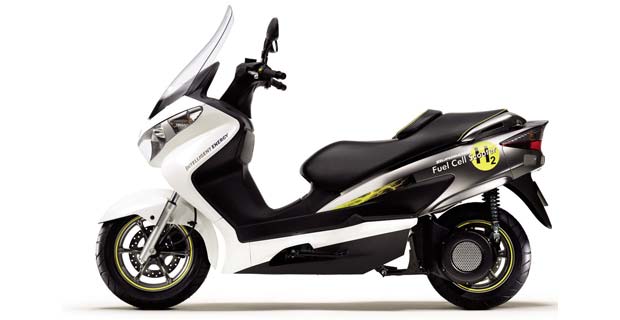
 Suzuki and Intelligent Energy and have announced that the jointly developed Suzuki Burgman Fuel-Cell Scooter has obtained Whole Vehicle Type Approval (WVTA) – the first time any fuel cell vehicle has achieved this level of certification.
WVTA qualifies the Suzuki Burgman Fuel-Cell Scooter design as safe to use on public roads without having to be inspected and tested individually, and brings zero emission motorcycles a step closer to becoming commercially available.
The Suzuki Burgman Fuel-Cell Scooter is equipped with the latest version of Intelligent Energy’s unique and proprietary air-cooled, clean fuel-cell power systems and is fuelled from a cylinder of hydrogen, which can be re-fuelled in a few minutes and gives a riding range of 350km (217 miles) comparable to a conventional Burgman scooter.
First exhibited at the 41st Tokyo Motor Show in October 2009, the Burgman Fuel-Cell Scooter has been participating in a UK public road testing program run by Intelligent Energy and supported by the UK Government’s Technology Strategy Board.
The Suzuki Burgman Fuel-Cell Scooter design has now met with specified EU performance standards meaning that the vehicle and its components are approved for production and sale within Europe.
The Suzuki Burgman Fuel-Cell Scooter was jointly launched in Europe at London’s City Hall in February 2010.[wzslider height=”400″ lightbox=”true”]