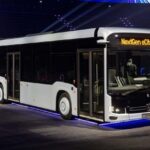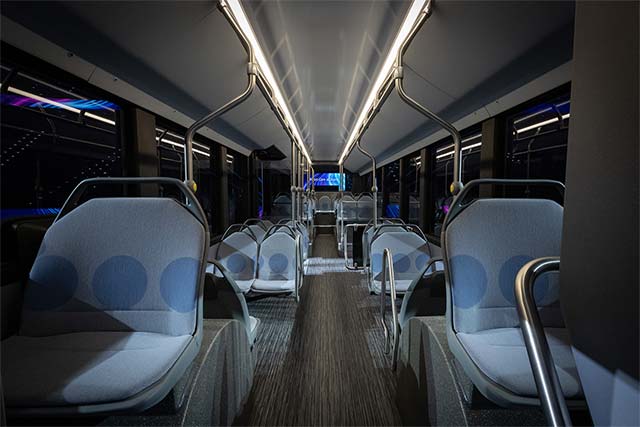
Daimler Buses has unveiled the first near-production prototype of its next-generation Mercedes-Benz eCitaro, introducing an entirely new electric bus platform, LFP battery technology, improved efficiency and a redesigned interior. The new electric city bus is scheduled to enter the European market in 2028, with its official world premiere planned for October 2027 at Busworld Europe in Brussels.
Presented during the Daimler Buses eMobility Days 3.0 in Munich, the new eCitaro represents a major step in the company’s electrification strategy. Unlike the current model, which is based on the conventional diesel-powered Citaro platform, the next generation has been developed from the ground up as a fully electric vehicle.
Daimler Buses will continue developing the vehicle in Mannheim, Germany, with production planned across Germany, France and the Czech Republic. The company aims to offer exclusively electrically powered city buses in its European new-vehicle business from 2030.
An Entirely New Electric Platform for the Mercedes-Benz eCitaro
The biggest change for the next-generation Mercedes-Benz eCitaro is its dedicated battery-electric vehicle architecture. Designed specifically for electric propulsion, the new platform will support vehicle lengths ranging from a 10-meter solo bus to an 18-meter articulated model.
The modular structure will enable seven different configurations, including three low-floor city bus versions measuring 10.63, 12.13 and 18.13 meters. Four additional low-entry versions will measure 10.63, 12.34, 13.08 and 14.68 meters, allowing the platform to serve both urban and intercity transportation needs.
The new architecture also incorporates components from the Mercedes-Benz Trucks portfolio adapted specifically for bus applications.
One of its main advantages is reduced vehicle weight. The articulated version is approximately 750 kilograms lighter than its predecessor, improving efficiency and potentially increasing the amount of energy available for passenger transportation.
Daimler Buses has also redesigned the roof, body shell and underbody. A new sandwich roof structure measures approximately 42 millimeters in height, compared with 70 millimeters previously, reducing weight by up to 100 kilograms in solo buses and 150 kilograms in articulated versions.
LFP Batteries Replace NMC Technology
Battery technology is another major development. The next-generation eCitaro will replace the nickel-manganese-cobalt (NMC) batteries used in the current model with lithium iron phosphate (LFP) cells.
The standardized compact battery packs will each offer approximately 50 kWh of capacity. Depending on vehicle configuration and operating requirements, solo buses can accommodate between six and twelve battery packs, while articulated versions can carry between eight and fourteen.
The batteries will be positioned across the roof and underbody, allowing Daimler Buses to adapt battery capacity to different routes and operating conditions.
Charging flexibility is also a priority. The new electric platform supports up to three charging interfaces: CCS2, pantograph and charging rail. Charging power can reach up to 450 kW, giving operators multiple options depending on their infrastructure and operational requirements.
The transition to LFP chemistry is an important technical change, although Daimler Buses has not yet disclosed the final driving range figures for the new generation.
More Powerful Electric Drivetrain and Improved Efficiency
The next-generation eCitaro will feature two different electric drivetrain configurations tailored to its low-floor and low-entry versions.
The low-floor model will use ZF’s AxTrax 2 LF electric portal axle, featuring wheel-mounted electric motors with a combined system output of up to 360 kW. This represents a substantial increase over the approximately 280 kW peak output of the current axle.
The additional power allows articulated versions to operate with just one driven axle, helping reduce weight and mechanical complexity.
Another important innovation is the new Modular Multi Torque Interface (MMTI). This system controls regenerative braking and torque individually at each wheel in real time. The technology is designed to improve energy efficiency, reduce brake wear and provide better driving stability.
The low-entry version takes a different approach, using a centrally positioned electric motor combined with the Mercedes-Benz RO 440 rear axle. This configuration allows speeds of up to 100 km/h, making it suitable for intercity routes in addition to urban transportation.
New Mercedes-Benz Design Inspired by Iconic Models
The new eCitaro also introduces a distinctive exterior design that draws inspiration from historic Mercedes-Benz vehicles, including the O321 bus and W123 passenger car series.
The front features a redesigned grille element incorporating the Mercedes-Benz star, alongside a distinctive three-stripe lighting signature for daytime running lights, position lights and indicators.
At the rear, patented LED lights featuring six individual lighting cells create a recognizable appearance.
Daimler Buses has also introduced a new design element called the “Abbraccio,” which visually connects the front and rear sections with the central body. Redesigned wheel arches and a more streamlined body structure complete the exterior.
Beyond appearance, the redesigned body incorporates defined crash zones to protect high-voltage components. A front impact protection system provides additional protection, building on technology already used in the current eCitaro.
Redesigned Interior, Climate Control and Driver Technology
The electric architecture creates additional interior space by eliminating the traditional engine tower. This allows the low-floor version to provide a completely level passenger compartment extending all the way to the rear.
Daimler Buses has also developed a new integrated thermal management system called ThexMO (Thermal Exchange Module). Using the natural refrigerant propane (R290), the system combines heating, ventilation and air conditioning while recovering waste heat from the drivetrain and auxiliary components.
The driver’s workplace has been redesigned based on feedback from professional drivers, including evaluations conducted through virtual reality workshops.
The new Multimedia Cockpit Interactive features two large 12-inch displays combining driving information and vehicle operating functions. Adjustable instrument panels and steering wheels are designed to improve ergonomics, while customizable driver and depot profiles provide additional flexibility.
The new electronic architecture also supports over-the-air software updates and the activation of optional vehicle functions after purchase.
Advanced Safety Systems for Urban Transportation
Safety remains another important development area for the next-generation eCitaro.
Daimler Buses will equip the vehicle with a comprehensive package of driver assistance technologies designed to protect passengers, drivers, pedestrians and other road users.
Available systems include:
– Preventive Brake Assist 2: Active braking assistance with pedestrian detection.
– Sideguard Assist 2: Radar-based monitoring to help prevent collisions when turning.
– Frontguard Assist: Monitors the area directly in front of the vehicle when moving off.
– Attention Assist 2: Uses camera technology to identify signs of driver fatigue or distraction.
– Electronic Stability Program: Available for the first time on the articulated version to improve stability in challenging driving conditions.
The MMTI drivetrain control system also contributes to safety by optimizing traction at individual wheels, particularly in demanding road conditions.
Daimler Buses Expands Its European Electric Bus Strategy
The new eCitaro is part of a broader electrification strategy covering city buses, intercity buses and coaches.
Daimler Buses says that two out of three city buses sold in Europe in 2025 were electrically powered, highlighting how quickly battery-electric technology is becoming established in the segment.
The company has delivered more than 4,600 Mercedes-Benz eCitaro buses to customers across Europe since the model’s market introduction in 2018.
At the end of 2025, Daimler Buses also presented the Mercedes-Benz eIntouro, its first battery-electric intercity bus, with a claimed range of up to 500 kilometers. The first customer delivery is scheduled for November 2026.
Battery-electric coaches are planned before the end of the decade, with fuel-cell coaches expected to enter series production in a subsequent phase.
However, Daimler Buses says that the expansion of charging infrastructure remains a major obstacle to electrifying longer-distance bus transportation.
According to the company, industry association ACEA estimates that Europe will need approximately 35,000 charging points for heavy-duty vehicles along its main transport corridors by 2030, together with more than 14,000 additional charging points for buses.
Unlike city buses, which can often recharge at dedicated depots, intercity buses and coaches require reliable public charging infrastructure along their routes and near tourist destinations.
To help address this challenge, Daimler Buses Solutions is developing public charging stations at important transport hubs. Initial projects are already underway in Hamburg, Cologne and Munich.
Daimler Buses Calls for Continued Electric Bus Funding
Alongside the prototype presentation, Daimler Buses used the Munich event to call for stronger political support for Europe’s electric bus transition.
The company supports the European Union’s target requiring 90% of newly sold, registered or put into service city buses to be CO₂-neutral from 2030.
However, it argues that the same timeline is more difficult to achieve for intercity buses and coaches because the necessary public charging infrastructure is not developing quickly enough.
Daimler Buses is calling for the 2030 target for these vehicle categories to be postponed until 2033, linking emissions requirements to the actual availability of charging infrastructure.
The manufacturer also expressed concern about proposed reductions in German electric bus funding from 2027, arguing that continued financial support is necessary to maintain the transition.
At the European level, the company supports the EU’s proposed Industrial Accelerator Act, which aims to strengthen industrial production and demand for low-carbon products manufactured in Europe. However, it warns that additional administrative requirements and inconsistent national regulations could undermine competitiveness.
For European public transportation operators, the new eCitaro could become an important option as cities continue replacing diesel buses with zero-emission alternatives. Its eventual success, however, will depend not only on vehicle technology but also on charging infrastructure, operating costs and the financial support available to transport companies.