


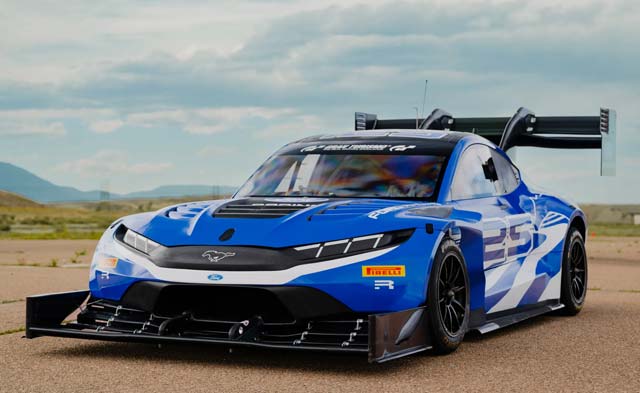
Ford Racing has claimed overall victory at the 104th running of the Pikes Peak International Hill Climb, with Romain Dumas taking the Super Mustang Mach-E EV demonstrator to the summit in 8:18.202.
Driving the No. 125 Ford Super Mustang Mach-E, Dumas secured his sixth “King of the Mountain” title and delivered Ford Racing its second overall victory at America’s Mountain. The result also gave the electric demonstrator victory in the new Unlimited — Production Based class, created for extreme competition vehicles that maintain a clear link to a production model.
The win comes as Ford Racing marks 125 years of competition. Ford entries first appeared at the inaugural Pikes Peak Hill Climb in 1916, and the 2026 victory extends a motorsport connection to the Colorado mountain that now spans 110 years.
1,400 HP Electric Mustang Takes on America’s Mountain
Developed with STARD and supported by Pirelli, the Super Mustang Mach-E is powered by three STARD UHP 6-Phase electric motors producing more than 1,400 horsepower. The all-wheel-drive EV demonstrator uses a 50 kWh battery pack and can deliver up to 710 kW of regenerative braking.
Its challenge was not simply outright power. Pikes Peak’s 12.42-mile route includes 156 turns and climbs 4,725 feet to a 14,115-foot summit. As altitude rises, thinner air reduces aerodynamic performance, while changing temperatures, pavement surfaces and corner speeds place huge demands on the car’s chassis, tires and braking system.
Ford says the Super Mustang Mach-E can generate up to 12,000 pounds of downforce, making aerodynamic balance a critical part of the program. The vehicle also became the highest-downforce car tested in Ford’s rolling road wind tunnel, helping the team develop methods that will support Ford Racing’s upcoming Hypercar program.
“Pikes Peak is unlike any circuit in the world,” said Nick Kuhajda, Program Supervisor for Ford Racing Demonstrators. “It requires complete focus from the technical team and tremendous bravery from the driver.”
Extensive Development After 2025 Attempt
Ford Racing returned to Pikes Peak with the same Super Mustang Mach-E that competed on a weather-shortened course in 2025, but the EV underwent extensive refinement during the following year.
Engineers scanned the car and compared it with its original CAD data, while also measuring its center of gravity, moments of inertia, suspension behavior and aerodynamic loads. The work led to improvements in steering precision, roll stiffness, suspension geometry and friction reduction within the suspension system.
The team also used five-way-adjustable dampers, 7-post and 8-post test rigs, underbody pressure testing, computational fluid dynamics and wind-tunnel validation to improve the car’s performance. Dumas worked with Ford Racing engineers in a driver-in-the-loop simulator, while virtual drivers completed thousands of simulated runs to fine-tune the setup.
“I’m really, really happy about this win,” Dumas said. “We were matching our simulation time or even possibly better, so we squeezed everything out. The car was great.”
Ford Uses Pikes Peak Program to Advance EV Development
While the Super Mustang Mach-E is a purpose-built competition demonstrator, Ford Racing says the lessons learned from the project will feed into future Ford electric and hybrid vehicle development.
The No. 125 entry was chosen to recognize Ford’s 125-year racing history. The company’s motorsport story began in 1901, when Henry Ford entered competition to demonstrate the potential of his engineering. Fifteen years later, Ford vehicles appeared in the first Pikes Peak Hill Climb.
More than a century later, Ford Racing has returned to one of America’s oldest motorsport events with an electric vehicle capable of winning overall.
The 2026 result confirms the Super Mustang Mach-E as one of the most extreme electric hill climb machines ever built, while giving Ford Racing a landmark victory in its 125th year of competition.


