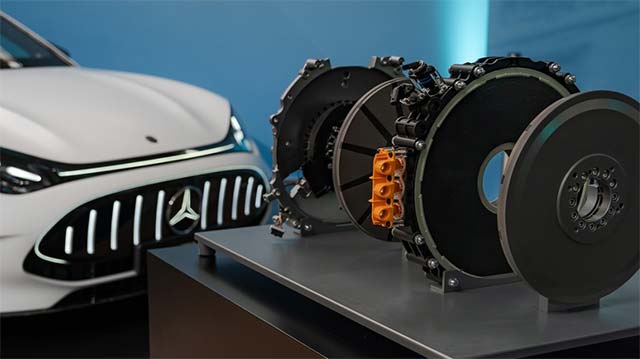
Mercedes-Benz has officially begun large-scale production of its groundbreaking axial flux electric motor at its Berlin-Marienfelde plant, marking a significant milestone in the company’s electrification strategy.
The highly compact, high-performance motor makes its production debut in the all-new Mercedes-AMG GT 4-Door Coupe and signals a new era for one of the automaker’s oldest manufacturing facilities.
Founded in 1902, the Berlin-Marienfelde site has long played a key role in Mercedes-Benz powertrain production. Today, it is evolving into a center of excellence for advanced electric drive systems, supported by the Mercedes-Benz Digital Factory Campus and cutting-edge manufacturing technologies.
A New Chapter for Electric Motor Manufacturing
The industrialization of the axial flux motor represents one of the most ambitious production projects in Mercedes-Benz history. What was once considered too complex for mass production has now become a reality through years of development and innovation.
Production of the motor involves 98 manufacturing steps, including 65 processes being used for the first time within Mercedes-Benz and 35 processes that are entirely new to the automotive industry. The development effort has generated more than 30 patent applications.
Across approximately 30,000 square meters of production space, Mercedes-Benz combines highly automated manufacturing systems with laser technology, intelligent process controls, AI-powered quality assurance, and specialized engineering expertise.
Engineering Precision at an Industrial Scale
The axial flux motor’s compact architecture and exceptional power density demand manufacturing tolerances far beyond those of conventional electric motors.
One example is the production of the stator’s copper coils. Mercedes-Benz uses rectangular copper wire rather than traditional round wire, allowing more copper to fit within the same space and increasing power density. However, forming the wire into tight shapes at high speed without damaging insulation or reducing conductivity required the development of entirely new manufacturing methods.
Another challenge involves connecting the coil packages within the stator. Because of the extremely limited space available, Mercedes-Benz developed a highly precise laser-based process that joins copper conductors while minimizing heat transfer to surrounding components. The result is faster production, improved reliability, and enhanced product quality.
AI and Laser Technology Drive Quality Control
Advanced laser technology plays a major role throughout the production process. One of the most sophisticated applications is laser transmission welding of plastic drivetrain components.
To ensure precision, AI-supported image processing systems identify the exact position of components in real time and create virtual protection zones around sensitive areas. This allows laser energy to be applied only where required, helping produce components that are both oil-tight and capable of handling significant mechanical loads.
Real-time optical inspection systems immediately verify weld quality, supporting consistent production standards and reducing the risk of defects.
The “Wedding” Process: Precision Meets Powerful Magnetism
One of the most demanding stages of production is the final assembly process, internally known as the “wedding.”
During this operation, the stator is positioned between two rotor discs containing powerful magnets. Magnetic forces reaching up to 9 kilonewtons—equivalent to roughly 900 kilograms of force—act on the components during assembly.
Despite these forces, the stator must remain aligned within a tolerance of less than 0.1 millimeters. Mercedes-Benz accomplishes this using advanced sensors and a proprietary control algorithm that continuously adjusts component positioning during the final fractions of a second before assembly is completed.
Why Axial Flux Motors Matter
Unlike conventional radial flux motors, where electromagnetic flux moves perpendicular to the motor shaft, axial flux motors direct magnetic flux parallel to the axis of rotation.
This configuration allows the motor’s major components to be arranged in a disc-shaped layout, delivering significant benefits in terms of packaging, efficiency, torque density, and overall performance.
The technology originated with British electric motor specialist YASA, which developed an innovative axial flux design before becoming a wholly owned subsidiary of Mercedes-Benz in 2021. Since then, Mercedes-Benz has refined both the motor technology and the manufacturing process to meet automotive-scale production requirements.
The resulting motors are remarkably compact. In the new Mercedes-AMG GT 4-Door Coupe, the front-axle motor measures less than nine centimeters in width, while the two rear motors are approximately eight centimeters wide each. These motors are integrated into High Performance Electric Drive Units (HP.EDU), which combine the motor and a compact planetary gearbox within a single housing.
Powering the New AMG Electric Flagship
The performance capabilities of the new axial flux motor are showcased in the upcoming Mercedes-AMG GT 4-Door Coupe.
Equipped with three axial flux motors, the all-electric performance model can sprint from 0 to 100 km/h (62 mph) in as little as 2.1 seconds. With the optional Driver’s Package, top speed reaches 300 km/h (186 mph).
The technology’s durability was also demonstrated by the CONCEPT AMG GT XX development vehicle, which covered more than 40,000 kilometers during a seven-day endurance run at Nardò while setting 25 long-distance records.
Berlin-Marienfelde Becomes a Hub for Future Manufacturing
The start of axial flux motor production highlights the growing importance of the Berlin-Marienfelde facility within Mercedes-Benz’s global manufacturing network.
Since 2022, the site has served as home to the Mercedes-Benz Digital Factory Campus, where new digital production technologies are developed and tested using the company’s MO360 manufacturing ecosystem.
By bringing together electric powertrain production, intelligent automation, AI-driven quality control, and digital manufacturing systems, Berlin-Marienfelde is becoming a key hub for the future of automotive production.
As Mercedes-Benz accelerates its transition toward electrification, the successful mass production of axial flux motors demonstrates how advanced engineering concepts can be transformed into scalable, high-volume manufacturing solutions capable of powering the next generation of performance EVs.