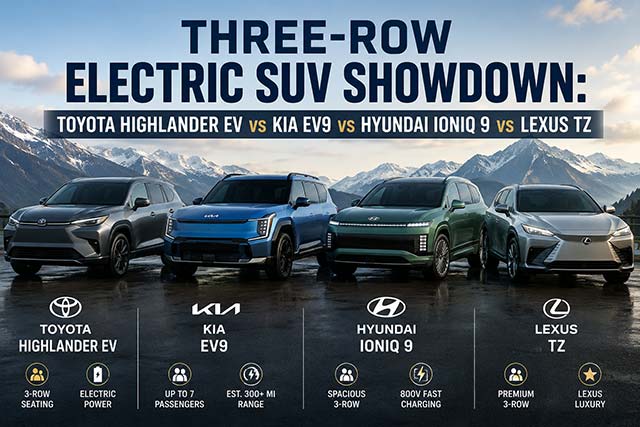
The three-row electric SUV segment has never been more competitive. The Kia EV9 and Hyundai Ioniq 9 set the standard, but the 2027 Toyota Highlander EV is now muscling in with a familiar name and competitive specs. And then there’s the freshly revealed Lexus TZ, a premium three-row luxury EV that takes things to another level entirely. We break all four down so you can figure out which one belongs in your driveway.
For years, if you wanted a three-row electric SUV without spending Tesla Model X money, you had basically one choice. The Kia EV9 was the answer, and it was a good one. Then the Hyundai Ioniq 9 arrived to give it real competition. Now Toyota is throwing the Highlander name into the ring as a proper three-row electric SUV, and Lexus has just pulled the covers off the TZ, its first-ever three-row EV, designed to compete at the premium end of the market.
This segment is growing fast. According to a 2024 AutoPacific study, analysts project three-row EV sales will quadruple from under 100,000 units in 2024 to around 400,000 units by 2029. It’s a segment worth paying attention to.
So here’s the full comparison: size, range, charging speed, performance, interior quality, and price. Let’s dig in.

How Big Are These Three-Row Electric SUVs?
The Hyundai Ioniq 9 is the largest of the four, stretching 199.2 inches overall and sitting on a 123.2-inch wheelbase. That size translates directly into passenger and cargo room: 21.9 cubic feet behind the third row, and 46.7 cubic feet with that row folded.
The Kia EV9 comes in just slightly shorter at 197.2 inches, with a 122-inch wheelbase. It offers 20.2 cubic feet behind the third row. Fold the seats and you get 43.5 cubic feet, which trails both the Ioniq 9 and the Highlander EV when the rows are down.
The 2027 Toyota Highlander EV sits in the middle at 198 inches overall, but it has the shortest wheelbase of the three mainstream rivals at 120.1 inches. That’s a meaningful difference. It also has the smallest cargo area behind the third row at 15.9 cubic feet, though it recovers nicely with 45.6 cubic feet when you fold the seats, per InsideEVs’ detailed size comparison.
Then there’s the Lexus TZ. At 5,100 mm long (200.8 inches), a 3,050 mm (120.1-inch) wheelbase, and 1,990 mm wide, it’s the biggest vehicle on paper. Its cargo capacity with the third row up comes in at roughly 10–14 cubic feet (US terms), expanding significantly with seats folded, per Lexus’ official debut specs. Note that the Lexus TZ comes standard with second-row captain’s chairs, making it a six-seater rather than seven like the others.
One design note worth mentioning: the EV9 has a more upright, boxy SUV silhouette that makes the cabin feel airy and vast. Both the Ioniq 9 and the Highlander EV have sportier, more tapered rooflines toward the rear.
How Far Can Each Three-Row Electric SUV Go on a Charge?
The Hyundai Ioniq 9 leads this group on EPA-rated range. It’s available only with a 110.3 kWh battery, which delivers up to 335 miles in rear-wheel-drive form and 320 miles with the dual-motor AWD setup. In real-world testing by Edmunds, the Ioniq 9 covered an impressive 349 miles, well above its EPA rating.
The Kia EV9 gives you more flexibility with two battery options. The base 76.1 kWh pack delivers around 230 miles, while the larger 99.8 kWh pack pushes that to 305 miles. In Edmunds’ real-world range test, the EV9 covered 306 miles on a charge.
The 2027 Toyota Highlander EV also comes with two battery sizes: a 77 kWh pack and a larger 95.8 kWh unit. Toyota estimates the top configuration will deliver up to 320 miles of range, though Consumer Reports notes that final EPA certification may adjust that figure.
The Lexus TZ shares those same two battery options (76.96 kWh and 95.82 kWh) with the Highlander EV, which makes sense since they share the TNGA platform. Lexus estimates up to 300 miles of range in the US market with the larger pack. Globally, the TZ’s range figures vary: up to 620 km in Japan, 530 km in Europe, and 640 km in China under their respective test cycles, as confirmed in our Lexus TZ debut article.

Charging Speed: Where the Korean Models Still Have an Edge
This is where the Kia EV9 and Hyundai Ioniq 9 have a clear, measurable advantage over the Toyota and Lexus options. Both Korean models use an 800-volt electrical architecture. That allows them to accept higher charging rates at compatible DC fast chargers, which translates directly into less time waiting.
The Ioniq 9 can charge from 10% to 80% in about 20 minutes at a 350 kW charger. The EV9 does the same in around 24 minutes. In Edmunds’ charging test, the Ioniq 9 added an equivalent of 606 miles of range per hour, compared to the EV9’s 543 miles per hour.
The Toyota Highlander EV and the Lexus TZ both use a 400-volt architecture and support a maximum DC fast charging rate of 150 kW. Both take approximately 35 minutes to go from 10% to 80%, per Lexus’ official TZ specs. That’s a meaningful gap on a long road trip, especially with kids in the back.
All four vehicles now come with NACS charging ports as standard, so plugging into Tesla Superchargers isn’t a problem for any of them.
For families doing regular road trips, this 10-to-15-minute difference in charging time adds up over a long journey. If fast charging is a top priority for you, the Korean pair still leads.
Performance and Powertrain: Which Three-Row EV Is Quickest?
The Lexus TZ tops the charts here among the four. It uses a dual-motor AWD setup producing 300 kW (407 HP), with a 0–100 km/h time of 5.4 seconds, as detailed in the Lexus TZ reveal. It also tows up to 3,500 lbs (around 1,587 kg), which is the strongest towing figure in this group.
The Hyundai Ioniq 9 isn’t far behind. Its top trim produces 422 HP with 516 lb-ft of torque, and Autoblog’s testing put its 0–60 mph time at 6.53 seconds in top trim. The Kia EV9’s dual-motor setup delivers 379 HP and 516 lb-ft, clocking 0–60 in 6.58 seconds in the same comparison.
The 2027 Toyota Highlander EV AWD produces 338 HP and 323 lb-ft of torque. That’s less punch than any of the other three in AWD form, but it’s still quick enough for a three-row family SUV. Toyota hasn’t confirmed an official 0–60 time yet.
The Lexus TZ also has optional Dynamic Rear Steering, which turns the rear wheels up to four degrees. That makes a noticeable difference when maneuvering in tight spaces with a vehicle this size.

Interior and Luxury: The Lexus TZ Steps Into a Different League
The Lexus TZ doesn’t just try to match its rivals here. It redefines what a three-row electric SUV interior can feel like.
Lexus calls it the “Driving Lounge” concept, and the name isn’t marketing fluff. The TZ is built on a dedicated EV platform with a completely flat floor, which frees up interior space in a way traditional platforms can’t match. The cabin features second-row power ottomans (a Lexus first for any SUV), a standard 21-speaker audio system, ambient lighting with six Japanese-inspired themes, and in-cabin fragrance. Every row gets heated seats. The second row and front passenger also get ventilated seats, as described in the official Lexus TZ debut.
Lexus has also put real thought into rear-passenger comfort. A dedicated “Rear Comfort” driving mode adjusts the suspension and torque delivery specifically to reduce pitching and swaying for passengers in the back. That’s the kind of detail that matters on a four-hour drive.
Lexus also introduced “Forged Bamboo” as a decorative interior material, sourced from Japan’s Shikoku region and designed to combine traditional craftsmanship with eco-conscious production. It’s a striking choice, and it fits with the brand’s push toward sustainable luxury.
The Hyundai Ioniq 9 also has a premium interior. Its top Calligraphy trim includes alcantara surfaces, soft-touch materials, and a touchscreen that lets you electronically raise or lower all second- and third-row seats. The EV9 takes a bolder, more playful approach, with customizable ambient lighting and a spacious, airy feel thanks to its upright silhouette.
The Toyota Highlander EV sits a step below on the luxury scale. It offers a solid, well-equipped interior with a 14-inch infotainment screen, 64-color ambient lighting, and Vehicle-to-Load (V2L) capability, but it doesn’t try to match the premium feel of the Lexus TZ.
Price and Value: Which Three-Row EV Fits Your Budget?
This is where the four split into two clear groups.
The Kia EV9 starts at $54,900 and tops out at $71,900, making it the most affordable entry point in this comparison. The Hyundai Ioniq 9 starts at $58,955, with top trims reaching around $76,490. Both qualify for the federal EV tax credit (when applicable), per Autoblog’s pricing comparison.
The Toyota Highlander EV hasn’t had pricing officially confirmed yet, but early industry estimates put the starting figure around $58,000, per dealer previews and spec reports. It’s expected to go on sale in late 2026 and will also qualify for the federal credit given its domestic US assembly.
The Lexus TZ is a different story. Industry estimates from CarsDirect and others peg the starting price at around $70,000, with actual pricing not confirmed until closer to its late 2026 launch. That places it above the Korean pair and Toyota, but well below the Volvo EX90 (from around $80,000) or the Cadillac Vistiq (from around $78,000). It occupies a genuine sweet spot in the premium segment.

Quick price and range comparison:
| Model | Starting Price | Top Range | Charging Arch. |
| Kia EV9 | $54,900 | 305 miles | 800V |
| Hyundai Ioniq 9 | $58,955 | 335 miles | 800V |
| Toyota Highlander EV | ~$58,000 est. | 320 miles | 400V |
| Lexus TZ | ~$70,000 est. | 300 miles | 400V |
If you want to learn more about affordable EVs available now, our year-in-review has a solid roundup of the segment’s best value picks.
Conclusion
The three-row electric SUV market has genuinely arrived. Just a couple of years ago, the Kia EV9 was practically alone in this space at a sensible price. Now you’ve got four serious options at very different price points, with real differences in charging architecture, luxury level, and driving feel.
The Kia EV9 remains a brilliant choice for families who want space and tech without paying a premium. The Hyundai Ioniq 9 edges it out on range, space, and refinement, and its 800V charging advantage is real. The Toyota Highlander EV brings a trusted name and genuinely competitive specs, even if it sits behind on charging speed. And the Lexus TZ introduces a whole new level of interior luxury to the segment, with the “Driving Lounge” experience making a genuine case for the premium price.
The right pick depends on your priorities. If fast charging matters most, go Korean. If luxury and refinement are the goal, the Lexus TZ is worth the wait. If Toyota trust and value are what you need, the Highlander EV deserves a serious look. Whatever you choose, the three-row EV segment is better than it’s ever been.
Frequently Asked Questions
Which three-row electric SUV has the longest range?
The Hyundai Ioniq 9 leads with up to 335 miles of EPA-rated range on a single charge, using its standard 110.3 kWh battery. In real-world testing by Edmunds, it covered 349 miles. The Toyota Highlander EV and Lexus TZ are expected to reach up to 320 miles and 300 miles respectively with their larger battery options, while the Kia EV9 tops out at 305 miles with its 99.8 kWh pack.
Is the Lexus TZ related to the Toyota Highlander EV?
Yes, very much so. Both share Toyota’s TNGA-K platform and use the same two battery options: 76.96 kWh and 95.82 kWh. They also share similar powertrain specs and the same 150 kW DC fast charging ceiling. The Lexus TZ is a six-seater with second-row captain’s chairs as standard, offers a significantly more luxurious interior with features like power ottomans and forged bamboo trim, and is expected to carry a higher starting price.
Why do the Ioniq 9 and EV9 charge faster than the Highlander EV and Lexus TZ?
The Kia EV9 and Hyundai Ioniq 9 use an 800-volt electrical architecture, which allows them to accept significantly higher DC fast charging rates. The Ioniq 9 can charge from 10% to 80% in about 20 minutes at a 350 kW charger. The Toyota Highlander EV and Lexus TZ both run on a 400-volt system with a 150 kW maximum DC charging rate, so the same 10% to 80% charge takes approximately 35 minutes. On a long road trip, that 10-to-15-minute gap can add up noticeably.
Does the Lexus TZ have a third row that adults can actually use?
Yes. Lexus specifically designed the TZ with comfort for all three rows in mind. The long 3,050 mm wheelbase and flat EV floor create genuine room throughout the cabin. The third row gets heated seats and sofa-like cushioning. There’s also a walk-in button to help passengers climb into the third row even with child seats installed in the second row. A dedicated “Rear Comfort” mode also softens the ride specifically for rear passengers.
Which three-row EV offers the best value for money?
For pure value, the Kia EV9 is hard to beat. It starts at $54,900, offers up to 305 miles of range, delivers strong performance with its dual-motor setup, and comes packed with tech. The Hyundai Ioniq 9 costs a little more from $58,955 but gets you more range, more interior space, and faster charging. The Toyota Highlander EV is expected to slot in at around $58,000 with competitive specs. The Lexus TZ starts at approximately $70,000 and sits in a different value bracket, but it delivers premium luxury features you won’t find on the other three.