
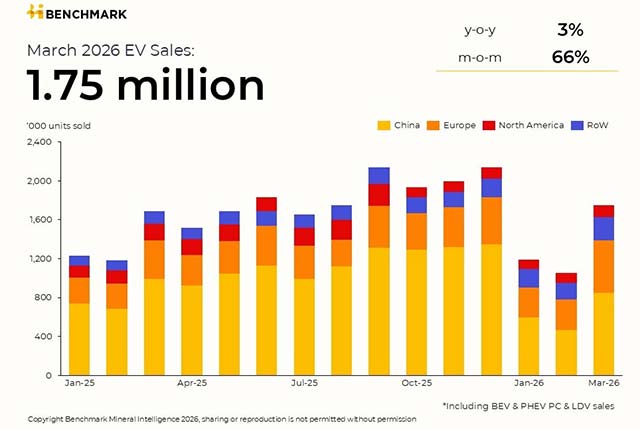
Global electric vehicle sales reached 4.0 million units in the first quarter of 2026, according to Benchmark Mineral Intelligence. While that total marks a 3% decline compared to the same period in 2025, March delivered a strong rebound that highlighted the resilience of the EV market.
A total of 1.75 million EVs were sold globally in March alone, up 66% from February and 3% higher than March 2025. The sharp monthly recovery was driven by seasonal demand in China and record-breaking sales across Europe and parts of Asia.
Europe Emerges as the EV Growth Leader
Europe was the standout performer in Q1 2026, with EV sales reaching 1.2 million units, up 27% year-on-year. March was especially strong, with the region surpassing 500,000 monthly EV sales for the first time.
Sales across Europe rose 72% month-on-month and 37% year-on-year in March, supported by renewed subsidy programs and higher petrol prices. The spike in fuel costs, partly linked to tensions in the Middle East, accelerated consumer demand for battery-electric vehicles (BEVs) and plug-in hybrid vehicles (PHEVs).
Major European markets delivered exceptional results:
– The United Kingdom posted a record March, helped by the annual registration plate change and rising fuel prices, with EV sales up 31% year-on-year.
– France saw EV sales jump 69% year-on-year in March as motorists reacted to fuel supply concerns.
– Italy, Spain, Belgium, Austria, and Finland also recorded strong BEV growth.
Chinese automakers are also gaining ground in Europe. In Italy, Leapmotor accounted for roughly 30% of BEV sales in Q1, while Chinese brands collectively approached a 40% share of the market.
China Rebounds in March but Q1 Remains Weak
China remained the world’s largest EV market in Q1 2026, with 1.9 million units sold. However, sales were down 21% year-on-year as policy changes continued to weigh on domestic demand.
March brought a sharp recovery, with EV sales nearly doubling compared to February after the seasonal slowdown caused by the Lunar New Year holiday.
Despite weaker local demand, Chinese automakers continued to export significant volumes of EVs. But rising overseas inventories suggest that registrations in export markets are not keeping pace with shipments, which could pressure supply chains in the coming months.
North America Faces Slower Momentum
North American EV sales totaled 320,000 units in Q1 2026, down 27% year-on-year. The decline was broad-based, with both the United States and Canada reporting weaker demand.
Still, March showed signs of stabilization. The US market surpassed 100,000 EV sales in a single month for the first time since federal tax credits ended in late 2025.
However, automaker caution continues to shape the market. Honda recently scrapped its planned Honda 0 Series EV lineup, while the Afeela project was also shelved. These decisions reflect growing concerns around profitability, demand pacing, and infrastructure readiness.
Rest of World Delivers Strongest Growth Rate
Markets outside China, Europe, and North America delivered the fastest growth in Q1, with EV sales rising 79% year-on-year to 600,000 units.
New Zealand was the standout performer in March, with BEV registrations soaring 263% compared to the same month last year. That surge pushed the country’s year-to-date EV growth above 100%.
Australia also posted strong gains, with BEV sales rising 89% year-on-year in March. Although growth was slightly slower than in the first two months of the year, March still set a new all-time monthly EV registration record.
Higher fuel prices have played an important role in Oceania’s EV growth, as supply concerns and pump price increases continue to influence buyer behavior.
Global EV Market Outlook for 2026
March’s rebound confirms that global EV demand remains fundamentally strong, but regional differences are becoming more pronounced.
Europe is currently driving momentum thanks to supportive policies and economic conditions. China remains a volume leader but faces domestic headwinds, while North America continues to adjust to a post-incentive environment.
As 2026 progresses, EV sales growth will likely depend on how governments manage incentives, how quickly charging infrastructure expands, and whether automakers can align production with shifting consumer demand.
[source: Benchmark Mineral Intelligence]


