


Mercedes-Benz EQS is entering its next chapter with major upgrades that push the flagship electric sedan further ahead in range, charging, software and comfort.
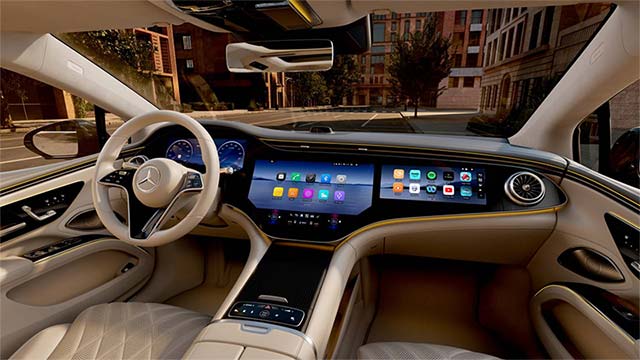
First launched in 2021, the EQS helped redefine Mercedes-Benz’s EV ambitions with standout aerodynamics and the debut of the MBUX Hyperscreen. For 2026, the automaker says more than a quarter of the vehicle’s components are newly developed, updated or refined, making this the most advanced EQS yet.
At the heart of the update is a next-generation electric platform featuring 800-volt architecture, newly developed in-house drive units, a two-speed rear transmission and larger batteries with improved cell chemistry. The result is significantly better efficiency, quicker charging and stronger real-world usability.
Up to 926 km WLTP Range
The headline figure is a WLTP range of up to 926 km (575 miles) for the EQS 450+, a 13% increase over the outgoing model.
That puts the EQS among the longest-range production EVs on sale today and makes long-distance driving far easier with fewer charging stops. Mercedes-Benz says the available energy is enough for trips such as Munich to Paris or Zurich to Hamburg without needing to plug in.
The updated battery pack in the EQS 450+, EQS 500 4MATIC and EQS 580 4MATIC now offers 122 kWh usable capacity, up from 118 kWh, thanks to improved silicon oxide-blended anodes that boost energy density without increasing pack size.
A new entry-level EQS 400 also joins the lineup, offering 270 kW of power and a 112 kWh battery for buyers seeking a lower starting price.
800V Charging Adds 320 km in 10 Minutes
The switch to 800-volt technology is one of the biggest improvements in the new EQS.
DC fast charging peaks at up to 350 kW, allowing up to 320 km (199 miles) of WLTP range to be added in just 10 minutes. At 400V charging stations, the battery can virtually split into two halves, enabling efficient charging at up to 175 kW.
That setup helps reduce total travel time while preserving comfort on long highway journeys.
Regenerative braking has also been improved, with recuperation power now reaching up to 385 kW — roughly a one-third increase over the previous model. That allows stronger energy recovery and smoother one-pedal-style driving in everyday use.
Mercedes-Benz Brings Steer-by-Wire to Series Production
One of the most notable innovations is steer-by-wire, which will become available shortly after launch.
Mercedes-Benz says it will be the first German automaker to offer this technology in a production car. By replacing the mechanical link between the steering wheel and front wheels with electronic controls, the system promises quicker response, easier low-speed maneuvering and reduced vibrations over rough roads.
The flatter steering wheel also improves cabin access and visibility of the driver display.
For safety, the system uses a redundant architecture with backup signal paths, while rear-axle steering and targeted braking support lateral control in unlikely failure scenarios.
Smarter Ride and Driver Assistance
Ride comfort gets a boost from an upgraded AIRMATIC suspension system with cloud-based damper control.
Using Car-to-X data shared by other Mercedes-Benz vehicles, the EQS can detect speed bumps ahead and adjust damping before reaching them. The result should be a smoother ride, especially for rear passengers.
The latest MB.DRIVE suite also improves driver assistance with:
– up to 27 sensors, including cameras, radar and ultrasonic sensors,
– faster parking assist that can now park at up to 5 km/h,
– diagonal parking support,
– improved lane-change and evasive steering functions.
MB.OS and MBUX Make the EQS More Intelligent
The new EQS is the first full expression of Mercedes-Benz’s new MB.OS operating system.
Connected to the Mercedes-Benz Intelligent Cloud, the system controls virtually every function in the car and supports over-the-air updates to keep features fresh over time.
The standard MBUX Hyperscreen remains a centerpiece, spanning more than 55 inches across three displays beneath one glass surface.
Mercedes-Benz has also upgraded the MBUX Virtual Assistant with AI features that support more natural, multi-step conversations and more personalized interactions.
Google Maps-based navigation with Electric Intelligence now plans routes more intelligently by factoring in traffic, terrain, charging availability and battery preconditioning.
Luxury Cabin Gets New Comfort Features
Inside, the EQS continues to focus on premium comfort, now with added refinement.
New front seatbelt heating can warm the belts to up to 44°C in cold weather for faster comfort and potentially better safety by encouraging passengers to remove bulky jackets.
Rear-seat passengers benefit from:
– dual 13.1-inch displays,
– updated MBUX remote controls,
– HD camera support for video calls,
– improved entertainment and office functions.
A HEPA filter system removes up to 99.65% of incoming particles, while new anthracite open-pore poplar trim and fresh upholstery details enhance the cabin’s upscale feel.
Aerodynamics and Energy Flexibility Still Stand Out
The EQS remains one of the world’s slipperiest production cars, with a drag coefficient as low as 0.20.
That ultra-low drag helps maximize efficiency while reducing wind noise.
Another standout feature is vehicle-to-home and vehicle-to-grid capability, allowing the EQS battery to supply energy back to a home or public grid when supported.
A More Competitive Flagship EV
The updated EQS is more than a facelift. It addresses key EV priorities — range, charging speed, software and efficiency — while adding genuinely useful luxury features.
For buyers seeking a premium electric sedan that can comfortably handle long distances without compromise, the new EQS strengthens its case as one of the most complete luxury EVs on the market.


