


Ford Pro has introduced the new Transit City, a fully electric commercial van designed specifically for inner-city delivery and service operations. Combining compact dimensions with a cost-focused approach, the model expands the iconic Ford Transit lineup into a more urban-friendly segment.
Set to launch later this year, the Transit City will be available as a panel van in two sizes—L1H1 and L2H2—as well as a chassis cab variant for specialized conversions.
Built for Urban Efficiency and Practicality
The Transit City is engineered to meet the evolving demands of city logistics, where emissions regulations, operating costs, and maneuverability are critical factors.
The larger L2H2 variant delivers:
– Over 3 meters of load length
– Payload capacity of up to 1,275 kg
– Cargo volume of approximately 8 m³
Meanwhile, the more compact L1H1 version offers:
– Around 6 m³ of cargo space
– Payload of up to 1,085 kg
– Excellent maneuverability for tight urban environments
Both configurations can accommodate three Euro pallets, ensuring practical usability despite the van’s compact footprint.
Electric Powertrain Optimized for Daily Use
At the heart of the Transit City is a 110 kW (150 hp) electric motor, paired with a 56 kWh lithium iron phosphate (LFP) battery. This setup delivers a range of up to 254 kilometers, comfortably exceeding the daily driving needs of most commercial operators.
Charging capabilities include:
– DC fast charging (up to 87 kW): 10–80% in ~33 minutes
– Quick top-up: Up to 65 km range in just 10 minutes
– AC charging (11 kW): 10–80% in ~4.5 hours
The inclusion of one-pedal driving enhances efficiency in stop-and-go traffic by maximizing regenerative braking.
Flexible Configurations for Every Business Need
Ford Pro offers the Transit City in three body styles:
– L1H1 Panel Van: Ideal for dense urban areas
– L2H2 Panel Van: Increased cargo capacity and payload
– Chassis Cab (Single Cab): Designed for custom conversions
The chassis cab variant benefits from standardized mounting points and electrical interfaces, making it compatible with a wide range of upfits. Through the Ford Pro converter network, businesses can access over 200 certified bodybuilders for tailored solutions.
Smart Features and Driver-Focused Design
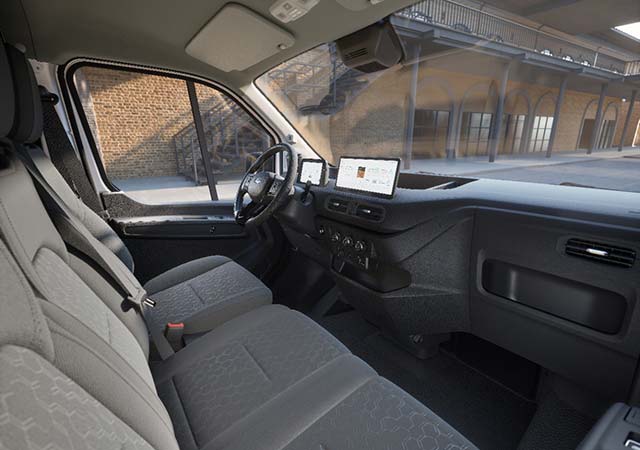
Courier and delivery drivers get in and out of their vans up to 200 times a day. The new Transit City is designed for this and for stop-and-go city traffic – for example, with standard heated seats, which have proven more effective than the cabin heater in cold temperatures, and with a keyless start system.
Also standard are automatic emergency braking, front and rear parking sensors, a reversing camera, adaptive cruise control, and lane keeping assist. The infotainment system features a 12-inch touchscreen. Smartphones can be wirelessly connected via Apple CarPlay and Android Auto
Lower Costs and Strong Fleet Support
Ford Pro has implemented an extensive testing and trial program to ensure the long-term durability and reliability of the new Transit City. This program simulated a ten-year service life and over 240,000 kilometers of driving under the most demanding conditions. Particular attention was paid to areas subject to the most wear and tear in urban delivery operations – from the doors to the driver’s seat. In addition, a comprehensive warranty is offered: for example, the warranty for high-voltage components extends over eight years or 160,000 kilometers.
Commercial customers benefit from lower energy costs thanks to the electric drive, thus reducing operating and maintenance expenses. Furthermore, Ford Pro anticipates that maintenance costs for the Transit City will be reduced by 40 percent compared to a similar diesel-powered van. This is also reflected in the extended service intervals, which have been extended to two years or 40,000 kilometers to minimize unproductive downtime.
Across Europe, 800 Transit Centers specifically geared towards commercial vehicle customers are available. In addition, approximately 500 Ford Pro Service mobile workshop vehicles are available to perform maintenance directly at the customer’s location when the Transit is already out of service.


