
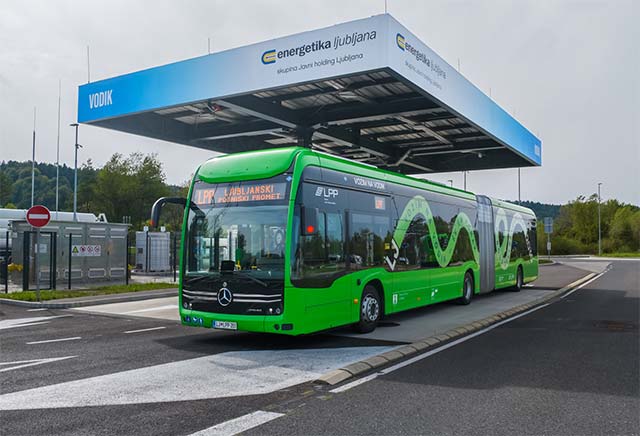
Slovenia’s capital, Ljubljana, has added 35 locally CO₂-free Mercedes-Benz buses to its public transport network, combining battery-electric and hydrogen fuel cell technology in its largest fleet modernization project to date.
The municipal transport operator, Ljubljanski Potniški Promet (LPP), introduced 25 Mercedes-Benz eCitaro battery-electric buses and 10 Mercedes-Benz eCitaro G fuel cell buses over the course of one year. The new vehicles are designed to improve the efficiency and reliability of urban public transport while helping reduce emissions and noise pollution.
Rather than relying exclusively on one alternative powertrain, Ljubljana is taking a technology-neutral approach that uses both electric and hydrogen buses to meet different operating requirements.
The 25 battery-electric Mercedes-Benz eCitaro buses are suited to city routes with predictable schedules and regular opportunities for recharging. Their deployment allows LPP to operate daily services without producing tailpipe emissions.
The 10 Mercedes-Benz eCitaro G fuel cell buses complement the battery-electric fleet by providing additional operational flexibility on routes with greater range requirements. These articulated buses use hydrogen fuel cell technology to generate electricity, helping extend their operating capabilities without relying solely on conventional battery charging.
Combining the two technologies allows LPP to match vehicles to the demands of individual routes while maintaining service reliability and vehicle availability.
According to LPP CEO Dr. Rok Vihar, the new fleet establishes a foundation for reliable, future-ready public transport by bringing battery-electric and hydrogen technology together.
The project represents the largest fleet modernization in the history of Ljubljana’s municipal transport operator.
Ljubljana’s transition to locally CO₂-free public transport involves more than replacing diesel buses with alternative powertrains. LPP has also established the necessary charging and hydrogen infrastructure and adapted its operational processes to support the new vehicles.
This integrated approach is essential because different powertrain technologies require different refueling, charging, maintenance and fleet-management arrangements.
Battery-electric buses can be particularly effective where charging can be incorporated into daily schedules, while hydrogen fuel cell buses offer another option for services that require greater operational flexibility.
By investing in vehicles, infrastructure and staff expertise together, Ljubljana is building a transport system that can accommodate different technologies as operational requirements evolve.
The project also supports the city’s participation in the European initiative 100 Climate-Neutral and Smart Cities, which helps cities advance their transition toward climate neutrality.
Rasto Oderlap, CEO of Autocommerce, Mercedes-Benz’s general distributor for buses in Slovenia, highlighted the importance of integrating vehicle technology with infrastructure and operational expertise to make cleaner public transport practical and efficient.
In addition to reducing local emissions, the new Mercedes-Benz buses are designed to improve conditions for both passengers and drivers.
Their quiet drivetrains and lower vibration levels can make journeys more comfortable while helping reduce noise in busy urban areas. Modern safety and driver-assistance systems also support everyday operation in city traffic.
The buses additionally provide a high level of accessibility, an important consideration for making public transport more convenient for passengers with different mobility needs.
Although the primary objective is to reduce the environmental impact of urban transport, improvements in comfort, safety and accessibility can also help make public transportation a more attractive alternative to private cars.


