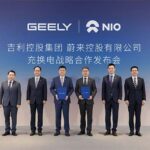
NIO and Geely Holding Group are expanding their partnership with a major strategic agreement covering electric vehicle charging, battery swapping, technology, operations, and investment.
The agreement will see the two Chinese automakers invest in each other’s energy businesses, share charging and battery-swapping technologies and standards, and connect their respective infrastructure networks. The goal is to create a more open and widely accessible recharging ecosystem for EV drivers in China.
The partnership could also accelerate the adoption of battery swapping beyond NIO vehicles by allowing Geely to develop consumer EVs compatible with NIO’s battery-swapping network.
Geely to Take 30% Stake in NIO Power
Under the agreement, Geely Holding will invest in NIO Power through a combination of its 100% ownership of Yiyi Power and RMB 640 million ($90 million) in cash.
Once the transaction is completed, Geely Holding will own a 30% stake in NIO Power.
Yiyi Power’s battery-swapping business for commercial mobility services will be integrated into NIO Power. NIO says it will continue developing its battery-swapping network for commercial fleets while supporting the expansion of Yiyi Power’s mobility operations.
The companies will also work together to establish unified battery-swapping technologies and standards for consumer vehicles.
Geely will develop passenger vehicles capable of using battery swapping, while NIO Power will provide the associated swapping services.
That arrangement could give Geely access to one of China’s largest existing battery-swapping networks while giving NIO the opportunity to expand its technology and infrastructure across a broader range of vehicles.
NIO Takes Stake in Geely’s Haohan Energy
The cooperation extends beyond battery swapping.
NIO will invest in Haohan Energy, a Geely Holding subsidiary focused on smart charging. After completion of the transaction, NIO will hold a 10% stake in the company.
The two companies plan to connect their charging infrastructure and expand network coverage. Sharing infrastructure is expected to improve utilization and operational efficiency while giving EV drivers access to a larger charging network.
The move reflects a broader shift in China’s EV industry toward interconnected charging infrastructure rather than competing networks operating independently.
NIO’s Battery-Swapping Network Continues to Expand
NIO has invested more than RMB 20 billion in charging and battery-swapping technology and infrastructure.
As of September 27, 2026, NIO’s network included 9,433 charging and battery-swapping stations across China. That total consisted of 4,126 Power Swap Stations and 5,307 charging stations equipped with 30,598 charging piles.
The company says its infrastructure has delivered more than 220 million charging and battery-swapping services, including more than 125 million battery swaps and over 99 million charging sessions.
NIO is targeting 10,000 Power Swap Stations by 2030. The company expects annual electricity demand across the network to eventually exceed 10 billion kWh.
The latest partnership with Geely could help NIO reach that target while increasing the number of vehicles and drivers able to use the network.
Geely Is Also Building a Large Charging Network
Geely has been developing its own charging and battery-swapping ecosystem.
On September 23, 2026, the company introduced its next-generation AI-powered charging technology, designed to improve charging speed and safety through artificial intelligence.
Haohan Energy currently operates 2,500 charging stations with more than 12,000 charging connectors across 232 Chinese cities.
Geely plans to expand that network substantially. By the end of 2027, the company expects to have more than 22,000 charging stations and over 100,000 charging connectors.
More than 15,000 of those stations are expected to be smart charging stations equipped with more than 50,000 smart charging connectors. Geely also aims to achieve charging coverage across county-level cities throughout China.
In battery swapping, Geely’s Yiyi Power is developing applications ranging from green mobility hubs to automated battery swapping for robotaxis and integrated transportation-energy systems.
A More Connected EV Charging Ecosystem
The NIO-Geely agreement comes as China’s EV industry looks for ways to reduce duplicated investment and make charging infrastructure more useful across different vehicle brands.
NIO founder, chairman and CEO William Li described the partnership as an effort to move beyond competition between individual companies and toward greater cooperation in technology, standards, operations, assets and capital.
Geely Holding Group CEO Andy An Conghui similarly emphasized the importance of interconnected charging infrastructure, arguing that recharging networks can serve a broader role as shared infrastructure.
For EV drivers, the most significant potential benefit is greater access to charging and battery-swapping services without being restricted to a single automaker’s ecosystem.
If the companies successfully establish common standards and connect their networks, the partnership could become an important step toward a more interoperable EV infrastructure system in China.
More automakers joining such networks could further expand the potential benefits, particularly for battery swapping, where infrastructure compatibility has traditionally been closely tied to individual vehicle manufacturers.