Volkswagen is bringing its iconic California camper van into the electric era with the new ID. California Cruise, an all-electric camper based on the Volkswagen ID. Buzz Pro.
Unveiled at Caravan Salon 2026 in Düsseldorf, the ID. California Cruise is the first member of a new all-electric California family. It combines the retro-inspired design and electric powertrain of the ID. Buzz with dedicated camping equipment designed for two people.
Prices for the short-wheelbase version start at €60,761 in Germany, while the long-wheelbase model will cost more. Volkswagen Commercial Vehicles plans to begin deliveries in early 2027, with additional electric California models expected to follow from 2028.
The California name has been associated with Volkswagen camper vans since 1988, when the company introduced the original VW California based on the Volkswagen Bus.
Now, the California brand is moving to an electric platform.
The ID. California Cruise is based on the rear-wheel-drive ID. Buzz Pro and will be offered with both short- and long-wheelbase configurations. The short-wheelbase model uses a 79 kWh battery, while the long-wheelbase version gets an 86 kWh battery.
Both versions use a 210 kW (286 hp) rear-mounted electric motor.
Volkswagen has not yet announced official WLTP range figures for the California Cruise.
For reference, the corresponding ID. Buzz Pro versions achieve up to 460 km (286 miles) or 498 km (309 miles) of WLTP range, depending on battery size.
The added weight and camping equipment are likely to affect the final range of the California Cruise.
A Camper Van Designed for Two
Unlike the regular ID. Buzz, the ID. California Cruise has been developed specifically for overnight trips.
The main sleeping area uses a newly developed folding mattress measuring 2.03 meters (6.7 feet) long and 1.20 meters (3.9 feet) wide. The nine-centimeter-thick mattress sits above the rear seats and folds into a dedicated storage area near the tailgate when it isn’t being used.
The camping equipment also includes:
– Two folding camping chairs
– A dedicated camping table
– Ventilation grilles for the front side windows
– Blackout covers for the windows
– A blackout cover for the panoramic glass roof when equipped
– Dedicated storage compartments for the camping equipment
The chairs and table can be stored inside the vehicle, helping keep the cabin usable during normal driving.
The camping equipment is included as standard rather than being treated simply as an accessory package. The ID. California Cruise also includes the Interior Style Package, Comfort Package and PowerSocket discharge adapter as standard.
The ID. California Cruise Can Power Camping Equipment
One of the biggest advantages of an electric camper is the large battery that can serve as more than just a source of propulsion.
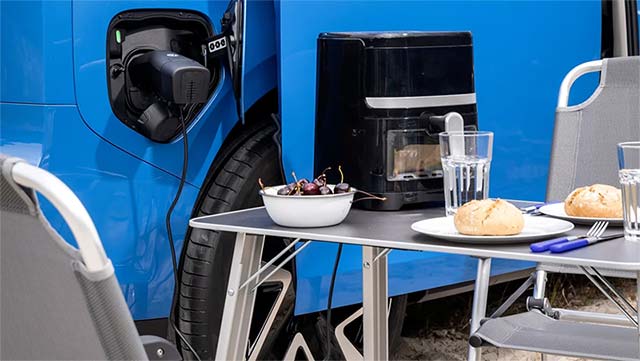
The ID. California Cruise features vehicle-to-load (V2L) capability, allowing the battery to supply electricity to external equipment.
Volkswagen says the system can provide 2 kW of continuous power and up to 3.6 kW of peak power.
That means campers can potentially use appliances such as coffee makers, kettles, coolboxes and air fryers without needing access to an external electrical hookup.
For an electric camper van, this could prove more useful than simply having a large battery for driving range.
New California Mode Can Run for Up to 48 Hours
Volkswagen has also developed a dedicated California Mode for the new electric camper.
The system is designed to make overnight camping more comfortable by allowing occupants to continue using key vehicle functions while parked.
Depending on the remaining battery charge and conditions, California Mode can keep the cabin’s heating or air conditioning operating, while also maintaining interior lighting and USB power for up to 48 hours.
That could be particularly useful during longer camping trips when the vehicle is parked away from traditional campsites.
The actual operating time will depend on factors such as battery charge, outside temperature and the temperature difference between the interior and exterior.
Charging and Electric Powertrain
The ID. California Cruise uses the same basic electric architecture as other ID. Buzz models, with the electric motor mounted at the rear.
The short-wheelbase version gets a 79 kWh battery, while the long-wheelbase model uses an 86 kWh battery.
Volkswagen has not yet published the final charging and range specifications specifically for the California Cruise. The ID. Buzz platform supports fast DC charging, with peak charging capability dependent on the battery and configuration.
The larger battery in the long-wheelbase model should provide additional range, although the extra size and weight of the camper equipment could reduce efficiency compared with a standard ID. Buzz.
How Much Does the Volkswagen ID. California Cruise Cost?
The Volkswagen ID. California Cruise starts at €60,761 in Germany for the short-wheelbase version.
Volkswagen has not yet announced pricing for the long-wheelbase model or confirmed UK pricing.
The first deliveries are scheduled for early 2027, while Volkswagen Commercial Vehicles says more electric California models will follow from 2028.
The new model effectively gives Volkswagen an electric successor to its long-running California camper vans while retaining the practical features that made the name popular in the first place.
Electric Camper Vans Are Getting More Practical
The ID. California Cruise is more than an ID. Buzz fitted with a mattress. Its V2L capability, dedicated camping equipment and California Mode show how an electric powertrain can add functionality to the traditional camper van formula.
The ability to use the vehicle’s battery to power appliances and maintain cabin heating or cooling for extended periods could make electric camping considerably more practical.
With a starting price of more than €60,000 and deliveries still several months away, the ID. California Cruise won’t be an inexpensive way to go camping. However, it represents an important step for Volkswagen as the company expands its iconic California range into the EV era.