


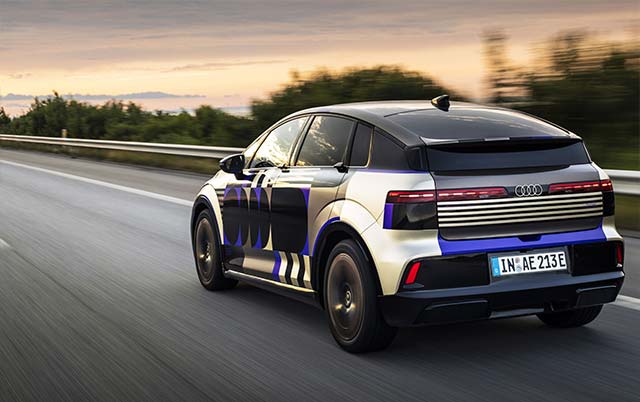
The upcoming Audi A2 e-tron is set to establish a new benchmark for efficiency within the German automaker’s electric vehicle lineup. According to preliminary WLTP figures, the compact electric hatchback consumes just 12.8 kWh per 100 kilometers (4.85 mi/kWh) in its 140 kW (190 PS) version equipped with the optional Efficiency Package, making it the most energy-efficient production Audi ever developed.
Audi says the impressive result is achieved through a combination of advanced aerodynamics, an optimized electric drivetrain, intelligent battery management, and software designed to maximize efficiency in everyday driving.
Inspired by the Original Audi A2
The new A2 e-tron revives the philosophy of the original Audi A2, which became known for its lightweight construction and exceptional fuel economy.
“The Audi A2 has been a constant in my career ever since I joined the Volkswagen Group in the 1990s,” said Gernot Döllner, CEO of AUDI AG. “Its groundbreaking three-litre version made efficiency its hallmark. That vision continues with the new A2 e-tron by combining outstanding efficiency with everyday practicality and the features customers expect from modern electric mobility.”
Record-Low Energy Consumption
The headline figure of 12.8 kWh/100 km places the A2 e-tron among the most energy-efficient electric vehicles expected to reach the market.
Key highlights include:
– 12.8 kWh/100 km (WLTP, preliminary) energy consumption with the Efficiency Package
– 0.24 drag coefficient, the lowest of any Audi compact model
– 61 kWh lithium iron phosphate (LFP) battery
– 89.6% wallbox charging efficiency
– Vehicle-to-Load (V2L) and Vehicle-to-Home (V2H) bidirectional charging capability
Aerodynamics Play a Major Role
One of the biggest contributors to the A2 e-tron’s efficiency is its aerodynamic design.
With a drag coefficient of just 0.24, the compact EV offers the lowest aerodynamic resistance in Audi’s compact range. Since aerodynamic drag accounts for more than half of an EV’s energy consumption at highway speeds, reducing air resistance has a significant impact on range.
The streamlined body features a rounded nose, flowing roofline, and sharply tapered rear section. Additional efficiency-focused details include:
– Air curtains that smooth airflow around the front wheels
– Gap reducers and wheel arch airflow management
– An active cooling air intake that remains closed during normal driving to reduce drag and only opens when extra battery or drivetrain cooling is required
According to Audi, these aerodynamic improvements alone reduce energy consumption by up to 0.9 kWh/100 km compared with an otherwise identical model.
New Electric Drive Improves Efficiency by Up to 10%
The A2 e-tron’s permanently excited synchronous motor has also been redesigned with efficiency as the primary objective.
Several engineering upgrades contribute to an overall improvement of up to 10 percent.
Silicon carbide semiconductors replace conventional silicon components in the power electronics, reducing switching losses and improving efficiency during partial-load operation.
Inside the motor, thinner laminations reduce iron losses, while a revised stator winding configuration allows the motor to operate more efficiently across common driving conditions.
Audi also developed a new low-friction transmission lubricant and paired it with a tall 10.2:1 gear ratio, helping reduce motor speed and energy consumption during highway cruising.
LFP Battery Designed for Everyday Use
Power comes from a 61 kWh lithium iron phosphate (LFP) battery built using a cell-to-pack architecture, allowing the battery cells to be integrated directly into the battery housing for improved packaging efficiency.
Audi chose LFP chemistry because it offers several advantages for daily driving:
– Longer service life
– Excellent thermal stability
– No rare-earth materials
– Safe routine charging to 100 percent
The battery’s naturally flat voltage curve also helps maintain consistent performance even as the state of charge decreases.
Rather than relying solely on hardware, Audi says software plays a major role in maximizing battery efficiency. Intelligent control algorithms continuously monitor battery health and charging conditions, while an optimized cooling strategy helps achieve an impressive 89.6% charging efficiency when connected to a wallbox.
Bidirectional Charging Adds Extra Practicality
Beyond powering the vehicle, the Audi A2 e-tron can also serve as an energy source.
The model supports Vehicle-to-Load (V2L), allowing users to power external electrical devices directly from the battery. It also offers Vehicle-to-Home (V2H) functionality, enabling the vehicle to operate as a residential energy storage system when paired with a compatible Audi-approved charging solution.
These capabilities further expand the A2 e-tron’s usefulness beyond transportation, giving owners greater flexibility in managing energy at home or on the go.
A New Benchmark for Efficient EVs
With industry-leading energy consumption, advanced aerodynamics, an optimized electric drivetrain, and a durable LFP battery, the Audi A2 e-tron demonstrates that maximizing efficiency requires more than simply increasing battery capacity.
Instead, Audi has focused on refining every aspect of the vehicle—from airflow and drivetrain engineering to battery chemistry and software—to create what is currently its most efficient electric vehicle. As competition intensifies in the compact EV segment, the A2 e-tron could become one of the most efficient electric cars available when it reaches production.


