
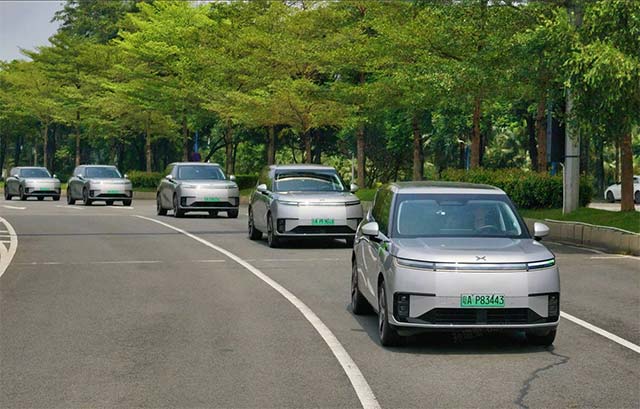
XPeng has secured approval to conduct Level 4 (L4) autonomous Robotaxi demonstration operations across Guangzhou, China, marking a significant milestone in the electric vehicle manufacturer’s push to commercialize its artificial intelligence and autonomous driving technologies.
The approval allows XPeng to move beyond technology testing and begin validating its Robotaxi service in real-world operating conditions. The company plans to use Guangzhou, its research, development, and mass-production hub, as the first city for its Robotaxi commercialization efforts.
The development represents another step in XPeng’s strategy to expand beyond electric vehicle manufacturing and turn its in-house AI capabilities into new products and services.
Operating a Robotaxi service involves more than demonstrating that a vehicle can drive autonomously. It also requires reliable order processing, vehicle dispatch, passenger pickup, fleet management, and the ability to handle unexpected situations.
XPeng’s newly approved demonstration operations will allow the company to test these elements under real-world conditions while improving service efficiency and operational reliability.
During the initial phase, access to XPeng Robotaxi will gradually expand through an invitation-code system. The company says it will prioritize safety as it increases the service’s availability and geographic coverage.
The experience gained in Guangzhou is expected to help XPeng refine its operational processes and establish a foundation for broader deployment.
XPeng Chairman and CEO He Xiaopeng has previously outlined a strategy that positions the company primarily as a technology provider and ecosystem partner, rather than an operator of large-scale Robotaxi fleets.
Under this approach, XPeng intends to supply integrated solutions to mobility companies and other partners worldwide. These solutions would combine its vehicle platforms, autonomous driving software, and AI technologies.
Potential revenue streams include vehicle and hardware sales, technology services, and commission-sharing arrangements with mobility partners.
In October, XPeng also announced XPENG YOYO as the brand name for its Robotaxi business and opened autonomous driving registration to the public in China.
The company is also holding advanced discussions with several major European mobility platforms. Experience from the Guangzhou demonstration program could help support future international partnerships and localized deployments, although the timing and scope of any overseas launches have not been confirmed.
XPeng’s Robotaxi program builds on technologies developed for its existing smart electric vehicles, extending the company’s in-house AI capabilities into Level 4 autonomous driving.
According to XPeng, the Robotaxi system is equipped with four self-developed Turing AI chips that together deliver 3,000 trillion operations per second (TOPS) of computing power. The system also uses the company’s VLA 2.0 model.
By reusing its existing AI models and technology stack, XPeng aims to reduce the need for extensive customization when adapting its Robotaxi platform to different road environments.
This approach could help the company scale its technology more efficiently as it explores new operating conditions and potential international markets.
However, computing power alone does not establish autonomous driving capability. Real-world performance, safety validation, regulatory requirements, and reliable operation across different traffic conditions will remain essential to the success of the program.
Guangzhou’s approval marks a transition from development and road testing toward supervised, real-world demonstration operations. It also gives XPeng an opportunity to evaluate how its vehicles, software, and AI systems work together as part of a mobility service.
The company’s longer-term ambition is to turn its self-developed Physical AI technologies into commercially viable products and services, creating potential growth opportunities beyond conventional electric vehicle sales.
For XPeng, the success of its Robotaxi program will depend not only on autonomous driving performance but also on its ability to establish efficient operations, develop partnerships, and build a sustainable business model.
With Guangzhou serving as its first commercialization base, XPeng is taking another step toward bringing its L4 Robotaxi technology into real-world use. The experience gained there could prove important as the company works toward broader deployment in China and potential expansion into overseas markets.


