


Peugeot is looking to bring back the spirit of its iconic RCZ coupe with the Peugeot RCZ Vision, a futuristic electric sports car concept that combines French design, advanced battery technology and a renewed focus on driving pleasure.
Positioned as a successor to the original Peugeot RCZ, produced between 2009 and 2015, the RCZ Vision previews the brand’s vision for high-performance electric mobility. It introduces Peugeot’s new “Feline Future” design language while showcasing technologies intended to shape the company’s next generation of vehicles.
The concept’s headline specifications include 500 horsepower, up to 600 km (373 miles) of range and a targeted energy consumption of 11.5 kWh/100 km. It also features a solid-state battery developed with Factorial Energy and a 1,000-volt electrical architecture designed to deliver exceptionally fast charging.
Peugeot has not presented the RCZ Vision as a conventional production-car launch. Instead, it serves as a design and technology manifesto, offering a glimpse of what future Peugeot models could look like.
Peugeot RCZ Vision Revives an Iconic Coupe
The original Peugeot RCZ became one of the French automaker’s most distinctive modern models thanks to its sculpted bodywork, low roofline and characteristic double-bubble roof design. Although production ended in 2015, the coupe has since developed a following among enthusiasts and collectors.
The RCZ Vision revisits that heritage with a more futuristic interpretation. Its proportions combine a low, wide stance with muscular bodywork, a compact-looking glass cabin and flowing surfaces intended to improve aerodynamic efficiency.
The concept also introduces Peugeot’s “Feline Future” design philosophy, built around five principles: freedom, courage, elegance, inner force and instinct. Together, these ideas aim to create a car that looks powerful without appearing unnecessarily aggressive.
At the front, ultra-slim lighting elements reinterpret Peugeot’s signature three-claw light design. An illuminated emblem, a distinctive RCZ graphic and intricately detailed air intakes give the concept a dramatic appearance.
The rear continues the same minimalist approach, with integrated three-claw lighting and an active spoiler that remains hidden when the car is stationary and deploys while driving to improve aerodynamic performance.
Peugeot has also retained the original RCZ’s distinctive double-bubble styling, reinterpreting it with slimmer, seemingly floating roof arches. The glass-bubble concept extends across much of the vehicle, creating a light and futuristic silhouette.
500 HP and Up to 373 Miles of Electric Range
Beyond its styling, the Peugeot RCZ Vision showcases an ambitious electric powertrain concept.
Peugeot targets 500 horsepower and a driving range of up to 600 km, equivalent to approximately 373 miles. The company also cites energy consumption of 11.5 kWh/100 km on the WLTP combined cycle, although the figure is marked as subject to confirmation.
If achieved in practice, that combination would make the RCZ Vision an especially efficient proposition for a high-performance electric sports coupe. Its final range and consumption would, however, depend on the production specification, driving conditions and other factors.
The concept is based on an architecture derived from Stellantis’ STLA One platform concept, designed to accommodate next-generation technologies and different battery solutions.
A key highlight is the solid-state battery developed in collaboration with Factorial Energy. Solid-state batteries are attracting interest across the automotive industry because their potential advantages include higher energy density, reduced packaging requirements and improved charging performance.
In the RCZ Vision, the battery is paired with a 1,000-volt electrical architecture. Peugeot targets a charging time of just 10 minutes to increase the battery’s state of charge from 10% to 80%.
These figures describe the concept’s intended capabilities rather than verified performance from a production vehicle. Nevertheless, they illustrate Peugeot’s ambition to combine sports-car performance with more efficient energy use and shorter charging stops.
Hypersquare Steering and Brake-by-Wire Technology
The RCZ Vision is also a showcase for Peugeot’s next-generation driving technology, particularly its Hypersquare steering control and electronic vehicle-control systems.
Hypersquare replaces the conventional round steering wheel with a distinctive rectangular control featuring four circular openings. The layout places key functions within easy reach, allowing the driver to keep their hands on the steering control.
Combined with steer-by-wire technology, Hypersquare eliminates the traditional mechanical connection between the steering control and the front wheels. Instead, electronic systems manage steering inputs and adjust the steering ratio according to vehicle speed.
At low speeds, the system is designed to make parking and tight manoeuvres easier by reducing the amount of steering input required. At higher speeds, the steering response is adjusted to provide greater stability and smoother control.
The concept also introduces brake-by-wire technology, replacing the conventional hydraulic connection between the brake pedal and braking system with electronic control. Peugeot says this approach can improve braking precision and integrate regenerative braking more effectively, helping recover energy during deceleration.
The RCZ Vision additionally previews Level 2++ automated-driving capabilities, including a hands-free function available on demand in city and highway environments. The precise operating conditions and availability of these features have not been detailed for a production vehicle.
Importantly, Peugeot says the production version of Hypersquare will also feature in the next-generation Peugeot E-208, indicating that at least part of the technology is intended to extend beyond the concept itself.
A More Minimalist Peugeot i-Cockpit
Inside, the Peugeot RCZ Vision takes a different approach to the increasingly screen-heavy interiors found in many modern electric cars.
The concept previews a new generation of Peugeot i-Cockpit technology, combining transparent Micro LED displays with a driver-focused dashboard. Rather than adding more screens, Peugeot aims to make information clearer, more personal and less distracting.
A transparent display positioned above Hypersquare presents essential driving information within the driver’s field of vision. A separate floating central screen provides access to navigation, infotainment and vehicle settings.
The central display can also be switched off when it is not needed. Its transparent structure allows it to fade visually into the dashboard, creating a cleaner cabin while leaving essential information available to the driver.
Physical controls remain part of the experience. The floating centre console incorporates machined-aluminium controls for functions such as climate settings and driving modes, mounted on a frosted-glass surface.
Peugeot’s approach reflects a broader effort to balance digital functionality with intuitive operation. Rather than relying entirely on touchscreens, the RCZ Vision combines digital displays with tactile controls and a layout designed around the driver.
Four Seats and a Grand Touring Interior
Although the RCZ Vision has the proportions of a sports coupe, its interior is designed to deliver a more comfortable grand touring experience.
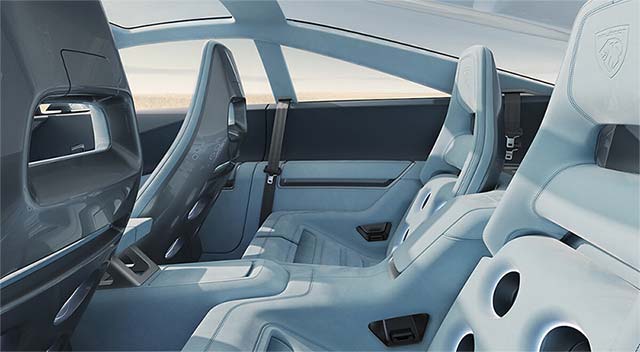
The concept features four seats, with space for two adults in the rear. Folding rear seatbacks provide additional luggage capacity when required.
The front seats combine pronounced support with a lightweight design, while open sections in the seatbacks help reduce material use. The dashboard is sculpted around the components it houses, and even the air vents can retract into the dashboard when they are not needed.
Materials are another important part of the concept. Peugeot combines Alcantara with recycled leather and other carefully selected finishes to create a cabin that feels sophisticated without losing its sense of warmth.
One notable innovation is PELINOVA leather, made from recycled offcuts from the leather-goods industry. The material uses untanned animal leather that would otherwise typically go unused, offering an alternative use for an existing by-product.
The cabin also includes a clock developed with French watchmaker SERICA. Integrated into the centre display support, it combines traditional watchmaking influences with a contemporary digital presentation.
Together, these details show how Peugeot intends to combine technology, craftsmanship and material reuse in its future interiors.
Lightweight Construction and Aerodynamic Efficiency
Efficiency is central to the RCZ Vision’s design, extending beyond the battery and electric drivetrain.
The concept uses an ultra-thin battery measuring just 110 mm in thickness, helping Peugeot create a low-profile body. Its sculpted surfaces, aerodynamic proportions and lightweight components are intended to support the targeted energy consumption figure.
The 21-inch front and 22-inch rear forged-aluminium wheels also follow the same philosophy. Their radiating-spoke design references Peugeot’s heritage while minimising material use.
Peugeot has also reinterpreted the original RCZ’s aluminium roof arches using a paint made from recycled aluminium, reflecting an effort to combine distinctive styling with more sustainable material choices.
These elements demonstrate how aerodynamics, packaging and weight reduction can contribute to electric-vehicle efficiency without abandoning the proportions and visual drama expected of a sports coupe.
What the Peugeot RCZ Vision Means for Future Electric Cars
The Peugeot RCZ Vision brings together several technologies that could influence the brand’s future vehicles, including solid-state battery development, high-voltage charging systems, steer-by-wire controls and a more configurable digital cockpit.
Its significance extends beyond the possibility of a new RCZ. The concept illustrates Peugeot’s ambition to differentiate its electric cars through design and driving experience rather than relying on range and performance figures alone.
The planned use of Hypersquare in the next-generation E-208 provides a more concrete indication of how some of these ideas could reach production. Other technologies, including the solid-state battery and the RCZ Vision’s full electric-performance package, remain part of the concept’s forward-looking vision.
For now, the RCZ Vision should be viewed as a preview of Peugeot’s design and engineering direction, not a confirmed production model with final specifications or a launch date.
If its key targets eventually translate into a road-going vehicle, the RCZ Vision could offer an intriguing combination of sports-coupe styling, long-distance electric capability and next-generation driving technology.
For fans of the original RCZ, it also raises an exciting possibility: a return of Peugeot’s distinctive coupe identity in an era increasingly defined by electric performance.


