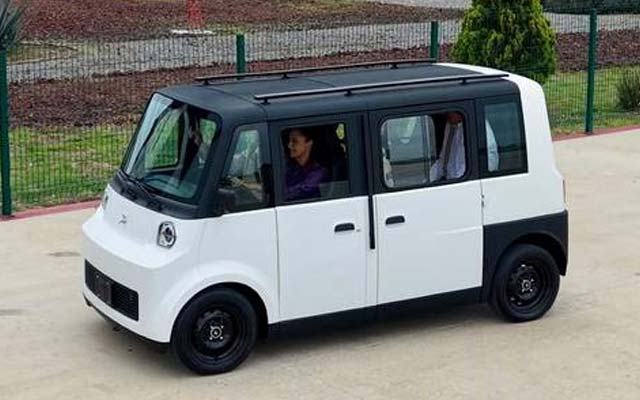
Mexico has officially unveiled Olinia, the country’s first domestically developed electric vehicle, marking a significant milestone in its efforts to build a national EV industry.
Presented by President Claudia Sheinbaum on June 7, 2026, the compact electric vehicle is scheduled to enter production and reach customers in 2027 with a starting price of approximately MX$150,000 (US$8,600).
More than just a new vehicle, Olinia represents Mexico’s ambition to move beyond its traditional role as a global automotive manufacturing hub and become a developer of its own automotive technologies.
“ Olinia represents much more than an electric automobile,” President Sheinbaum said during the presentation. “It represents the seed of a new innovation ecosystem built from Mexico and the beginning of a national industry that can grow from the ground up.”
A New Chapter for Mexico’s Automotive Industry
For decades, Mexico has been one of the world’s largest vehicle manufacturing centers, producing millions of vehicles annually for export markets. However, unlike China, which developed extensive domestic intellectual property, battery expertise, and EV supply chains, Mexico’s automotive growth has largely focused on assembly operations for international automakers.
The Olinia project aims to change that dynamic by creating a vehicle designed, engineered, and developed within Mexico.
The initiative was coordinated by the Ministry of Science, Humanities, Technology, and Innovation (SECIHTI) and involved collaboration between the National Technological Institute of Mexico (TecNM), the National Polytechnic Institute (IPN), and several public research centers. More than 80 researchers participated in an intensive 18-month development program, supported by a new engineering center established in Puebla.
The state of Puebla is expected to play a key role in the project’s future, serving as a hub for automotive innovation, electromobility research, artificial intelligence, and clean energy technologies.
Olinia generará ahorros de 50 mil pesos al año tan solo en combustible, puede transportar a 6 personas de manera segura y tiene espacio suficiente para trasladar a una persona en silla de ruedas.
Tiene 125 kilómetros de autonomía por carga y su operación costará 5 veces menos… pic.twitter.com/JziASVHVHj
— Gobierno de México (@GobiernoMX) June 7, 2026
Designed for Affordable Urban Mobility
The first production model, known as Olinia Uno, is aimed at consumers seeking an affordable and practical electric vehicle for daily transportation.
Designed for both urban and rural environments, the compact six-seat EV prioritizes simplicity, low operating costs, and ease of ownership. The vehicle is also designed to accommodate a wheelchair, expanding accessibility for a broader range of users.
Power comes from a 14.7-kWh lithium iron phosphate (LFP) battery pack paired with a 13.5-kW electric motor. Olinia is expected to deliver up to 100 kilometers (62 miles) of driving range on a single charge and reach a top speed of 50 km/h (31 mph), making it best suited for city use.
While the range and performance figures are modest compared with modern long-range electric vehicles, the vehicle is targeted at short daily trips where affordability and efficiency are more important than highway capability.
Charging is designed to be straightforward. The EV uses a conventional three-phase plug compatible with standard household outlets. Charging times are estimated at approximately four hours using a 220-volt connection and around eight hours on a standard 110-volt outlet, making overnight charging a practical option.
Inside, Olinia features a minimalist cabin equipped with a 7-inch infotainment display, Bluetooth 5.0 connectivity, and a two-speaker audio system.
Can Olinia Spark a Domestic EV Ecosystem?
Industry observers see Olinia as more than an affordable city car. The project serves as a test of whether Mexico can develop higher-value automotive technologies and strengthen domestic supply chains in the rapidly growing EV sector.
Experts note that long-term competitiveness in electromobility depends not only on vehicle assembly but also on technological capabilities, supplier networks, battery expertise, and control of key industrial inputs.
By focusing on local engineering talent, public research institutions, and domestic innovation, Mexico hopes Olinia can become the foundation for a broader national EV ecosystem.
With a launch price below US$9,000, Olinia Uno is expected to target market segments often overlooked by global automakers. If successful, it could provide affordable electric mobility for thousands of consumers while helping establish Mexico as more than just an automotive production center.
Commercial sales are scheduled to begin in June 2027, with customer deliveries expected shortly thereafter.