

Two of Germany’s biggest luxury brands launched all-electric versions of their most popular SUVs just two days apart. That’s not a coincidence. The BMW iX3 vs Mercedes GLC Electric rivalry is as deliberate as it gets, and buyers in the premium electric SUV market have never had a harder choice to make.
The BMW iX3 went on to claim the 2026 World Car of the Year and World Electric Vehicle titles, beating 57 rivals judged by 98 journalists across 33 countries. The Mercedes GLC Electric answered back with its biggest-ever in-car screen, an 800V charging system, and a cabin that feels like a five-star hotel lobby on wheels.
Both are built on brand-new, EV-only platforms. Both charge on 800V architecture. Both start around £60,000 in the UK. And both are pitching at exactly the same buyer: someone who wants a long-range premium SUV that doesn’t feel like a compromise.
So which one actually wins? Let’s go through it section by section.
Which Car Has More Range?
The BMW iX3 is the clear range leader. The iX3 50 xDrive offers up to 500 miles on the WLTP cycle, thanks to its 108.7 kWh usable battery. The Mercedes GLC 400 4MATIC delivers up to 406 miles from a 94 kWh pack. In real-world testing on mixed roads in warm conditions, Electrifying.com recorded around 413 miles for the iX3 and about 360 miles for the GLC, with both cars achieving a nearly identical efficiency of around 3.7 to 3.9 miles per kWh.
The iX3’s bigger battery is a major part of the story. BMW switched to cylindrical cells with 20% higher energy density than the previous generation. That lets the iX3 carry more energy without a disproportionate weight penalty. The GLC uses a 94 kWh NMC pack, which is still a serious battery, but it simply can’t match the BMW’s capacity.
If you’re buying the entry-level model, the picture shifts slightly. The BMW iX3 40 delivers up to 395 miles of WLTP range from an 82.6 kWh usable battery, which still edges the GLC’s top figure. There’s no rear-wheel-drive entry-level GLC available at launch; Mercedes is leading initially with the all-wheel-drive GLC 400 4MATIC only.
For long-distance drivers and those who want fewer charging stops on road trips, the iX3 is the stronger choice.
How Fast Do They Charge?
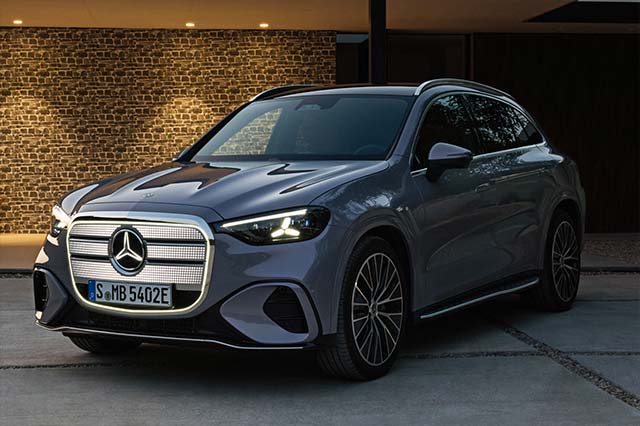
Both cars use 800V architecture, so they can both charge much faster than most EVs on sale today. The BMW iX3 peaks at 400 kW DC charging, while the Mercedes GLC tops out at 330 kW. At a compatible 400 kW charger, the iX3 can add up to 372 km of range in just 10 minutes. The GLC adds roughly 303 km in the same time. Both cars complete a 10-80% charge in approximately 21 minutes.
Here’s the practical reality, though. Most rapid chargers in the UK currently top out at 350 kW. At that speed, the iX3 and GLC perform almost identically, since neither car can exceed what the charger offers. The BMW’s 400 kW capability will matter more as infrastructure catches up over the next few years.
For AC charging at home, both cars come standard with 11 kW. The iX3 50 xDrive offers an optional 22 kW AC upgrade, and the GLC does too. The iX3 also supports bidirectional charging (V2L), letting you power devices or even your home from the car’s battery. Mercedes also equips the GLC with bidirectional charging technology as standard.
The GLC adds a smart touch with its integrated reservation system for public charging stations through MB.CHARGE Public. It’s a small but genuinely useful feature for planning long journeys.
Charging winner: BMW iX3, with a higher peak rate and V2L as standard. But in everyday use on current UK infrastructure, the gap is smaller than the specs suggest.
Performance and Driving Feel
This is where the two cars show their personalities most clearly.
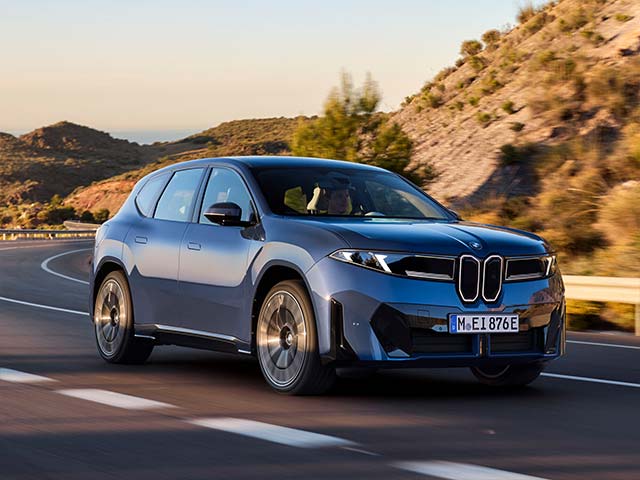
The GLC 400 4MATIC is the quicker car on paper. Its dual-motor setup produces 489 hp combined and gets to 62 mph in 4.3 seconds. The iX3 50 xDrive produces 463 hp (345 kW) and 645 Nm of torque, reaching 100 km/h in 4.9 seconds. Real-world testers from BMWBlog clocked 4.59 seconds on a drag timer, slightly quicker than BMW’s official claim.
The bigger difference is in how each car feels to drive. The iX3 is the sportier, firmer option. BMW’s new “Heart of Joy” central control unit reacts up to ten times faster than earlier systems, binding together the drivetrain, braking, and energy management. The result is a car that feels sharp, responsive, and distinctly BMW. Some road testers note that the suspension can feel firm over rougher surfaces and that some tyre noise enters the cabin at motorway speeds.
The GLC is softer and more refined. It prioritises comfort and smoothness. The Carwow twin test noted that the GLC is the better bet if ride comfort is your priority, while the iX3 is the firmer, sportier choice. Both cars feature available air suspension, but the GLC’s setup feels more naturally at home in luxury mode.
Both cars also introduce impressive new software brains. The iX3 runs BMW Operating System X, powered by four high-performance processing units delivering over 20 times the computing power of previous BMW systems. The GLC runs MB.OS, Mercedes’ AI-driven superbrain capable of 254 trillion operations per second.
Which Car Has the Better Interior and Tech?
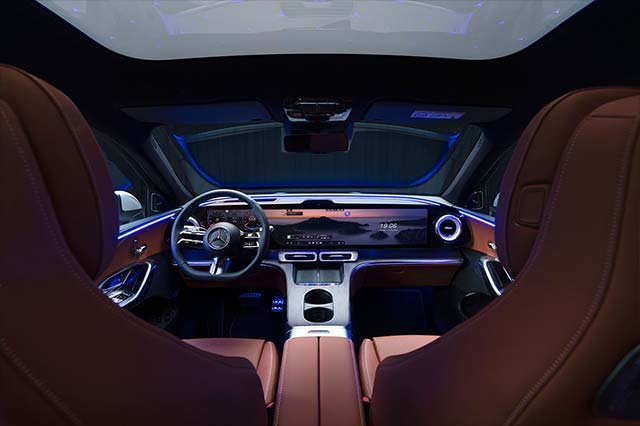
The Mercedes GLC wins on interior drama. It features the 99.3 cm MBUX HYPERSCREEN, the largest display ever fitted to a Mercedes-Benz. The screen sweeps across the entire dashboard and combines infotainment, passenger display, and driver information in one seamless panel. It’s genuinely stunning to look at, and the active ambient lighting that illuminates 162 “stars” in the optional SKY CONTROL panoramic roof adds to the showroom wow factor.
The iX3’s Panoramic iDrive system takes a different approach. It’s a full-width display too, but the design is more restrained and driver-focused. BMW built it around one principle: hands on the wheel, eyes on the road. Fewer distractions, cleaner layout. Most testers find it easier to use day-to-day, even if it doesn’t have the GLC’s visual drama.
Both cars offer AI-powered voice assistants. The iX3 integrates Amazon Alexa+, built on large language model technology for natural, conversational interaction. The GLC’s MB.OS system learns driver preferences over time and adapts to changing conditions in real time.
Mercedes also deserves credit for its optional Vegan Package, which it says makes the GLC the first car in the world with an interior certified by The Vegan Society. That’s a meaningful detail for some buyers.
If you want a cabin that makes an impression every time someone climbs in: GLC. If you want a tech-forward interior that’s genuinely easy to live with: iX3.

Space, Practicality and Towing
The GLC is the more practical choice for families, and it’s not particularly close.
Mercedes built the electric GLC on a longer wheelbase than the combustion GLC: 84 mm more. Rear passengers gain 47 mm of extra legroom and 17 mm more headroom. The boot holds 570 litres, expanding to a generous 1,740 litres with the rear seats folded. There’s also a 128-litre frunk (front trunk) that opens via a touch control. That’s a lot of usable space.
The GLC tows up to 2,400 kg braked, which puts it ahead of most electric SUVs in this class. The iX3 manages 2,000 kg, which is still respectable but noticeably lower. If you need to pull a caravan or a large trailer, the GLC has the edge.
The iX3 is no slouch on space. BMW’s new EV-only platform freed up significant room compared to the previous X3-based iX3, and the cabin feels wide and airy. But it doesn’t quite match the GLC’s rear seat generosity or its boot volume.
For buyers with families, dogs, bikes, or towing needs, the GLC is the more sensible choice.
Pricing: Which Is Better Value?
In the UK, the BMW iX3 40 starts from £53,250, making it the more accessible entry point. The iX3 50 xDrive starts at a higher price point in line with its dual-motor spec. The Mercedes GLC starts from £60,350 in the UK across five trim levels: Sport, AMG Line, AMG Line Premium, AMG Line Premium Plus, and Premier Edition.
In Germany, the GLC opens at €71,281. In the US, the iX3 50 xDrive starts at $61,500 plus destination. Both cars can climb well past £70,000 (or $80,000) once you add common-sense options like the panoramic roof, premium audio, and driving assistance packages.
At their respective starting prices, the iX3 delivers more range and faster charging for less money. The GLC delivers more standard luxury equipment and a more dramatic interior for a broadly similar price at the top of its range.
There’s no universally right answer here. If you’re prioritising EV technology and long-range efficiency, the iX3 offers better value. If you’re prioritising the overall luxury SUV experience, the GLC justifies its price with a more complete, family-friendly package.
You can also compare the iX3 against other rivals in our BMW iX3 vs Volvo EX60 comparison to see how a third strong contender stacks up
Verdict: Which One Should You Buy?
The BMW iX3 is the better electric car. It has more range, faster charging, sharper driving dynamics, and cleaner tech. It won the 2026 World Car of the Year for good reason. If you want the most advanced EV in the premium SUV class right now, the iX3 is the one to get.
The Mercedes GLC Electric is the better all-round family SUV. It’s more spacious, more comfortable, more dramatic inside, and it tows more. If you’re coming from a traditional luxury SUV and want the transition to electric to feel seamless and familiar, the GLC won’t disappoint.
Neither car is a wrong choice. They’re two of the best electric SUVs ever made. Your lifestyle decides the winner.
If you want to dig deeper into the iX3’s specs, check out our full coverage of the BMW iX3 40 entry-level model and the iX3 50 xDrive US pricing and specs. For the GLC, see our full breakdown of the all-new Mercedes GLC with EQ Technology.


