Hyundai Motor Company has unveiled at CES 2020 its innovative vision for urban mobility to help vitalize human-centered future cities.
To realize the vision, Hyundai Motor showcased three mobility solutions, comprising Urban Air Mobility (UAM), Purpose Built Vehicle (PBV) and Hub, a place for mobility transfer and community activities. Based on these mobility solutions, Hyundai aims to free future cities and people from constraints of time and space and allow them to create more value in their lives.
The company will also accelerate the implementation of its brand vision ‘Progress for Humanity’ and transform itself into a ‘Smart Mobility Solution Provider’.
Working closely together, UAM, PBV and Hub play key roles in vitalizing human-centered future cities and enriching people’s lives.
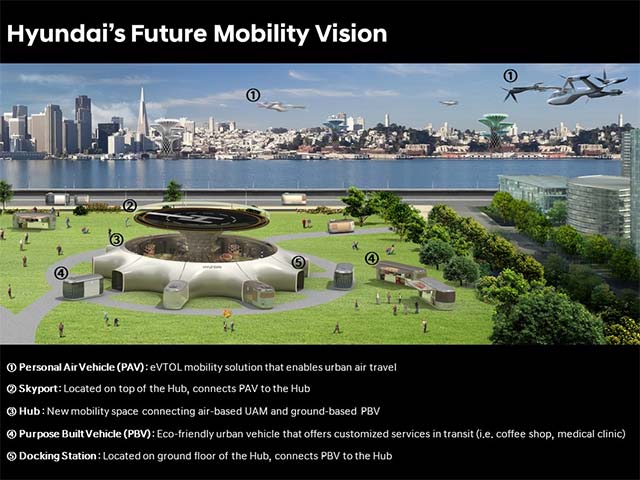
UAM connects the sky and the ground, while PBV links people to people on the road. These two smart mobility solutions connect at the Hub, which will be installed across future cities to form a mobility ecosystem.
With this smart mobility vision built around the UAM-PBV-Hub network, Hyundai has outlined its commitment to provide customers seamless mobility and a differentiated mobility experience.
The vision is also in line with the company’s mid-term innovation plan ‘Strategy 2025’ to shift to its business structures based on two pillars – ‘Smart Mobility Device’ and ‘Smart Mobility Service’.
‘Human-Centered City Advisory Group’ and a study on creating new values for future cities
Hyundai’s future mobility vision stems from the idea that mobility is closely related to city infrastructure.
The company established the Human-Centered City Advisory Group with top global experts from fields such as psychology, architecture, urban design, transportation, and political science, and conducted research on how future cities should be designed to foster new human-centered values.
The advisory group derived three key values for future cities: vitalize, enable, and care. Considering Hyundai’s strength in mobility and connecting people, the advisory group decided to place priority on the ‘vitalization’ of cities.
In addition to the advisory group, Hyundai also envisioned different city archetypes and developed future city scenarios to predict the infrastructure and development direction that will be required for future cities.
The company focused on human-centered mobility solutions to address traffic congestion challenges in major cities.
UAM, innovative mobility solution offering liberation from grid-lock
The first solution that Hyundai is offering to vitalize future cities is Urban Air Mobility, an innovative mobility solution that offers ‘liberation from grid-lock’ and ‘democratization of flight’.
Mega-urbanization taking place around the world has resulted in dramatic reduction of transfer efficiency for urban residents and increased social costs related to logistics transportation.
UAM enables runway-free urban air travel with Personal Air Vehicles capable of electric vertical takeoff and landing (eVTOL).
UAM is considered a key future innovation business that can help overcome urban challenges like traffic congestion and transform the paradigm of mobility.
Hyundai also announced four pillars of UAM: safe, quiet, affordable, and passenger-centered.
For safety, the PAV has multiple rotors to provide multi-layer redundancy and ensure safe operation, and a parachute deployment system will be placed in the vehicle for emergencies.
PAVs will be designed with low noise levels, making them more acceptable for urban travel and offering comfort to passengers.
UAM will be made affordable and accessible through utilization of Hyundai’s manufacturing know-how in automobiles, aerodynamic design, use of light-weight from carbon composite materials, productive design technology, and reduced operating costs.
Lastly, Hyundai’s UAM will be passenger-centered by designing the interior with Internet of Things (IoT) features while ensuring comfort and safety of passengers.
World premiere of ‘S-A1’, concept PAV developed jointly with Uber
Hyundai unveiled its first concept Personal Air Vehicle, named ‘S-A1’. The concept PAV is equipped with eVTOL and designed to seat five people, including a pilot.
The PAV will be operated initially by a pilot during the early stages of commercialization and enable autonomous operation once the relevant technologies are developed.
Hyundai has the manufacturing capacity and expertise required to develop and mass-produce transportation vehicles such as the PAV.
The ‘S-A1’ concept PAV was developed jointly with Uber, the world’s largest mobility company.
Hyundai plans to strengthen its partnerships with global companies like Uber and accelerate its UAM business, including developing world-class PAVs, offering fleet service and maintenance, and developing skyports.
PBV, the ultimate mobility solution for all lifestyles
Hyundai’s second mobility solution for a dynamic human-centered future is the Purpose Built Vehicle.
The PBV is a new urban mobility solution that can accommodate a wide spectrum of future lifestyles with limitless personalization.
It allows passengers to enjoy tailored services while traveling to their destinations, offering a whole new take on the concept of mobility beyond a means of transportation.
Upon personalization, PBVs can function as a restaurant, coffee shop, and hotel, or even a clinic and pharmacy, in addition to being an urban shuttle.
Hyundai’s concept PBV embodies three key messages: city icon, living space on wheels, and clustered mobility.
The PBV is inspired by San Francisco’s iconic cable car: “The design comes alive and makes us feel connected to the way we get around through a progressive reinterpretation of its DNA and incorporation of the urban scenery,” said SangYup Lee, Senior Vice President and Head of Hyundai Global Design.
The PBV is highly customizable with complete disassembly of upper- and under- bodies and adjustable size from 4 to 6 meters.
Its interior can be personalized to individual needs by assembling modular parts, taking the PBV beyond transportation into the realm of living space.
The fully-electric PBV is also an environmentally-friendly mobility solution.
Its artificial intelligence (AI) feature allows the PBV to navigate along the best routes and charge in-transit with the help of the charger PBVs.
The PBV can also travel autonomously in platoon, which is expected to bring innovative changes to personal deliveries, as well support the wider logistics industry within future cities.
Hub, a perfectly new mobility space connecting UAM and PBV
The third mobility solution presented by Hyundai is the Hub, an innovative new community space that connects air-based UAM and ground-based PBV.
The Hub has a skyport for the PAV on the top and docking stations on the ground for the PBV to approach and depart from multiple directions.
The Hub can be transformed into an infinite number of new spaces depending on how PBVs are connected.
For instance, the Hub can be turned into a cultural complex by bringing together PBVs functioning as concert halls, movie theaters, and museums.
It can also be transformed into a medical complex by connecting medical service PBVs in the form of clinics, doctor’s offices and pharmacies.
Hyundai plans to make smart mobility more accessible by placing Hubs throughout future cities and build a new mobility ecosystem around the UAM-PBV-Hub network.
The company will overcome mobility limitations of time and space and create new spaces where people can gather and interact to help build and vitalize human-centered future cities.