
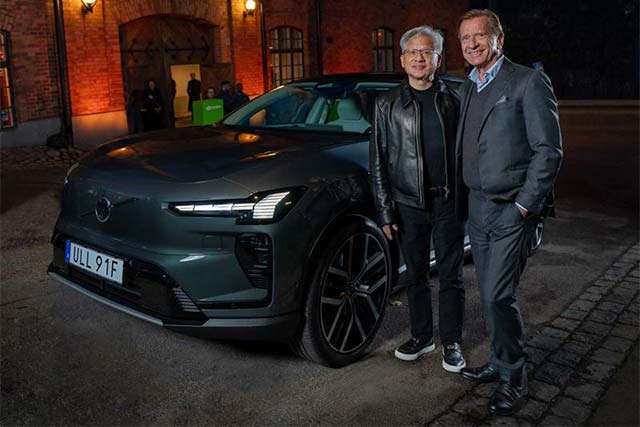
Volvo Cars is expanding its long-standing partnership with NVIDIA to develop a new generation of safer, more intelligent vehicles, with advanced AI technology expected to debut in a next-generation Volvo model.
The expanded collaboration builds on nearly a decade of cooperation between the two companies and forms part of Volvo’s largest-ever product launch initiative. The goal is to combine Volvo’s extensive vehicle safety expertise with NVIDIA’s artificial intelligence (AI) and accelerated computing technologies to advance automated driving.
The technology is expected to support a gradual introduction of more advanced driving capabilities, including eyes-off and, eventually, mind-off driving, as the companies work toward making future journeys safer and more convenient.
Volvo Cars plans to integrate NVIDIA’s advanced computing platforms and driving software with its own vehicle safety systems, engineering expertise, and human-centered approach to automotive development.
The collaboration will incorporate NVIDIA’s Hyperion sensor and computing architecture, Halos operating system, and Alpamayo Stack driving software. Together, these technologies are intended to help future Volvo vehicles better understand their surroundings and make more informed driving decisions.
For Volvo, the partnership builds on almost 100 years of safety research and development. The Swedish automaker has long emphasized occupant protection and accident prevention, and it aims to apply that experience to the increasingly complex world of AI-powered driving systems.
The companies are targeting automated driving technology that can improve safety while reducing the effort required from drivers. However, the introduction of more advanced driving functions is expected to take place gradually, rather than through an immediate transition to fully autonomous vehicles.
One of the most significant aspects of the expanded partnership is the ambition to introduce increasingly advanced levels of driving automation in future Volvo models.
Eyes-off driving would allow drivers to stop continuously monitoring the road under approved operating conditions. Mind-off driving represents a further step toward automation, in which drivers may be able to disengage from the driving task more extensively, subject to the system’s capabilities and applicable regulations.
These technologies remain dependent on extensive development, validation, and safety requirements. Their availability and capabilities will depend on the specific vehicle, operating conditions, and regulatory approval.
By combining advanced sensors, computing power, and AI-driven software, Volvo and NVIDIA aim to create vehicles that can interpret their surroundings more effectively and support more sophisticated automated driving functions.
The focus remains on building customer trust while making everyday driving safer and less demanding.
The expanded agreement also highlights Volvo’s broader shift toward software-defined vehicles, in which software and computing capabilities play an increasingly important role in vehicle performance, safety, and functionality.
NVIDIA’s accelerated computing technology is designed to process large amounts of data from a vehicle’s sensors, helping onboard systems analyze the surrounding environment and support complex driving decisions.
For next-generation electric vehicles, this computing infrastructure could become an increasingly important part of the overall driving experience, alongside battery technology, electric powertrains, and charging capabilities.
Volvo has been investing in advanced vehicle computing as part of its transition toward more connected, intelligent cars. Integrating NVIDIA’s technologies into future models could help the automaker develop new safety features and more sophisticated software-based functions over time.
The first application of the expanded collaboration is planned for a next-generation Volvo vehicle, although further details about the model, launch timing, and specific production features have not been disclosed.
The latest announcement marks another milestone in a collaboration that started in 2017. Both companies are now expanding their work as AI becomes increasingly central to the automotive industry’s development of advanced driver assistance and automated driving systems.
Volvo Cars President and CEO Håkan Samuelsson said the partnership brings together the automaker’s established safety expertise and NVIDIA’s AI capabilities, creating an opportunity to develop safer and more appealing vehicles.
NVIDIA founder and CEO Jensen Huang also highlighted the role of accelerated computing in transforming vehicles into intelligent machines capable of understanding the world around them.
The partnership reflects a wider industry shift in which automakers are combining advanced computing platforms, sophisticated sensors, and AI software to improve vehicle safety and automation.
For Volvo, the challenge will be translating these technologies into reliable production vehicles that deliver meaningful safety improvements in real-world conditions.
As the company prepares its next generation of cars, the expanded NVIDIA partnership signals that AI-powered safety and automated driving will remain central to its future vehicle strategy.


