


Toyota has launched its next-generation Sora hydrogen fuel cell bus, bringing longer range, faster refueling, improved safety technology and greater accessibility to zero-emission public transportation.
The new Sora was jointly developed by Toyota Motor Corporation and Isuzu Motors Limited as part of their efforts to expand zero-emission route buses. It combines Isuzu’s battery-electric full-flat route bus platform with Toyota’s fuel cell technology.
Toyota sees hydrogen as an important energy source for achieving carbon neutrality and has been expanding its fuel cell technology beyond passenger cars. The company introduced the first-generation Sora in 2018, following the launch of the Mirai fuel cell vehicle in 2014.
New Toyota Sora Offers More Than 300 Km of Range
One of the biggest improvements with the new Sora is its increased driving range.
Toyota says the updated hydrogen fuel cell bus can travel more than 300 km on a full tank, around 100 km farther than the previous-generation model. At the same time, the total hydrogen tank capacity has been reduced by approximately 20 percent.
The improvement comes from more efficient use of the fuel cell system and a large-capacity battery, allowing the Sora to achieve greater range without requiring larger hydrogen storage.
For public transit operators, the longer range could reduce the need for additional refueling during daily routes and make hydrogen buses more practical for a wider range of operations.
Compact Hydrogen Fuel Cell System
Toyota has developed a new compact fuel cell stack specifically for commercial vehicles. The system provides increased output and durability while being packaged to make better use of the available space.
A newly developed large-capacity hydrogen tank is also used. The fuel cell system is mounted compactly on the roof, which Toyota says helps simplify maintenance for bus operators.
The new Sora is available in four variants, including two configurations designed for urban operation and two intended for suburban routes. Different seating layouts allow operators to choose a configuration based on their specific transportation requirements.
Hydrogen Refueling Takes About 10 Minutes
The new Toyota Sora can be completely refueled with hydrogen in approximately 10 minutes, making it suitable for transit operations where buses need to spend as little time as possible out of service.
The bus also complies with a new high-speed hydrogen filling standard. Once compatible hydrogen stations become available, Toyota says refueling time could eventually be reduced by around half.
This could become an important advantage for hydrogen-powered buses operating intensive schedules, particularly where battery-electric buses would require longer charging periods.
Advanced Safety Technology
Toyota has equipped the new Sora with several technologies designed to improve passenger and road-user safety.
The bus features an Emergency Driver Stop System (EDSS) linked to a Driver Status Monitor. If the system detects that the driver is unable to continue operating the vehicle, the bus can automatically decelerate and stop. Once stopped, the parking brake is automatically applied, including when the vehicle is operating on a slope.
A front blind-spot monitoring system is also available to detect pedestrians and bicycles ahead of the bus and alert the driver.
These systems are designed to help reduce the risk of accidents both inside and outside the vehicle.
Fully Flat Floor Improves Accessibility
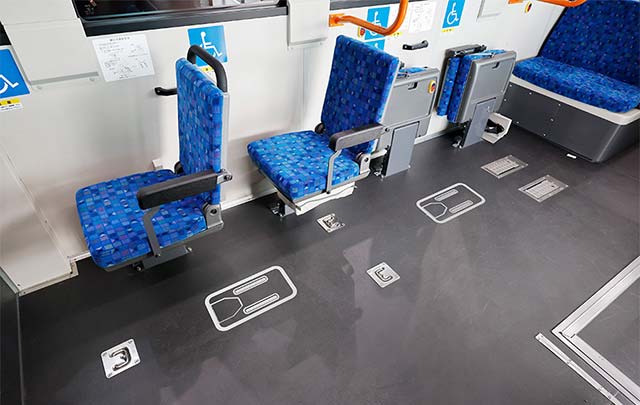
The passenger compartment uses a full-flat floor without steps, allowing passengers to move more easily through the bus.
The design is particularly beneficial for passengers using wheelchairs or strollers, while an optional one-touch wheelchair securement system can make boarding and securing a wheelchair faster and easier for both passengers and drivers.
Toyota is offering multiple interior configurations to accommodate different public transportation needs.
Sora Can Provide Emergency Power
Beyond passenger transportation, the new Sora can also serve as a source of electricity during emergencies.
By connecting an external power supply unit, the hydrogen fuel cell bus can be used as an emergency power source during disasters. This gives the vehicle a potential secondary role for communities where backup electricity may be required after severe weather or other emergencies.
Fuel cell vehicles can generate electricity from stored hydrogen without relying on an external charging network, making this capability particularly useful in emergency situations.
Toyota Continues Expanding Hydrogen Mobility
Toyota has been investing in hydrogen technology for more than a decade. The company launched the Mirai fuel cell vehicle in 2014 and has since sold it in more than 30 countries and regions.
Since 2019, Toyota has also supplied fuel cell systems for commercial and stationary applications. The company says it has provided more than 3,500 fuel cell systems to over 100 customers worldwide, including applications involving buses, rail transportation and stationary power generation.
The company has also worked with partners on hydrogen-related technologies such as hydrogen cartridges and hydrogen-powered applications beyond transportation.
With the new Sora, Toyota and Isuzu are targeting another area where hydrogen fuel cells could play a role: high-utilization public transportation.
The combination of more than 300 km of range, approximately 10-minute refueling, improved safety systems and a fully flat passenger floor gives the new Sora a broader range of capabilities than its predecessor.
Toyota says it will continue working with governments and businesses across the hydrogen supply chain, including initiatives focused on developing hydrogen infrastructure and expanding the use of hydrogen mobility.


