Europe’s electric vehicle market is entering a major new phase as automakers introduce more affordable EVs and battery-electric vehicle sales continue to climb. However, weakening the European Union’s 2030-35 vehicle emissions targets could put that progress at risk, according to a new analysis from Transport & Environment (T&E).
The latest EV progress report from the clean transport campaign group shows that EU car CO2 regulations are helping expand consumer choice while pushing automakers to introduce more affordable electric models.
Nearly 40 new electric models were launched in Europe during the first half of 2026, bringing the number of mass-market battery-electric vehicles available to more than 150. Around 60 additional models are expected to arrive by the end of the year.
That represents a significant acceleration compared with recent years. Between 2021 and 2025, European automakers introduced an average of about 15 new mass-market EVs annually. The number of launches expected in 2026 is nearly four times higher.
Affordable EVs Are Becoming More Common
One of the biggest changes is happening at the lower end of the electric car market.
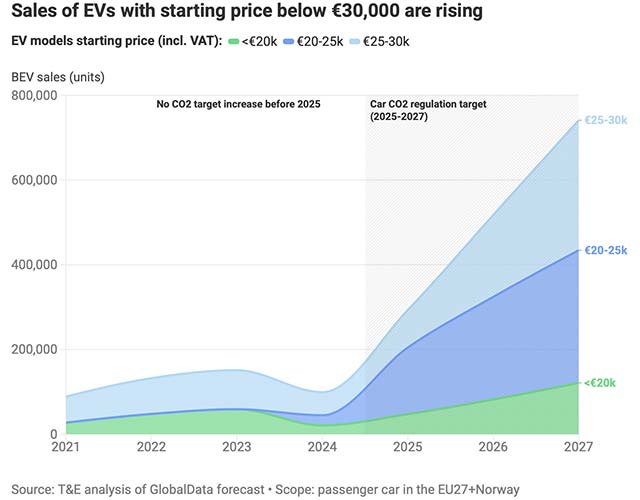
The number of EV models starting below €25,000 is expected to double, giving European consumers considerably more choice in a segment that has historically been dominated by gasoline and diesel vehicles.
T&E estimates that sales of electric cars with a starting price below €25,000 will increase sevenfold in 2026 compared with 2024.
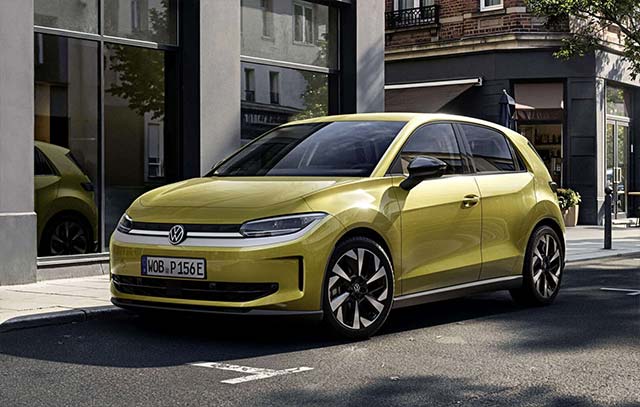
The growing demand for affordable EVs is becoming increasingly difficult for automakers to ignore. Volkswagen’s new ID. Polo, for example, reportedly attracted more than 40,000 orders and generated a waitlist stretching to around 10 months.
The strong response suggests that European consumers are interested in smaller electric cars when competitively priced models are actually available.
“The issue was not the demand, but what they had to offer,” said Lucien Mathieu, cars director at T&E.
The shift is particularly important as high energy prices continue to put pressure on household budgets. Lower purchase prices combined with cheaper EV running costs could make electric cars increasingly attractive to mainstream European buyers.
Rising Fuel Prices Are Making EVs More Attractive
The financial argument for electric vehicles has also become stronger as fuel prices rise.
According to T&E, the recent oil price shock has cost European road users around €53 billion. By mid-September, filling a 50-liter diesel tank cost approximately €30 more than before the Iran war.
Drivers who switched to an electric car at the beginning of the crisis could have saved around €350 in running costs by mid-September, according to the report.
While electricity prices vary significantly between countries and charging locations, EVs generally require less energy per mile than conventional gasoline and diesel vehicles. For drivers who can charge at home, the potential savings can be even more significant.
That makes affordable electric cars increasingly important as Europe attempts to reduce its dependence on imported oil.
European EV Sales Reach Record Levels
The combination of new models, stronger consumer demand and higher fuel costs is helping battery-electric vehicle sales reach record levels across the EU.
Between January and August 2026, approximately 1.64 million battery-electric vehicles were sold in the European Union, representing a 45% increase compared with the same period a year earlier.
EVs also achieved an important milestone during the second quarter of 2026. Battery-electric vehicles accounted for 22% of the market and outsold pure gasoline cars across the entire quarter for the first time.
The rapid growth comes as European manufacturers work toward their 2025-2027 emissions targets. T&E expects all European automakers to comply with those targets.
The organization argues that the regulatory targets have been an important factor behind the recent increase in EV launches. During the period of relatively flat targets between 2021 and 2024, manufacturers had fewer incentives to expand their affordable electric vehicle lineups.
Europe’s Global EV Position Could Be at Risk
The expansion of affordable EVs is not only about consumer choice. It could also determine how competitive European automakers remain against manufacturers from China and other global markets.
European automakers are facing increasing competition in the global EV industry, particularly from Chinese companies that have rapidly expanded their electric vehicle portfolios.
A sustained regulatory push could encourage European manufacturers to invest in smaller, lower-cost EVs and develop the technology needed to compete in increasingly price-sensitive markets.
T&E warns that weakening the EU’s 2030 emissions target at this stage could have the opposite effect.
According to the organization, reducing the ambition of the target could significantly slow the rollout of affordable electric models just as demand is accelerating.
“The EU’s car targets are expanding consumer choice, bringing down the cost of going electric and giving European manufacturers a chance to compete in the global EV race,” Mathieu said.
The European EV market is therefore approaching an important crossroads. More affordable models are finally reaching showrooms, sales are growing rapidly and consumers are demonstrating strong demand for electric cars.
Whether that momentum continues will depend in part on regulatory policy and how quickly automakers can bring lower-cost EVs to market.
For European drivers, the arrival of more affordable electric cars could mean greater choice and lower long-term running costs. For European automakers, maintaining the current momentum could be critical to competing in the next stage of the global EV market.