
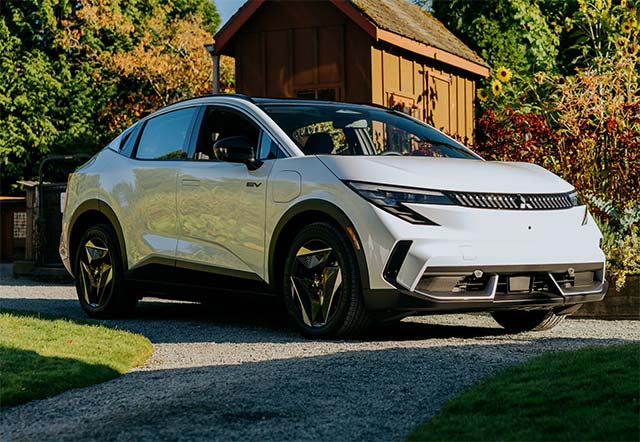
Mitsubishi is making another push into the U.S. electric vehicle market with the all-new 2027 Mitsubishi Eclipse Sportback EV, nearly a decade after the company stopped selling the i-MiEV in America.
The new electric crossover goes on sale in the U.S. in October with a starting MSRP of $37,745. Including Mitsubishi’s $1,995 destination charge, the starting price rises to $39,740.
The Eclipse Sportback EV will initially be offered in a single, well-equipped configuration. Buyers can add one option, the $2,600 Technology Package, which brings additional technology and convenience features.
2027 Mitsubishi Eclipse Sportback EV Range and Battery
Beneath its distinctive exterior, the Eclipse Sportback shares much of its technology with the latest Nissan LEAF. The 2027 Eclipse Sportback is powered by a 75-kWh liquid-cooled lithium-ion battery and offers an EPA-estimated range of up to 282 miles on a full charge.
That figure is respectable for a midsize electric crossover, although it falls short of the latest Nissan LEAF’s maximum range.
The base Nissan LEAF S+ can travel up to 303 miles according to EPA estimates. The LEAF’s range varies by trim, with the Platinum+ offering up to 259 miles.
Despite sharing the same battery capacity and underlying technology, Mitsubishi and Nissan have positioned the two vehicles differently in the market.
The Mitsubishi Eclipse Sportback starts at $37,745 before destination charges, while the Nissan LEAF starts at $34,230 for the SV+ and $38,990 for the top Platinum+.
That makes the Mitsubishi considerably more expensive than the LEAF’s lower-priced configuration, while putting it close to the price of the range-topping Nissan.
Mitsubishi Eclipse Sportback Is Closely Related to the Nissan LEAF
The Eclipse Sportback EV is essentially Mitsubishi’s version of the latest Nissan LEAF, thanks to the longstanding alliance between the two Japanese automakers.
The two EVs share the same basic platform and 75-kWh battery technology, much like the relationship between the Toyota and Subaru electric vehicles.
Mitsubishi, however, has given the Eclipse Sportback its own exterior design. The vehicle features the company’s Triple Diamond logo and styling intended to differentiate it from the Nissan.
The overall proportions remain similar to the LEAF, but Mitsubishi’s design elements give the new EV a more distinctive appearance and help establish it as a separate model within the company’s lineup.
The strategy allows Mitsubishi to enter the growing U.S. EV market without developing an entirely new electric platform from the ground up.
NACS Charging and 150-kW DC Fast Charging
Charging is another area where the Eclipse Sportback benefits from its Nissan-derived technology.
The Mitsubishi EV comes standard with a native NACS charging port, allowing owners to access Tesla Supercharger stations without relying on a separate adapter.
The Eclipse Sportback supports Level 1 and Level 2 AC charging through the SAE J1772 format, while DC fast charging can reach 150 kW.
Mitsubishi says the battery can be charged from 10% to 80% in approximately 35 minutes using a compatible DC fast charger.
That is essentially the same charging performance offered by the latest Nissan LEAF, giving the Eclipse Sportback the ability to add a meaningful amount of range during longer road trips.
Technology-Focused Interior
Inside, Mitsubishi has equipped the Eclipse Sportback with an all-black synthetic leather interior and a dual-screen digital cockpit.
The setup includes two 14.3-inch digital displays, along with wireless Apple CarPlay and Android Auto.
The EV also features built-in Google services, including Intelligent Route Planning powered by Google Maps.
The technology package gives buyers an opportunity to add even more equipment to an already well-equipped vehicle.
For comparison, the base Nissan LEAF S+ uses dual 12.3-inch displays, while the more expensive SV+ and Platinum+ versions receive the larger 14.3-inch screens.
This gives Mitsubishi another way to differentiate the Eclipse Sportback from its Nissan sibling, despite their close technical relationship.
Mitsubishi’s Momentum 2030 EV Strategy
The Eclipse Sportback is the first new vehicle launched under Mitsubishi’s Momentum 2030 North American business plan.
The strategy calls for Mitsubishi to introduce at least one new or completely refreshed vehicle every year from fiscal 2026 through fiscal 2030.
The plan covers more than electrification. Mitsubishi also wants to expand its product lineup, modernize its retail sales model and grow its dealer network and overall sales presence in North America.
Following the Eclipse Sportback, Mitsubishi plans to introduce a new rugged, off-road-oriented version of the Outlander SUV in early 2027.
The company has also indicated that additional adventure-focused and off-road-capable vehicles are planned for the future.
Mitsubishi is also preparing to return to the pickup truck segment in North America through its collaboration with Nissan, giving the company another potential growth opportunity.
2027 Mitsubishi Eclipse Sportback Warranty
Mitsubishi is also using its extensive warranty coverage as part of the Eclipse Sportback’s appeal.
The EV comes with Mitsubishi Motors Confidence, including a 10-year/100,000-mile powertrain and battery limited warranty and an eight-year/100,000-mile battery capacity warranty.
Additional coverage includes a five-year/60,000-mile new vehicle limited warranty, seven-year/100,000-mile anti-corrosion/perforation coverage, a two-year/30,000-mile limited maintenance program and five years of unlimited-mile roadside assistance.
The long battery warranty could provide additional reassurance for buyers who are making the transition to an electric vehicle.
Is the Mitsubishi Eclipse Sportback EV Too Expensive?
Pricing could be one of the biggest challenges for the new Mitsubishi EV.
With destination charges included, the Eclipse Sportback starts at $39,740, before any available incentives or additional options. That puts it well above the Nissan LEAF’s entry point and close to the price of the LEAF Platinum+.
The competition is also becoming increasingly aggressive.
For example, the Hyundai IONIQ 5 and Toyota bZ have starting prices below $36,000 before destination charges, while the upcoming Kia EV3 is expected to offer a range of up to 321 miles at a significantly lower starting price.
That means the Eclipse Sportback will have to rely on its combination of styling, standard equipment, charging compatibility, warranty coverage and Mitsubishi’s growing SUV lineup to justify its position in the market.
Its 282-mile EPA range is also lower than the maximum range available from the Nissan LEAF, despite the two vehicles sharing a 75-kWh battery.
The Bottom Line
The 2027 Mitsubishi Eclipse Sportback EV gives Mitsubishi a new entry into one of the fastest-changing segments of the U.S. automotive market.
With a $37,745 starting MSRP, 75-kWh battery, up to 282 miles of EPA range, 150-kW DC fast charging and native NACS support, the Eclipse Sportback has the core specifications expected from a modern electric crossover.
Its close relationship with the Nissan LEAF also gives Mitsubishi access to proven EV technology, while the brand’s own exterior design and interior presentation help distinguish it from its Nissan counterpart.
The bigger question will be whether buyers are willing to pay more for the Mitsubishi version when the closely related LEAF offers more range in some configurations at a lower price.
Either way, the Eclipse Sportback represents an important step in Mitsubishi’s North American comeback. With additional new and refreshed vehicles planned through 2030, including more rugged and adventure-focused models, the company is clearly preparing for a much larger role for electrification in its U.S. lineup.


