
Europe’s new-car market continued to expand in July, but the pace of growth slowed compared with recent months. At the same time, electric vehicle sales surged, while Chinese automakers continued to rapidly increase their presence across the European market.
According to preliminary data from market analyst Dataforce, new-car registrations across the European Union, the U.K., Iceland, Norway and Switzerland increased 4.1% in July. Through the first seven months of 2026, the market was up 5.7%.
The figures cover approximately 98% of registrations in the region and highlight two major trends: rapid EV adoption and accelerating competition from Chinese automakers.
European EV Sales Jump 51% in July
Electric vehicles were the biggest story in July. Sales of fully electric cars increased 51% year over year, giving EVs a 25% share of the European new-car market.
EV sales are now up 37% for the year, with higher fuel prices helping encourage more buyers to consider switching away from gasoline and diesel vehicles.
Plug-in hybrid sales also increased, rising 15% in July, while full-hybrid sales grew by 9%. However, both categories are expanding more slowly than they have over the course of 2026.
The stronger performance of fully electric vehicles suggests that the European market is continuing to move toward battery-powered cars, particularly as automakers introduce more affordable and smaller EVs.
Chinese EV Brands Reach Record 11.2% Market Share
Chinese automakers continued to make significant gains in Europe during July. Their combined market share reached a record 11.2%, while sales increased by an impressive 107% compared with July 2025.
BYD led the Chinese brands, followed by Chery and SAIC, the parent company of MG.
Several manufacturers recorded particularly strong growth. Leapmotor, which operates in partnership with Stellantis, increased sales by 294% to 9,306 vehicles. Xpeng sales climbed 270% to 5,244 units.
Chery, including its Omoda, Jaecoo and Chery brands, increased sales by 202%, while BYD, including its premium Denza brand, grew by 150%.
SAIC recorded a more modest 22% increase, while Geely Group was up 21%.
The rapid growth of Chinese automakers is becoming increasingly difficult for established European, Japanese and Korean manufacturers to ignore. Competitive pricing, expanding EV lineups and the arrival of new models are giving Chinese brands a growing foothold in one of the world’s most important electric-car markets.
Several individual Chinese brands stood out in July.
Changan increased its European sales from just seven vehicles in July 2025 to 1,249 units a year later. Chery’s namesake brand jumped from 107 sales to 5,868, while Geely rose from 168 vehicles to 4,508.
The figures underline how quickly some Chinese brands are moving from relatively small European volumes to meaningful market presence.
Their expansion is also occurring as European consumers gain access to a broader selection of competitively priced electric cars.
Tesla Sales Fall 36% in July
Tesla had a significantly weaker July, with European sales falling 36% year over year.
The decline continues Tesla’s volatile sales pattern in Europe. The automaker has historically experienced weaker registrations during the first month of a new quarter, making July’s results particularly notable.
Tesla was not the only major automaker to struggle. Ford sales fell 16%, Hyundai-Kia declined 8.5%, Nissan was down 5.8%, and Volkswagen Group fell 3%.
Among major manufacturers that increased sales, Mercedes-Benz was one of the strongest performers, with registrations rising 4.7%. Toyota was up 2.3%, Stellantis increased 2.0%, and BMW Group gained 1.7%, although those companies still lost overall market share as faster-growing competitors expanded.
Renault’s Small EVs Help Drive Growth
Some traditional European brands are benefiting from the growing demand for affordable electric vehicles.
Fiat sales increased 25%, Citroen gained 16%, and Renault was up 11% in July.
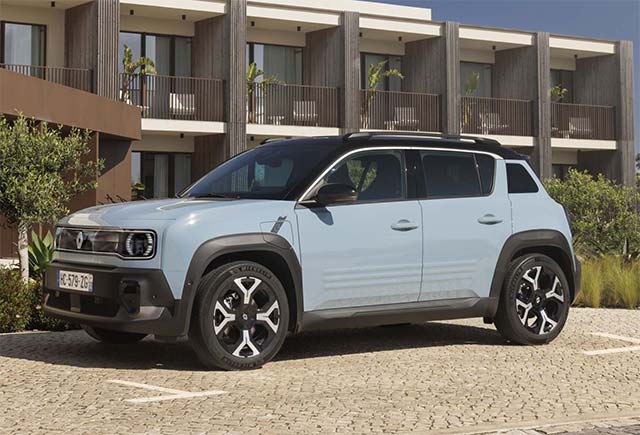
Fiat and Citroen are benefiting from the rollout of more affordable models built around Stellantis’ Smart Car platform. Renault, meanwhile, has found momentum with its expanding range of smaller EVs, including the Renault 5 E-Tech, Renault 4 E-Tech and new Renault Twingo.
The Twingo was the 12th-best-selling EV in Europe during July, recording 4,831 sales. Its volume placed it just behind the Tesla Model Y.
The Renault 5 E-Tech performed even better, ranking third among electric vehicles and increasing sales by 49%.
The performance of these smaller models highlights the importance of affordable EVs as European consumers increasingly look beyond expensive electric SUVs and premium models.
Dacia Sandero Leads Europe’s Overall Sales
Despite the rapid growth of EVs, the European market’s best-selling vehicle overall in July was not electric.
The Dacia Sandero took the top position, ahead of the Volkswagen Golf and Volkswagen T-Roc.
The Mercedes-Benz GLC was another notable performer, reaching seventh place overall after sales increased 45%.
The results show that while electric vehicles are gaining ground quickly, conventional and hybrid models continue to account for a substantial portion of European new-car demand.
European EV Market Enters a New Phase
July’s figures point to a rapidly changing European automotive market.
Electric vehicle sales are growing far faster than the overall market, while Chinese manufacturers are increasing their market share at a remarkable pace. At the same time, established automakers are increasingly relying on smaller and more affordable EVs to compete.
With EV sales up 37% through July and Chinese brands now accounting for 11.2% of the market, the competitive landscape is becoming increasingly difficult to predict.
The next few months will be particularly important for determining whether Europe’s EV growth can maintain its current momentum and whether Chinese manufacturers can continue gaining ground against established brands.


