
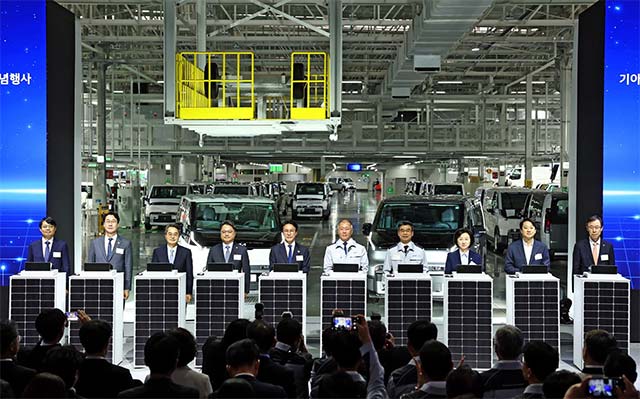
Kia’s first dedicated Platform Beyond Vehicle (PBV) production hub in Korea is now taking shape. The Hwaseong EVO Plant has finished its East facility and broken ground on the West. When both are fully operational, they will support a combined annual PBV capacity of 250,000 units.
The recently commissioned EVO Plant East will produce 100,000 units of the PV5 annually. EVO Plant West, scheduled for 2027, will add 150,000 units of larger PBVs, including the PV7. Kia is investing approximately 4 trillion South Korean won ($\approx 2.4$ billion euros) in the 296,882-square-meter site.
Complementing this, Kia is establishing a PBV Conversion Centre to co-develop specialized PBV variants with partners, starting with the PV5 (e.g., open-bed trucks, box vans). This centre aims to “foster a collaborative PBV ecosystem” for global expansion.
Kia’s leadership sees the electrification of light commercial vehicles and PBVs as a core future business, emphasizing innovation in mobility, autonomous driving, and AI. The facility, first announced in 2022, is on schedule, with the first phase completed by the end of 2025. This follows the opening of the Hyundai Motor Group Metaplant America (HMGMA) earlier this year.
Hwaseong EVO Plant Integrates Cutting-Edge Manufacturing Technologies
The name ‘EVO Plant’ combines ‘Evolution’ and ‘Plant’, reflecting Kia’s commitment to pursuing evolution and innovation, and its ambition to become a brand that leads the new mobility environment.
Hwaseong EVO Plant applies a wide range of future-oriented manufacturing technologies and is designed to minimize carbon footprint. The facility emphasizes automation, sustainability, and a human-centric environment, with each process integrating features that reflect these priorities.
The EVO Plant will also apply Hyundai Motor and Kia’s E-FOREST smart factory brand to enable real-time operation and quality control.
In the body shop, a smart logistics system has been implemented through the integration of automated guided vehicles (AGVs) and other advanced technologies.
The paint shop operates dry booths that reduce the impact of controlled substances, making the EVO Plant a low-carbon sustainable facility.
In the final assembly shop, Kia has created a human-centric environment based on advanced automation technologies. The facility will feature specification guidance monitors to prevent operational issues, automation of labor-intensive processes, such as heavy component installation, and low-noise equipment, contributing to a human-centric environment.
Additionally, a flexible production process has been adopted by combining Kia’s mass-production conveyor system with a cell-based production process, which enables simultaneous manufacturing of different mobility types.
Annual Production Capacity of 250,000 Units and Conversion Center Operation
The newly completed EVO Plant East is a dedicated PBV facility built on a 98,433 square-meter site, with an annual production capacity of 100,000 units for Kia’s PV5 mid-size PBV, including the Passenger, Cargo, Chassis Cab, and Wheelchair Accessible Vehicle (WAV) models.
EVO Plant West will be built on a 136,671 square-meter site, securing an annual production capacity of 150,000 units for Kia’s upcoming large-size PBV models, including the PV7. Once both EVO Plant East and West are fully operational, Kia will establish a full PBV lineup with an annual capacity of 250,000 units.
Kia is also launching its dedicated PBV Conversion Center in collaboration with strategic partners to develop specialized PBV models. Built on a 63,728 square-meter site, the Conversion Center will produce a wide range of customized models based on Kia’s first PBV model, the PV5, including open-bed trucks, box vans, and camping vehicles.
The center will also develop and produce additional conversion models, based on upcoming PBVs, such as the PV7. It will serve as a strategic base for the expansion of Kia’s PBV business, while fostering a sustainable PBV ecosystem through close collaboration with partner companies.
Kia also plans to accelerate its RE100 initiative by investing in a 50 MW solar power generation facility within AutoLand Hwaseong.
Once EVO Plant East, EVO Plant West, and the Conversion Center are fully operational, Kia will have established a comprehensive PBV hub capable of producing its entire PBV lineup. To establish a dominant position in the PBV sector, Kia’s strategic focus is on five key areas: Product, Manufacturing, Solutions, Services, and Channels.
By reinforcing its global EV leadership and expanding its PBV business across these pillars, Kia is committed to delivering sustainable and innovative solutions that meet the evolving needs of global customers – in line with its brand vision to become a Sustainable Mobility Solutions Provider.


