
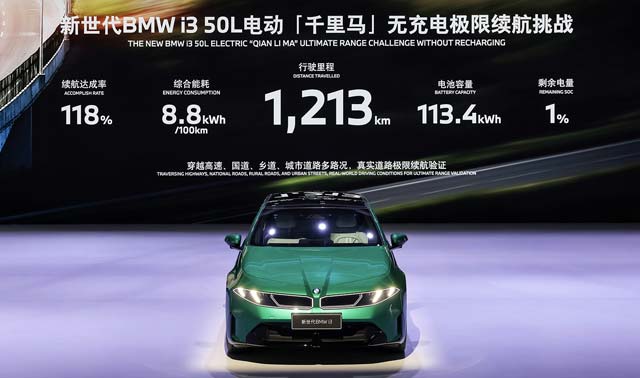
BMW has taken another major step in electric vehicle efficiency. The upcoming all-electric BMW i3 has completed an impressive 1,213-kilometer (754-mile) journey without stopping to recharge, setting a new single-trip driving distance record for a BMW electric vehicle.
The achievement was completed in China using the new BMW i3 50L, which covered highways, national roads, rural routes, and urban streets during a real-world range challenge. The vehicle completed the entire journey without any charging stops, demonstrating the efficiency potential of BMW’s next-generation electric vehicle technology.
Even more impressive, the BMW i3 managed to travel approximately 18% farther than its official CLTC-rated driving range.
According to BMW, the new i3 50L started its journey at the company’s Tiexi plant in Shenyang, China. BMW engineers drove the vehicle across a combination of different road conditions to test its long-distance capabilities under real-world driving circumstances.
The car eventually completed 1,213 kilometers without requiring additional energy.
The result is particularly notable considering that the BMW i3 50L has an official CLTC-rated range of 1,028 kilometers. By exceeding that figure, the vehicle achieved approximately 118% of its certified range during the challenge.
BMW also reported an average energy consumption of just 8.8 kWh per 100 kilometers, an exceptionally low figure for a vehicle in this category.
However, it is important to note that the challenge was conducted under specific route, weather, and driving conditions. Actual driving range will vary depending on temperature, speed, road conditions, passenger and cargo weight, and climate control usage.
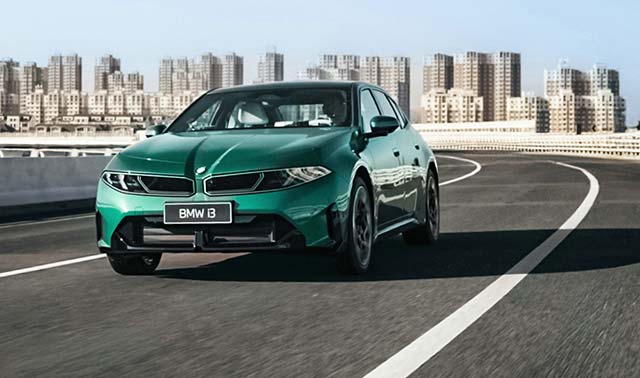
113.4 kWh Battery and BMW’s Sixth-Generation eDrive Technology
The new BMW i3 50L is equipped with a 113.4 kWh battery pack featuring BMW’s latest large cylindrical battery cells.
However, the impressive range achievement is not simply the result of installing a large battery. BMW says the vehicle benefits from several interconnected technologies designed to improve overall energy efficiency.
At the heart of the system is BMW’s sixth-generation eDrive technology, which works alongside an 800-volt electrical architecture and the company’s Energy Master control unit.
These technologies are designed to optimize energy management throughout the vehicle, helping reduce electricity consumption while maintaining the performance and driving characteristics expected from a BMW.
The new large cylindrical battery cells are another important part of the package. BMW’s sixth-generation battery technology focuses on improving energy density, charging performance, durability, and safety.
According to BMW, the battery system has also entered production at the company’s powertrain facility in Shenyang, China, marking an important step toward the introduction of its next-generation electric vehicles.
800V Architecture Supports Charging Speeds of Up to 400 kW
Although the 1,213-kilometer journey attracted most of the attention, the new BMW i3 is also designed to improve charging convenience.
Its 800-volt electrical architecture supports a maximum charging power of up to 400 kW, potentially allowing drivers to spend less time at charging stations during longer journeys.
This is an important part of BMW’s broader strategy. Long-distance electric driving is not just about maximizing battery capacity. Charging speed, energy efficiency, and the availability of reliable charging infrastructure also play significant roles in making electric vehicles practical for everyday use.
By combining a large battery, advanced electric motors, and high-speed charging capabilities, BMW aims to make its next-generation EVs more competitive in the increasingly crowded electric car market.
BMW i3 and iX3 Lead the Brand’s Next Electric Vehicle Generation
The new BMW i3 is part of the company’s Neue Klasse (New Class) electric vehicle strategy, which represents a major technological shift for the German automaker.
Alongside the new BMW iX3, the i3 will introduce the latest generation of BMW electric powertrains, battery technology, digital systems, and vehicle architecture.
BMW has already presented the new i3 to the Chinese market, positioning it as an electric driver’s car that combines traditional BMW driving characteristics with modern electric vehicle technology.
The company also plans to introduce nearly 20 new BMW models featuring Neue Klasse technologies in China during 2027.
This product offensive highlights the importance of the Chinese market in BMW’s electrification strategy, particularly as domestic manufacturers continue to push the boundaries of battery technology, charging speeds, and driving range.


