
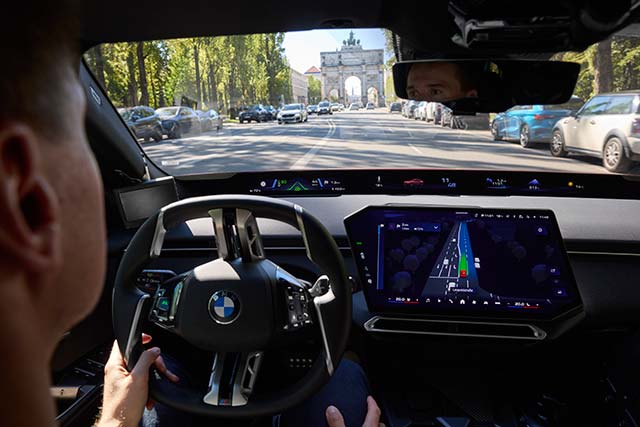
BMW is preparing to take its partially automated driving technology into urban environments, with new Level 2 driver assistance functions scheduled to arrive in 2027. The expansion will allow compatible BMW models to assist with more complex city-driving situations, including turning, navigating roundabouts, changing lanes and handling priority intersections.
The new technology will extend BMW’s navigation-guided assistance beyond motorways and rural roads, creating a more seamless driving experience from highways to city centres. Germany will be the first market to receive the upgraded system, with additional countries expected to follow gradually.
Despite the expanded capabilities, the technology will remain an SAE Level 2 driver assistance system. Drivers must stay attentive, monitor the road and remain ready to take control at all times.
BMW’s Level 2 Driving Assistance Expands to Urban Traffic
BMW’s upcoming City Assistant expansion will build on the company’s existing partially automated driving technology. While the current system can already handle stopping and restarting at traffic lights in supported markets, the 2027 update will introduce more advanced functions designed for complex urban environments.
With active route guidance through BMW Maps, the system will be able to support drivers throughout an entire navigation journey. This includes motorway driving, country roads and, for the first time, a broader range of city-driving situations.
In urban environments, the technology will assist with lane positioning on multi-lane roads, turning manoeuvres, navigating roundabouts and responding to right-of-way situations at intersections.
The integration with BMW Maps is particularly important because the system uses the planned route to anticipate upcoming driving situations and provide appropriate assistance.
Rather than treating motorway and city assistance as separate experiences, BMW aims to make partially automated driving available more consistently across different road environments.
Regulatory Approval Expected in Early 2027
The expansion of BMW’s urban driving assistance functions depends on updated European regulatory requirements.
The system is being developed in accordance with the revised UNECE Regulation No. 171, specifically DCAS Series 02. These regulations establish the framework for Driver Control Assistance Systems and provide the regulatory basis for more advanced assisted-driving manoeuvres in urban traffic.
BMW says the required real-world road tests have already been successfully completed by an independent technical service. This represents an important milestone towards type approval, although official regulatory confirmation is expected in early 2027.
The system will continue to operate under Level 2 requirements. An interior camera will monitor the driver’s attention, and the assistance functions will only remain available when the driver is detected as attentive.
This means BMW’s technology will not turn its vehicles into fully autonomous cars. Drivers will remain responsible for supervising the vehicle and responding whenever necessary.
BMW Symbiotic Drive Allows Drivers to Intervene Naturally
One of the central features of the updated system is BMW Symbiotic Drive, which is designed to make the interaction between the driver and automated assistance more natural.
With conventional driver assistance systems, manually steering, accelerating or braking can sometimes cause the system to disengage. BMW’s Symbiotic Drive takes a different approach by allowing the driver and assistance technology to work together.
When the system is active, drivers can make their own steering, acceleration and braking inputs without necessarily interrupting the assistance functions. The technology adapts to the driver’s actions and individual driving style.
The same approach also applies to active safety functions such as Lane Keeping Assist.
By analysing steering behaviour and the driver’s gaze direction, the vehicle can better understand the driver’s intentions. Steering interventions and warnings are designed to occur when the system detects unintended lane departure or an imminent collision.
The objective is to make driver assistance less intrusive while maintaining an additional layer of safety.
BMW Panoramic iDrive Makes Assistance Information Easier to Follow
The upcoming urban driving functions will also be supported by BMW’s Panoramic iDrive interface, which is designed to make information easier to understand without distracting the driver.
When assistance systems are active, relevant status information will appear directly in the driver’s field of vision through BMW Panoramic Vision, the panoramic display positioned along the lower section of the windscreen.
BMW is also introducing a dedicated BMW Maps with Driver Assistance navigation view on the central display.
This new interface combines three important elements in a single three-dimensional presentation:
– Navigation guidance, including the next driving manoeuvre.
– Information about the vehicle’s surroundings detected by its sensors.
– The driver assistance functions currently supporting the driving task.
The combination is intended to help drivers better understand what the vehicle detects, which manoeuvre is coming next and how the assistance technology is responding to surrounding traffic.
BMW has also filed several patent applications connected with the development of its new urban driver assistance functions.
Which BMW Models Will Get the New City Driving Assistance?
BMW has confirmed that the hardware required for the new functions will be fitted as standard in the new BMW iX3 and BMW iX4, as well as all model variants of the BMW X5, 3 Series and 7 Series.
One important advantage for customers is that the new assistance functions will not necessarily need to be activated when purchasing the vehicle.
Instead, compatible models will be able to receive the necessary software through over-the-air updates, allowing owners to activate available functions after taking delivery.
This approach gives BMW greater flexibility to expand vehicle capabilities through software rather than requiring customers to purchase an entirely new model whenever additional assistance features become available.
However, the availability of individual functions will depend on market-specific regulations and the completion of the relevant approval processes.
BMW has not yet disclosed how much customers will pay to activate the expanded urban driving assistance functions.
The pricing structure is expected to become clearer closer to the planned 2027 introduction. The final cost could depend on the vehicle model, market and available driver assistance packages.


