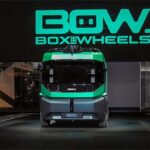
Stellantis Pro One is exploring the future of last-mile logistics with a new autonomous electric delivery vehicle called BOW, short for “Box-on-Wheels.”
Developed in partnership with robotics and artificial intelligence company UQI Robotics, the concept is designed to test how electric mobility, autonomous driving, connectivity and digital services could reshape urban commercial operations.
The BOW autonomous electric delivery vehicle is being presented publicly for the first time at IAA Transportation in Hannover. Rather than serving simply as another electric van, Stellantis describes BOW as a platform for an integrated logistics ecosystem aimed at improving efficiency, productivity and sustainability for commercial operators.
BOW Targets the Future of Urban Logistics
Urban delivery operations are becoming increasingly complex as cities introduce stricter emissions requirements, restricted-access areas and growing demand for fast last-mile deliveries. Stellantis Pro One and UQI Robotics are developing BOW specifically around these challenges.
The fully electric and autonomous vehicle is designed to transport goods in urban environments while potentially reducing the need for conventional driver-operated delivery vehicles in certain applications.
Stellantis says the concept could eventually be used in environments beyond public roads. Potential applications include industrial facilities, airports, hospitals and other controlled areas, particularly locations with restricted access or low-emission requirements.
However, the companies have not yet released key technical specifications for BOW. Battery capacity, driving range, payload capacity, autonomous-driving sensors and other performance details remain undisclosed.
Stellantis and UQI Robotics Combine Commercial and AI Expertise
The BOW project brings together Stellantis Pro One’s commercial-vehicle expertise and UQI Robotics’ experience in artificial intelligence, robotics and autonomous systems.
Stellantis Pro One is contributing its knowledge of commercial vehicles and the operational requirements of professional customers. UQI Robotics, meanwhile, brings expertise in autonomous technology and robotic systems.
UQI Robotics was established in 2020 as a joint venture between UBTECH and Miracle Automation. The company says its technologies have been deployed across more than 60 cities worldwide.
The partnership is intended to go beyond developing a single vehicle. The companies are evaluating how autonomous driving, vehicle electrification, connectivity and supporting digital services can work together as one logistics solution.
Europe Will Be the First Testing Ground
The initial validation phase will focus on Europe, where Stellantis and UQI Robotics plan to examine how autonomous logistics technology can be adapted to local operating conditions and customer requirements.
The project could eventually expand into international markets as the companies evaluate potential commercial applications for autonomous delivery vehicles.
This approach is particularly significant because autonomous logistics vehicles are already being tested and deployed in some markets, while European commercial fleets face different regulatory, infrastructure and operational requirements.
Rather than simply adapting an existing autonomous vehicle, Stellantis says the collaboration is intended to investigate a more comprehensive model in which the vehicle becomes part of a connected logistics operation.
BOW Is Part of Stellantis’ FaSTLAne 2030 Strategy
The BOW project is also linked to Stellantis Pro One’s FaSTLAne 2030 strategy, which focuses on combining customer-oriented technologies with partnerships across the commercial-vehicle industry.
As part of that strategy, Stellantis Pro One plans to develop a broader support framework for commercial customers. Potential elements include fleet integration, services and business solutions designed to help operators improve efficiency while moving toward more sustainable delivery models.
The strategy reflects a broader shift in the commercial vehicle industry. Electric vans are increasingly becoming only one part of the equation, with fleet operators also looking at automation, connected vehicles, route optimization and digital fleet management to reduce operating costs.
Eric Laforge, Global Senior Vice President of Stellantis Pro One, said the collaboration with UQI Robotics is intended to explore how autonomous technologies, connectivity and services could contribute to the future of commercial mobility.
According to Stellantis, the goal is to expand the role of the light commercial vehicle beyond transportation and turn it into an integrated logistics platform.
Autonomous Electric Delivery Vehicles Could Change Last-Mile Logistics
BOW remains a concept vehicle, and Stellantis has not announced production plans or a launch date. Its importance instead lies in the technologies and business models being tested.
The combination of an electric powertrain, autonomous operation and connected logistics services could eventually allow commercial operators to rethink how goods move through cities and controlled environments.
For Stellantis Pro One, the project also provides an opportunity to study autonomous commercial mobility in Europe while working with a technology partner that specializes in robotics and AI.
As urban areas continue to tighten emissions rules and logistics companies look for more efficient last-mile solutions, concepts such as BOW could provide an early look at how the electric commercial vehicle may evolve beyond the traditional delivery van.