
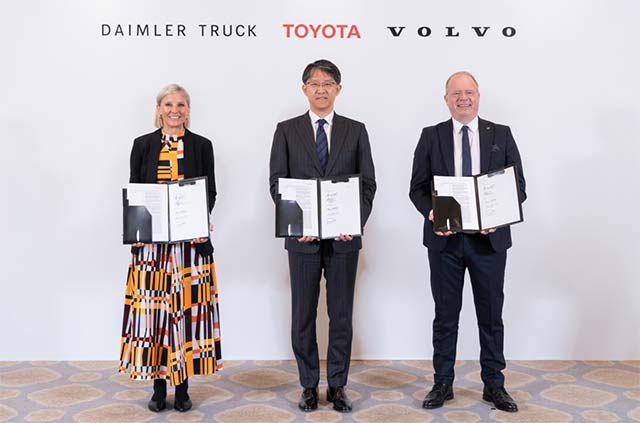
Global leaders Daimler Truck AG, Volvo Trucks, and Toyota Motor Corporation are moving to strengthen hydrogen’s role in zero-emission transport through an expanded partnership centered on cellcentric.
The companies have signed a non-binding agreement that would bring Toyota in as an equal shareholder in cellcentric, alongside Daimler Truck and Volvo. The goal is clear: accelerate the development, production, and commercialization of hydrogen fuel cell systems for heavy-duty vehicles and other demanding applications.
Scaling Hydrogen for Heavy Transport
The collaboration combines complementary strengths across the automotive and commercial vehicle sectors. Daimler Truck and Volvo contribute extensive expertise in heavy-duty transport, while Toyota brings more than three decades of fuel cell research, development, and manufacturing experience.
A key focus of the partnership will be the joint development of fuel cell unit cells—the core building blocks of hydrogen systems—along with associated architecture and control technologies. By aligning engineering and production efforts, the partners aim to deliver competitive, scalable solutions for trucks, off-road machinery, and stationary applications.
Cellcentric is expected to remain an independent entity, serving a broad customer base across multiple industries while acting as a central hub for fuel cell innovation.
Hydrogen as a Complement to Battery-Electric
While battery-electric trucks are gaining traction, hydrogen fuel cells are increasingly viewed as a complementary solution—particularly for long-haul and heavy-duty use cases where fast refueling and extended range are critical.
The three companies see hydrogen as a key pillar in decarbonizing transport. By pooling resources and expertise, the partnership aims to accelerate technological progress and reduce costs, helping fuel cell systems reach commercial viability faster.
Supporting Infrastructure and Industry Adoption
Beyond vehicle technology, the partners plan to work with industry stakeholders to support the development of hydrogen infrastructure. Early-stage investment in supply chains, refueling networks, and production capacity is seen as essential for widespread adoption.
This collaborative approach aligns with broader global initiatives, including Europe’s decarbonization targets and Japan’s long-term vision for a hydrogen-based society.
Equal Partnership Structure
To establish equal ownership, Toyota intends to invest in cellcentric through a capital increase. Despite the collaboration, all three companies will continue to compete independently in their core businesses.
The joint effort reflects a growing industry trend: cooperation is becoming essential to tackle the high costs and complexity of next-generation clean technologies.
What Comes Next
The agreement remains non-binding, with further negotiations underway. A final, legally binding deal will require approval from company boards and regulatory authorities.
If completed, the partnership could mark a major step forward for hydrogen-powered transport—positioning cellcentric as a global leader in fuel cell systems for heavy-duty applications and accelerating the transition to zero-emission mobility.


