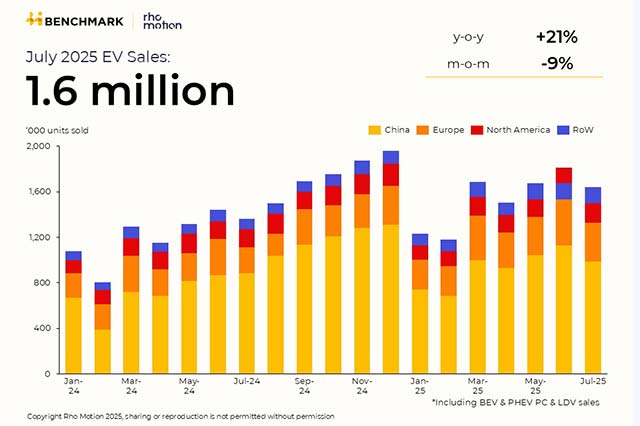
The number of electric vehicles sold globally in July is 1.6 million, according the data revealed by leading EV supply chain research and insights company Rho Motion. This represents a 21% increase compared to July 2024, but a 9% decline from May 2025.
Snapshot electric vehicle sales in YTD 2025 (Jan-Jul 2025) vs YTD 2024 (Jan-Jul 2024), YTD %:
– Global: 10.7 million, +27%
– China: 6.5 million, +29%
– Europe: 2.3 million, +30%
– North America: 1.0 million, +2%
– Rest of World: 0.9 million, +42%
Rho Motion Data Manager, Charles Lester, commented:
“Global EV sales passed 10.7 million in the first seven months of 2025, showing a robust 27% increase ytd. China continues to lead the global market and maintains EV penetration rates over 50% despite weaker sales month-on-month. Europe’s momentum is also impressive, with markets like Germany and the UK surging ahead, although France remains sluggish despite new subsidy plans. Italy is emerging as a fast-growing player thanks to fresh incentives. In contrast, North America’s growth has been muted so far in 2025, with the US facing policy headwinds and Canada seeing a slowdown. We expect a short-term lift in US demand ahead of the IRA consumer tax credit deadline in September, followed by a likely dip. Despite regional variations, the overall trajectory for EV adoption in 2025 remains strongly upward.”
Europe
The European EV market has grown by 30% year-to-date, with strong momentum in both battery electric vehicles (BEVs) and plug-in hybrids (PHEVs), up 30% and 32% respectively.
Performance remains mixed across the region: Germany and the UK lead with growth of 43% and 32%, while France, despite a 9% year-on-year gain in July, remains down 11% year-to-date. To stimulate demand, the French government will relaunch its EV leasing scheme for low-income households on 30 September 2025, expected to support just over 50,000 purchases.
Italy has surged by around 40% in 2025 as it narrows the gap with other European markets. EV penetration there now stands at 11%, compared to 27% in Germany and over 30% in the UK. Growth in Italy is set to accelerate further following the approval of EUR600 million (~USD 700 million) in new subsidies.
North America
North American EV sales (US, Canada, and Mexico) are up just 2% year-to-date. A short-term boost is expected in Q3 ahead of the 30 September 2025 expiry of the IRA consumer tax credit, followed by a likely slowdown in demand.
In the US, Q2 financial results revealed a multi-billion-dollar hit from tariffs, partially offset by reduced requirements to purchase ZEV credits. Some major automakers are eyeing higher profits by increasing the share of internal combustion engine vehicles in their line-ups. Ford has announced its new ‘Universal EV Platform’ and plans to launch a USD 30,000 electric midsize pickup with LFP batteries in 2027.
On the trade front, the US has agreed deals with South Korea, Japan, and the EU to implement a 15% tariff on imported cars.
China
The Chinese EV market fell 13% month-on-month in July but rose 12% year-on-year, bringing year-to-date growth to 29%. Battery electric vehicles (BEVs) continue to outpace plug-in hybrids (PHEVs), with BEV sales up 40% year-to-date compared to 14% for PHEVs. Domestic PHEV sales declined both month-on-month (-15%) and year-on-year (-10%). Despite the slowdown, overall passenger car sales also fell, and EV penetration has remained above 50% for the third consecutive month.
In late July, the Chinese government allocated its Q3 funding for the consumer goods trade-in scheme, which has supported EV demand since its launch last year. The final round of funding for 2025 is expected in October.
[source: Rho Motion]