

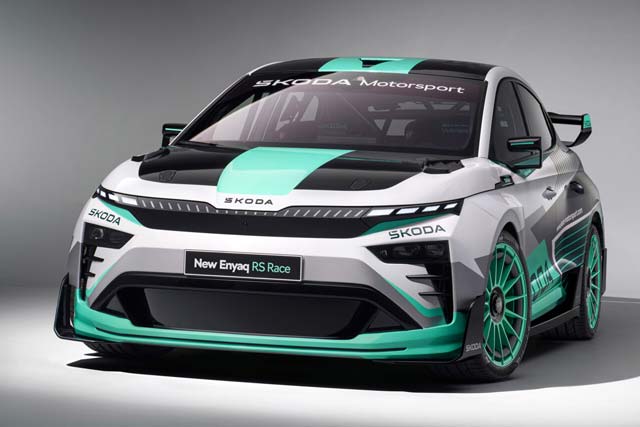

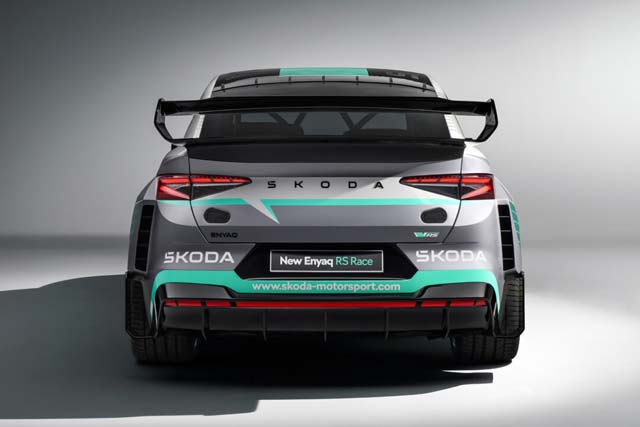
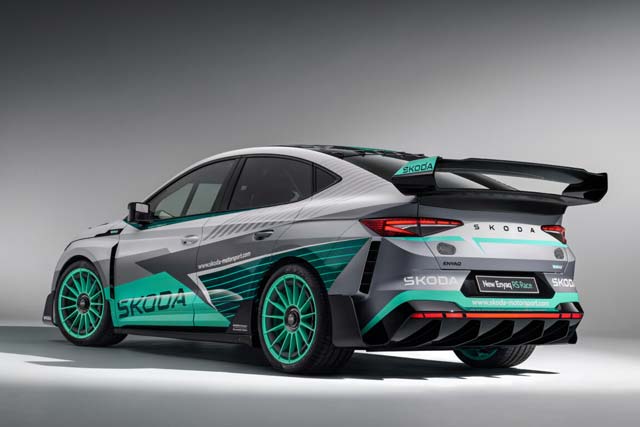
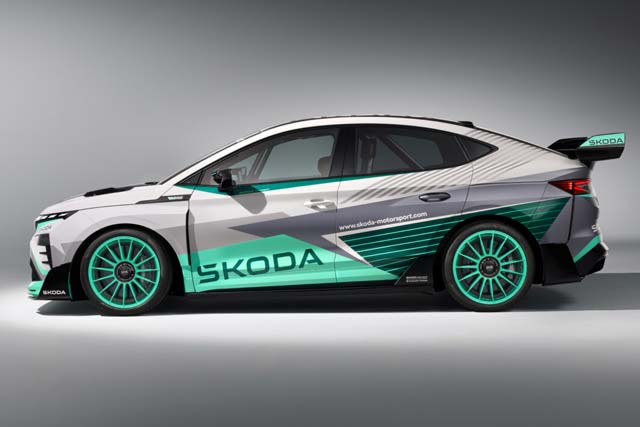
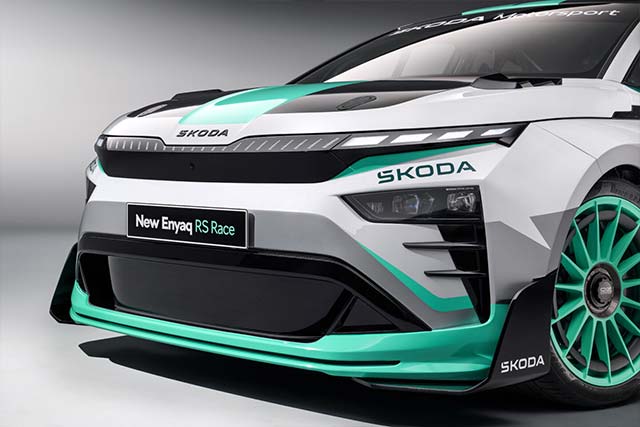
Skoda Motorsport is showcasing the latest version of its recently presented all‑electric racing car concept: the new Skoda Enyaq RS Race. Rooted in the Czech brand’s racing DNA, this concept supports the development of innovative technologies and sustainable materials, serving as a pilot project for future production models.
The lower and wider concept car incorporates innovative, sustainable biocomposite parts that provide the same rigidity and weight advantages as carbon fibre, contributing to an overall weight reduction of more than 300 kg compared to the new Skoda Enyaq Coupé RS on which it is based.
An all-electric race car defined by the motorsport DNA of the Skoda Fabia RS Rally2
Skoda Motorsport engineers have developed an all-electric race car that closely matches the handling of the successful Skoda Fabia RS Rally2. Skoda’s racing DNA and the rigorous demands of motorsport continue to push the boundaries of technical innovation. Development of the first Enyaq RS Race began in 2023, followed by its world premiere in October 2024. With the new Enyaq RS Race, the teams used the expertise gained in developing the first concept and took it to the next level with the recently introduced new Skoda Enyaq Coupé RS.
The project showcases Skoda’s activities in the field of electrified motorsport, driving progress towards a more sustainable future. The latest version of the concept car uses the same electric powertrain but is 70 mm lower, 72 mm wider at the front, and 116 mm wider at the rear. Most importantly, it is significantly lighter than the production model. Additionally, the concept benefits from numerous visual and technical modifications, including an optimised chassis, redesigned bumpers, as well as modified shock absorbers and springs.
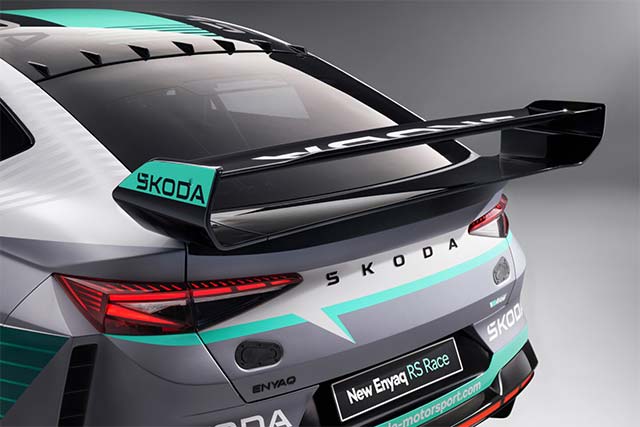
A completely new high-performance braking system, racing seats, and a roll cage ensure the highest possible active and passive safety. The vehicle’s front is now defined by the sleek, high‑gloss black Tech‑Deck Face, with Skoda lettering replacing the logo on the bonnet. The car is also equipped with new segmented LED rear lights.
Biocomposite parts: reducing weight and enhancing sustainability
To reduce the weight compared to the production model, Skoda Motorsport engineers employed innovative and sustainable materials and removed all components not needed for the car’s intended use. Additionally, they incorporated side and rear windows made of lightweight polycarbonate. These measures together resulted in total weight savings of 316 kg.
The introduction of sustainable biocomposite parts incorporating flax fibres, developed in collaboration with Skoda’s motorsport partner Bcomp, serves as a pilot for future production models. Replacing carbon, these lightweight parts are used in both the interior and the body, including the bumpers, fenders, roof, roof vent, and rear wing. Applications in the interior include the dashboard, door panels, and footrests for the driver and passenger. Additionally, the standard model’s panoramic glass roof has been replaced with a biocomposite panel.
Sustainable flax fibre components: a carbon alternative
A total of 16 vehicle components are made from sustainable materials, with natural flax fibres replacing carbon in both the interior and the exterior. These are tested under the most challenging racing conditions, for instance in the Skoda Fabia RS Rally2, alongside sustainable lubricants for engines, motors, transmissions and dampers.
Bcomp’s PowerRibs technology utilises extremely lightweight, high-performance natural fibres also made from flax. PowerRibs combine maximum stiffness and minimum weight by creating a 3D structure to reinforce the thin‑walled panels of the car body. The benefits include raw material savings, weight reduction, and lower production costs due to using fewer consumables. The material offers comparable rigidity and weight advantages to carbon fibre while reducing CO₂ emissions by approximately 85%.
In the original Enyaq RS Race, Skoda Auto has used this material for the first time for large, complex components such as the front wings, side panel and bumpers. The engineers also made extensive use of 3D printing in preparing and producing the prototype, using recycled materials such as nylon and CO₂-neutral biodegradable biopolymer filaments. One example is AmpliTex, a technical reinforcement fabric made from renewable flax fibres grown in Europe. These woven fibres not only reduce vibrations in the interior and contribute to weight reduction but also serve as a visually appealing design element. Moreover, flax cultivation has a significantly lower impact on the soil compared to other crops.
Aerodynamic optimisation of the bodywork
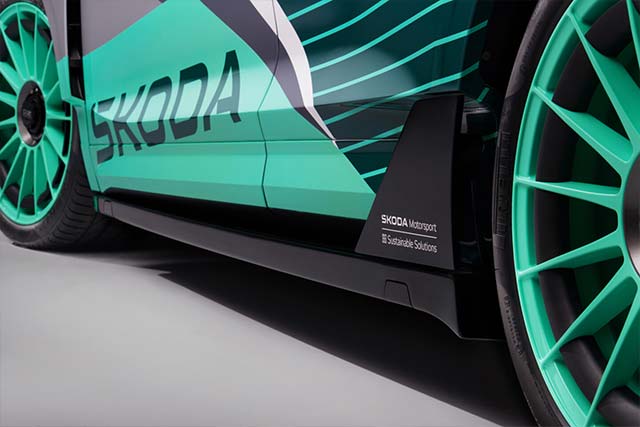
To create the widened body, individual bodywork parts were taken from the production line, redesigned from scratch, and reassembled. In addition to the roll cage made of high-strength chrome-molybdenum steel—which reinforces the body and protects the occupants—the concept car features other safety elements derived from the Skoda Fabia RS Rally2. These include Atech racing seats with six-point seatbelts, safety door filling, and an automatic fire extinguisher. Like WRC rally cars, green and red lights on either side of the vehicle indicate the status of the high-voltage system. The ride height has been lowered by 70 mm, and special protective skids on the underside of the vehicle prevent excessive wear to the chassis components and protect the battery.
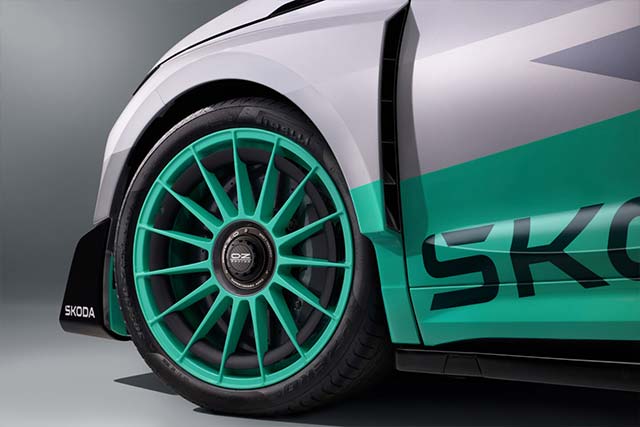
The aerodynamics package includes a large rear wing, an aerodynamically optimised roof, and a NACA air intake channelling air into the interior. Small winglets at the rear of the roof direct airflow straight onto the rear wing. The air intake for the cooling system has also been redesigned, with the front section now completely solid and air drawn in through the lower part of the bumper, necessitating a tilted radiator wall. Redesigned bumpers with two additional air curtains at the front, wider fenders, and a new rear diffuser along with the large rear wing increase the downforce, improving drivability at higher speeds. Turbulence around the wheels is minimised by wing-shaped air-guiding elements, while ventilation grilles in the front and rear wheel arches enhance both aerodynamics and brake cooling. Furthermore, the new Enyaq RS Race is fitted with aerodynamically optimised wheels.
Race-ready adjustments: handbrake, suspension, and limited-slip differentials
Skoda Motorsport has adapted several components of the new Enyaq RS Race. For example, the production model’s braking system has been replaced with a high-performance setup featuring carbon-ceramic brake discs, ten-piston callipers at the front, four-piston callipers at the rear, and a new brake cooling system. Moreover, the concept car has been fitted with a rally-type hydraulic handbrake with a long lever and the pedal system from the Skoda Fabia RS Rally2. Instead of the standard DCC suspension, a special sports suspension has been installed, allowing for individual adjustments to spring stiffness, compression, and rebound settings. To improve handling and acceleration, the new Enyaq RS Race is equipped with limited-slip differentials on both the front and rear axles.
The 20-inch wheels are fitted with low-profile tyres. The two electric motors, delivering a combined output of 250 kW, are identical to those in the production model. Like the Skoda Enyaq Coupé RS, the top speed is 180 km/h, but the lighter new Enyaq RS Race now accelerates from 0 to 100 km/h in under five seconds.
Enhanced steering and controls for on-track performance
The completely redesigned interior is inspired by the Skoda Fabia RS Rally2 and also includes a modified infotainment system. Featuring new buttons, the racing steering wheel resembles the one from the Skoda Fabia RS Rally2. Instead of the progressive rack‑and‑pinion steering used in the Enyaq Coupé RS, the new Enyaq RS Race features linear steering, with power assistance levels adjusted through control software and an optimised drive ratio tailored specifically for racing performance. The drive selector and central panel for starting the car and activating the automatic fire extinguishing system are positioned between the seats of this two-seater vehicle.
Havas sound system: amplified for an authentic motorsport experience
The new Enyaq RS Race features a Havas premium sound system that incorporates a digital sound amplifier to deliver a characteristic, exhilarating motorsport sound. This system is significantly more powerful than the unit in the new Enyaq Coupé RS production model, and its tone can be adjusted. The Havas sound system features bigger loudspeaker units, one at the front and two at the rear. The sound is also activated at speeds above 30 km/h, ensuring an exciting acoustic experience throughout the drive.


