Europe’s transition to electric heavy-duty transport could depend as much on smarter electricity management as on building new charging infrastructure. Milence, the joint venture between Daimler Truck, the TRATON GROUP and Volvo Group, is calling for a more integrated approach to energy infrastructure, arguing that better use of existing grid capacity could significantly accelerate the rollout of public charging for electric trucks.
In its new whitepaper, “Making More of the Grid: How Integrated Energy Hubs Can Accelerate Europe’s eHDV Transition,” Milence outlines how combining high-power truck charging, renewable energy generation, battery storage and intelligent energy management could help overcome one of the biggest obstacles to electric heavy-duty vehicle (eHDV) adoption: limited access to grid capacity.
The report comes as Europe’s public charging network for heavy-duty vehicles continues to expand, with more than 2,500 charging points now available across the continent.
Milence is among the leading players in this development, operating 42 charging hubs across nine European markets. The company plans to increase that number to 70 by the end of 2027, with more than half of its locations expected to support Megawatt Charging System (MCS) technology.
However, expanding the network will require more than additional charging stations. Securing sufficient electricity connections is becoming an increasingly important challenge.
Grid capacity emerges as a major obstacle to electric truck adoption
According to Milence, Europe’s electric heavy-duty vehicle fleet could reach approximately 1.1 million vehicles by 2040 across its 14 focus countries. Supporting this growth could require more than 20 GW of public charging capacity.
Delivering that level of infrastructure will require substantial investment in reliable, high-power charging facilities along Europe’s main freight corridors.
Yet grid congestion, lengthy connection procedures and the need for additional network reinforcement are slowing progress. Based on Milence’s experience, securing grid connections for projects requiring approximately 4 MW takes an average of one to two years in Belgium, France, Germany and the Netherlands. Projects requiring grid reinforcement can face even longer delays.
The challenge is particularly significant for truck charging infrastructure because locations cannot simply be selected based on where spare electricity capacity is available. Charging hubs need to be positioned along major freight routes, close to logistics centres and other locations where heavy-duty vehicles operate.
” We are building one of Europe’s largest public charging networks for heavy-duty vehicles, and our ambition is to continue scaling rapidly. But to accelerate the transition to electric road transport, we also need faster access to electricity,” said Anja van Niersen, CEO of Milence.
She added that grid connections are becoming a critical factor in determining how quickly charging infrastructure can be deployed, making smarter use of existing electricity capacity increasingly important.
Integrated energy hubs could unlock existing grid capacity
Milence’s whitepaper identifies integrated energy hubs as a practical way to accelerate charging infrastructure deployment without relying entirely on new grid connections.
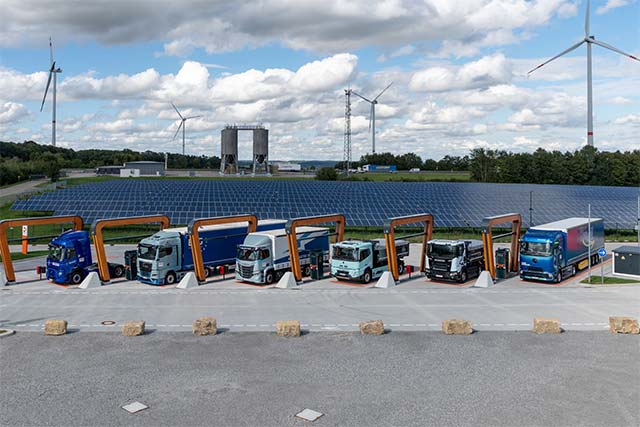
The concept combines several energy technologies within a single system, including electric truck charging, renewable electricity generation, battery energy storage systems (BESS) and intelligent energy management.
Rather than operating these assets independently, integrated energy hubs coordinate electricity generation, storage and consumption to make better use of available grid capacity.
For example, renewable energy generated locally can be stored in batteries and used during periods of high charging demand. Battery storage can also help manage peak electricity consumption, allowing charging hubs to deliver higher power without requiring an equivalent increase in their grid connection capacity.
This approach could reduce pressure on local electricity networks, improve the utilisation of renewable energy and help charging operators bring new locations online sooner.
For the rapidly expanding electric truck market, this could prove particularly important as demand for high-power charging and MCS infrastructure increases.
Milence outlines six priorities for faster deployment
Beyond the technical concept, the whitepaper calls for regulatory and policy changes at both European Union and national levels to make integrated energy hubs easier to develop.
At EU level, Milence identifies three priorities. Grid connection rules should recognise renewable generation, battery storage and charging infrastructure operating behind a single connection as one integrated system. Projects that demonstrably reduce pressure on the electricity network should receive priority in connection queues, while network charges should better reflect the lower grid impact of integrated energy hubs.
At the national level, the company calls for coordinated permitting procedures and standardised contracts to reduce administrative delays and improve investment certainty.
Milence also highlights the need to make flexible and shared grid connections a standard offering, with clear and predictable conditions. Greater transparency regarding existing renewable energy parks could further help charging operators identify potential partners and opportunities to integrate locally generated electricity.
Together, these six recommendations aim to create a more predictable investment environment and remove regulatory barriers that currently slow the development of integrated charging infrastructure.
Projects in the Netherlands and Germany demonstrate the potential
Milence’s recommendations are supported by experience from its charging infrastructure projects across Europe, including its latest project in Tiel, the Netherlands, as well as developments in Germany.
These examples demonstrate how charging facilities can share grid connections with other electricity users and renewable energy providers, improving the utilisation of existing network infrastructure.
The integration of renewable generation and battery storage could further increase the flexibility of these locations, creating a more efficient energy system capable of supporting growing demand from electric trucks.
As Milence expands its network and prepares for wider MCS deployment, these alternative energy and grid connection models could become increasingly important.
“Europe does not need to choose between expanding its electricity grids and accelerating electrification of road transport. We need to do both,” van Niersen said.
By recognising integrated energy hubs as part of the solution, Europe could unlock more of its existing grid capacity, support infrastructure investment and accelerate the deployment of charging facilities where they are needed most.
Smarter energy infrastructure will be essential for electric freight
The electrification of Europe’s heavy-duty transport sector is gaining momentum, but the availability of charging infrastructure remains a critical factor in determining how quickly electric trucks can become a mainstream option for freight operators.
The expansion of public charging networks, particularly along major logistics corridors, will be essential. However, simply building more charging stations will not be enough if grid connection delays continue to restrict deployment.
Grid reinforcement will remain necessary to support long-term electricity demand, but integrated energy hubs could provide an important bridge while new network infrastructure is being developed.
By combining renewable energy, battery storage and intelligent energy management, charging operators could make better use of existing electricity networks and accelerate the rollout of high-power charging.
For Milence, the message is clear: Europe’s electric truck transition needs not only more charging points, but also a smarter and more flexible approach to delivering the energy behind them.