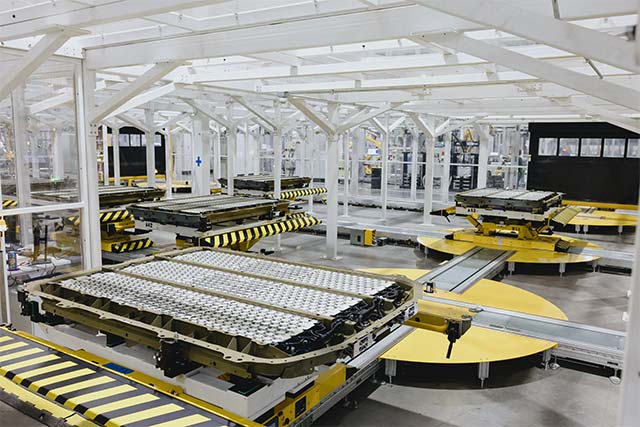
Rivian is expanding its partnership with Redwood Materials to create a more comprehensive battery lifecycle system that combines EV battery recycling, second-life energy storage, and manufacturing waste recovery. The expanded agreement will help Rivian recover valuable materials from used batteries while deploying repurposed battery packs to support electricity demand at its manufacturing plant in Normal, Illinois.
The partnership brings together Rivian’s electric vehicle operations and Redwood Materials’ battery recycling and energy storage technology, offering a potential solution to two growing challenges for American manufacturers: rising electricity demand and the need for a reliable domestic supply of battery materials.
Under the expanded agreement, Redwood Materials will collect Rivian battery packs that are no longer suitable for use in electric vehicles through Rivian’s nationwide service center network.
Each battery pack will be evaluated to determine whether it can be reused in stationary energy storage systems or should be recycled to recover valuable materials.
Battery packs that retain sufficient capacity can be repurposed for stationary storage at Rivian’s manufacturing facilities or other locations. Batteries that are no longer suitable for energy storage will be sent for recycling.
The agreement also expands Redwood’s responsibilities to include battery manufacturing scrap generated at Rivian’s production operations. This will allow more battery materials to be recovered and returned to the supply chain instead of being wasted.
The expanded partnership builds on an energy storage agreement announced in April 2026, which involves deploying 10 megawatt-hours (MWh) of energy storage using repurposed Rivian battery packs at the automaker’s Normal, Illinois, manufacturing plant.
Instead of immediately recycling batteries removed from vehicles, the companies will give suitable packs a second life by using them to store electricity.
These systems can charge during periods of lower electricity demand or when renewable energy is readily available, then release stored power when demand increases. This approach can help reduce electricity costs, ease pressure on the grid, and improve energy reliability for industrial facilities.
Stationary storage also offers a way to extract additional value from EV batteries before they reach the end of their useful lives.
Rivian Founder and CEO RJ Scaringe said that giving retired battery packs a second life in stationary storage could help make the electricity grid more reliable while lowering energy costs.
When batteries can no longer support energy storage applications, recycling becomes the next step in the process.
Redwood Materials says its advanced recycling technology can recover more than 95% of critical minerals, including lithium, nickel, cobalt, and copper.
Recovering these materials can help reduce dependence on newly mined resources and strengthen the domestic supply chain for EV battery production in the United States.
The process also creates a more circular battery economy. Materials recovered from retired EV batteries and manufacturing scrap can potentially be returned to the supply chain for use in new batteries and other applications.
Redwood Materials Founder and CEO JB Straubel said that every Rivian battery pack returned to the company represents a potential source of grid energy storage and critical raw materials.