
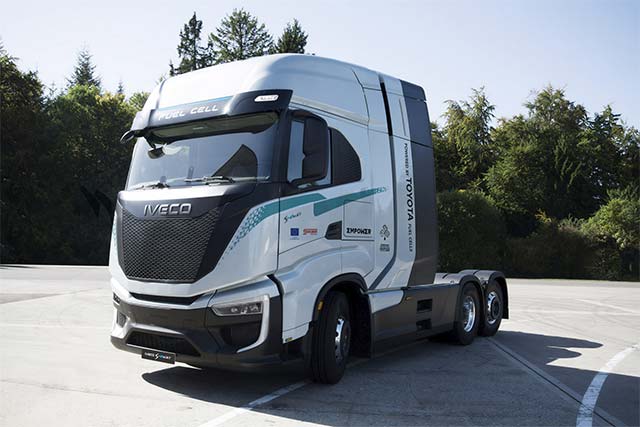
Toyota and Iveco are joining forces to develop the next generation of hydrogen fuel cell electric trucks, targeting longer range, greater durability and improved efficiency for heavy-duty transportation.
The collaboration is part of EMPOWER, an EU-funded research project focused on advancing zero-emission heavy-duty vehicles. Toyota will supply its latest hydrogen fuel cell technology, while Iveco will lead vehicle development, system integration and validation.
The partnership comes shortly after Scania announced plans to adopt Toyota’s hydrogen fuel cell technology, highlighting the growing interest in fuel cells for long-haul commercial vehicles.
The next-generation IVECO S-eWay Fuel Cell represents a significant step forward from the company’s first-generation hydrogen trucks developed under the H2Haul project.
Toyota will provide fuel cell systems delivering a combined 300 kW of power. The upgraded system is designed to improve both efficiency and durability while supporting the demanding operating conditions of heavy-duty freight transport.
One of the biggest improvements is range. The new IVECO fuel cell truck is expected to travel more than 900 km (559 miles) on a hydrogen fill, making it better suited to long-distance freight operations where minimizing downtime is critical.
Toyota and Iveco are also targeting more than 25,000 operating hours of fuel cell durability. That represents a major focus on the long service life required by commercial fleets.
The vehicle’s overall weight has also been reduced. At the same time, the architecture has been simplified through a more efficient energy-management strategy.
Interestingly, the new truck requires only half the battery capacity of the previous-generation fuel cell vehicle. Reducing battery size can help lower weight while allowing the hydrogen fuel cell system to handle a larger share of the vehicle’s energy requirements.
Toyota’s contribution is based on more than three decades of fuel cell research, development and commercialization across mobility and industrial applications.
The company says its latest fuel cell technology has increasingly been developed with commercial vehicles in mind, where reliability, efficiency and long operating life are particularly important.
For long-haul trucking, hydrogen fuel cells offer a potential alternative to large battery-electric packs. Heavy trucks typically require significant amounts of energy to cover long distances, and reducing charging downtime is an important consideration for fleet operators.
The EMPOWER project is intended to determine how far the technology can progress toward the operational and economic requirements of large-scale commercial transportation.
Validation and testing of the new fuel cell truck are scheduled to begin in the fourth quarter of 2026. Real-world road trials are expected to start during the first half of 2027.
The testing will place the hydrogen truck under demanding operating conditions to evaluate its performance, efficiency, durability and overall suitability for heavy-duty applications.
The results will be used to help develop commercially viable hydrogen trucks for long-haul transportation and could provide a foundation for future industrial-scale production.
While battery-electric trucks are expanding rapidly, hydrogen fuel cell technology continues to attract interest for applications involving high annual mileage, long driving distances and demanding payload requirements.
The Toyota-Iveco project combines Toyota’s fuel cell expertise with Iveco’s experience developing and operating heavy-duty commercial vehicles. The goal is to demonstrate whether the latest fuel cell technology can deliver the range, uptime and durability needed by freight operators without tailpipe emissions.
If the EMPOWER trials prove successful, the project could become an important step toward bringing more capable hydrogen-powered trucks to European roads.
The combination of 300 kW of fuel cell power, more than 900 km of range and a targeted 25,000-plus operating-hour lifespan gives the next-generation IVECO S-eWay Fuel Cell some impressive targets to meet.
The real test will begin when these trucks move from development and laboratory validation to regular operation on public roads in 2027.


