
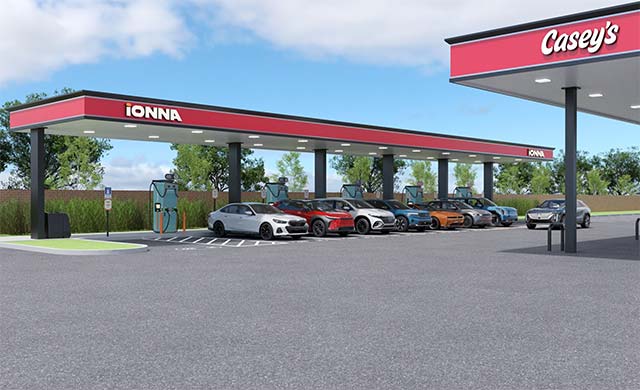
The public electric vehicle charging experience is improving, with DC fast-charging satisfaction reaching its highest level in the latest JD Power 2026 U.S. Electric Vehicle Experience (EVX) Public Charging Study.
The sixth annual study found that satisfaction with DC fast chargers increased significantly over the past year, while the percentage of EV drivers arriving at a public charger but being unable to charge fell to the lowest level recorded since the study began.
The improvements come as newer charging networks deploy faster equipment, larger charging sites, better locations and more convenient payment options. However, the results also highlight a growing divide between DC fast charging and public Level 2 charging, where satisfaction has declined.
Satisfaction with public DC fast chargers increased 12 points to 666 on a 1,000-point scale, with improvements across all 10 factors measured by JD Power.
The biggest gains were recorded in charger availability, safety and charging cost. Charger availability improved by 27 points, while perceptions of safety and charging cost each increased by 18 points.
Charging speed remains one of the most common complaints among EV drivers, but the issue has improved considerably for DC fast charging in recent quarters.
Public Level 2 charging, meanwhile, moved in the opposite direction. Satisfaction fell 12 points to 595, with ease of payment and ease of charging among the primary areas contributing to the decline.
The contrast suggests that newer fast-charging infrastructure is increasingly setting a higher standard for what EV drivers expect from public charging.
New EV Charging Networks Raise Expectations
Newer OEM-backed DC fast-charging networks performed particularly well in the 2026 study.
Three networks becoming award-eligible for the first time demonstrated significant advantages over the segment average in areas such as charging speed, charger availability and ease of charging. In some categories, the advantage exceeded 100 index points.
The trend is important for EV adoption because charging reliability remains one of the biggest concerns among consumers considering an electric vehicle.
A charging network that makes it easy to locate a station, start a session, pay and quickly get back on the road can help reduce one of the major barriers to EV ownership.
As more automakers invest in dedicated charging networks and improve the charging experience, expectations among EV drivers are also rising.
Failed Charging Attempts Reach Record Low
One of the most encouraging findings is the decline in so-called non-charge visits.
The industrywide non-charge visit rate fell to 12%, down from 14% during the same period a year earlier. That means fewer EV drivers are arriving at public charging stations only to discover that they cannot start a charging session.
The 12% rate is the lowest recorded in the history of the JD Power study.
Newer OEM-backed charging networks recorded the lowest failure rates, while established networks also showed improvement.
Reliability is particularly important because a failed charging attempt can have a much greater impact on an EV driver’s journey than a minor inconvenience at a conventional gas station.
Where EV Drivers Prefer to Charge?
The study also found that the location of a charging station can significantly influence customer satisfaction.
DC fast chargers located at hotels generated the highest satisfaction score at 692. Gas stations and convenience stores followed at 689, while restaurants scored 688.
By comparison, charging at dealerships and stand-alone parking lots or garages produced significantly lower satisfaction scores, at 570 and 606, respectively.
The findings suggest that charging is becoming more than simply a technical stop. EV drivers increasingly value locations where they can eat, shop, use amenities or otherwise spend their time while their vehicle charges.
This could become an increasingly important consideration as charging networks expand and compete for EV drivers.

IONNA Leads the 2026 DC Fast-Charging Rankings
Only the DC fast-charging segment is award-eligible in the 2026 study.
IONNA ranked first with a score of 807, followed by the Mercedes-Benz Charging Network at 797 and the Rivian Adventure Network at 755.
The strong performance of newer networks indicates that charging providers can differentiate themselves through reliability, speed, convenient locations and a smoother overall charging process.
Public Charging Remains Critical to EV Adoption
Despite the improvements, public charging remains a major consideration for consumers deciding whether to purchase an EV.
JD Power says its data consistently shows that public charging is the leading reason new-vehicle shoppers reject electric vehicles. Improving the charging experience therefore has implications beyond customer satisfaction—it could directly influence the pace of EV adoption.
The 2026 results show meaningful progress, particularly in DC fast charging. Faster and more reliable equipment, improved station availability and better charging locations are making public charging more predictable.
At the same time, the decline in Level 2 satisfaction demonstrates that the industry still has work to do. Payment systems, charging usability, network quality, location strategy and consumer education remain important areas for improvement.
The 2026 U.S. Electric Vehicle Experience (EVX) Public Charging Study included responses from 6,594 owners of battery-electric vehicles and plug-in hybrid vehicles. The study was conducted from January through June 2026 in collaboration with PlugShare and measures satisfaction across 10 factors, including charging speed, availability, location convenience, safety, cost, ease of charging and ease of payment.
[source: JD Power]


